
Tree Removal Cost per Hour: What Crews Charge and Why
Tree removal cost per hour is the rate a tree crew bills for each hour of work on your property. For a full crew with equipment, figures around $150 to $400 per hour are commonly quoted. For labor alone, rates run about $55 to $100 per worker per hour. Most companies still quote a flat price for the whole job, so the hourly number works best as a yardstick for checking whether a quote is fair.
Integrity Landscape handles tree trimming, removal, stump grinding and crane-supported jobs in Jupiter, FL and across Palm Beach County. That work shows us how crew size, equipment and access turn into the total on a quote. Hourly figures only help once you know what sits inside them, and that is where most homeowners get confused.
This article explains why the hourly rate matters, how to turn it into a budget for your own tree, and what pushes it up or down. It then compares hourly pricing with per-tree and per-foot pricing, and shows how to collect quotes you can compare side by side.
Why the hourly rate matters for your tree job
The hourly rate matters because it is the one number that lets you compare quotes that look nothing alike. If one company quotes $1,800 for an oak and another quotes $2,600, the hourly view shows whether the gap comes from crew size, equipment or margin.
What a crew's hourly rate covers
An hourly rate bundles the people, saws, rigging, chipper, truck and insurance behind them. The trap is that "per hour" can mean two different things : one worker's labor, or a whole crew with its gear. A quote of $90 an hour sounds cheap for a crew and ordinary for a single climber, so always ask which one you are hearing.
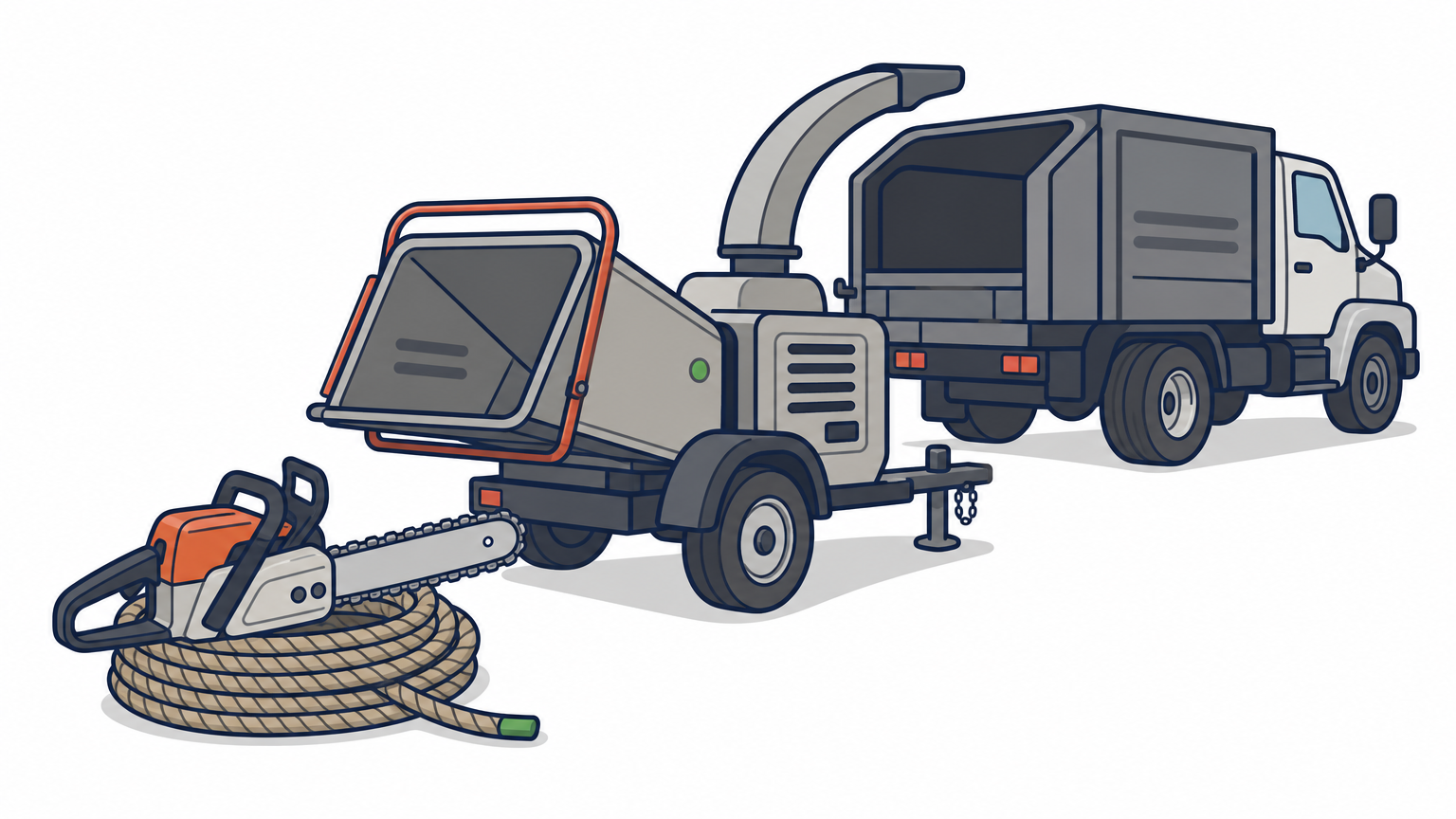
Crew size multiplies the figure fast. Three workers cost three times as much per hour as one, although they usually finish much sooner. That is why total hours on site matter as much as the rate itself.
Typical hourly rates
These ranges give you a frame for budgeting before you collect quotes.
| Rate type | Typical range | What it usually includes |
|---|---|---|
| Labor only, per worker | $55 to $100 per hour | One climber or ground worker, equipment billed separately |
| All-in, per person | $78 to $94 per hour | Labor plus saws, chipper and truck |
| Whole crew with equipment | $150 to $400 per hour | A small crew with chipper and truck |
Treat these as budgeting ranges drawn from published cost guides and crew-pricing discussions, not as a price list for Jupiter. Local labor costs, insurance and demand move them. Heavy gear such as cranes and grapple saw trucks is typically billed on top of a basic crew rate. Your written quote is the only number that counts.
An hourly rate is only comparable once you know whether it covers one worker or the whole crew.
When crews bill hourly and when they quote a flat price
Most residential removals get a flat price once the crew has seen the tree. Hourly billing shows up when the scope is hard to judge up front, such as storm cleanup, several trees in one day, or work packed tightly around structures.
A flat price protects you from a running clock. Hourly billing protects you from paying for risk that never shows up. If a crew bills hourly, ask for an estimated number of hours and a cap you both agree on before work starts.
How to estimate a tree removal job by the hour
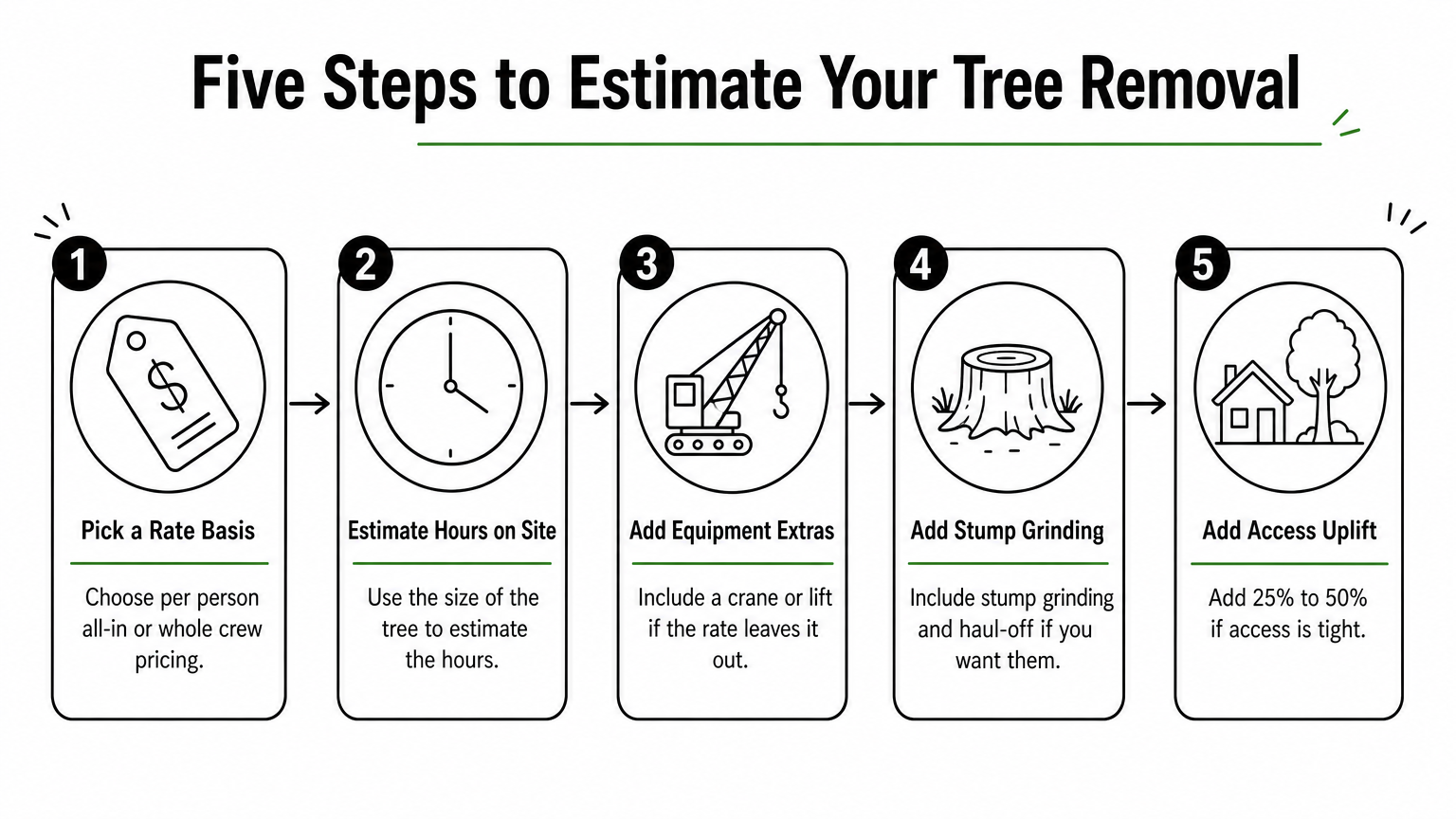
Multiply the hourly rate by the number of people and the hours on site, then add equipment, stump work and cleanup. Work with a range rather than a single number, because the hours are the least certain part of the sum.
The five-step estimate
- Pick a rate basis: per person all-in, or whole crew.
- Estimate the hours on site from the tree's size (see the table below).
- Add equipment not in the rate, such as a crane or a lift. One Florida tree company owner notes that delivering a large tree lift on a truck can run about $450 by itself.
- Add stump grinding and haul-off if you want them.
- Add 25% to 50% if access is tight, which is the typical uplift for trees close to structures, power lines or other trees.
How many hours a job usually takes
Job length depends on the tree. A small removal takes a few hours, a medium tree takes 4 to 8, and a very large tree can run up to two 8-hour days. The table applies the whole-crew range of $150 to $400 per hour to those durations.
| Tree size | Hours on site | Crew cost at $150 to $400 per hour |
|---|---|---|
| Small | 2 to 3 | $300 to $1,200 |
| Medium | 4 to 8 | $600 to $3,200 |
| Very large | up to 16 | $2,400 to $6,400 |
The spread is wide on purpose. Photos and a site visit narrow it faster than any calculator, because the real variables are rigging difficulty and what sits under the tree.
Hours on site drive the bill more than the headline rate does.
A worked example and a quote check
Say a three-person crew works at the all-in $78 to $94 per person per hour. That is $234 to $282 per hour for the crew. Over a 6-hour day, labor and equipment total $1,404 to $1,692 . Add stump grinding at a national average of $307 to $426 and the job lands between $1,711 and $2,118, before any crane or permit costs.
You can also run the math backward on a flat quote. Suppose you receive $2,400 for a job where three workers spend 6 hours. That works out to $133 per person per hour ($2,400 divided by 18 person-hours). If that is above the all-in range, ask what else the price covers , such as stump work, hauling, a crane or permit handling. The same check helps if you are the one pricing a job: your rate has to carry labor, equipment, insurance, fuel and disposal, not just wages.
What raises or lowers the hourly rate
Four things move the rate more than anything else: crew skill and size, equipment, access and tree condition, and timing. Understanding them tells you which parts of a quote are fixed and which you can influence.
Crew skill and size
Certified arborists and experienced climbers cost more per hour because they work safely in places a groundcrew cannot. Their rate buys speed and fewer mistakes near roofs and power lines. A bigger crew raises the hourly total but can cut the hours enough that the job costs about the same.
Cheap hourly rates deserve a question about insurance. A crew without proper liability and workers' compensation coverage can quote less because you carry the risk if something goes wrong.
Equipment
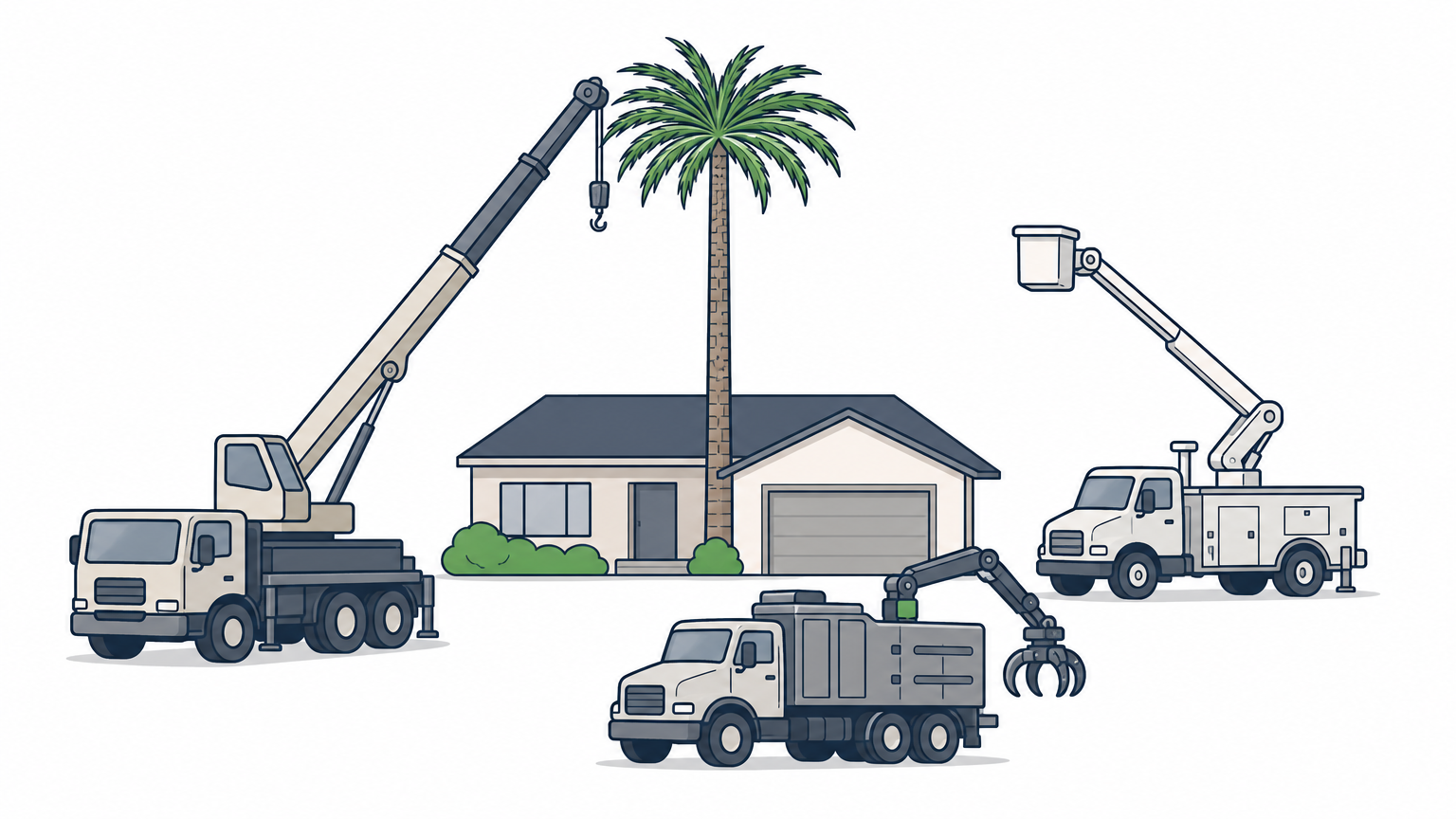
Saws and a chipper are baked into most crew rates. Specialty machines are not. Grapple saw trucks, bucket lifts and cranes need operators and transport, so they add their own charges. Crane support is what makes tall, hazardous or tightly boxed-in trees practical to remove, and it saves climbing hours even when its price looks high.
Access, condition and local conditions
A tree beside a pool enclosure, roof or fence costs more per hour than one in an open yard, because every cut needs rigging. Decay adds time, since a rotten trunk can behave unpredictably and needs specialty rigging. Palms, oaks and pines also differ in how they cut up and haul away. In Palm Beach County, storm-damaged trees add urgency and strong demand after a storm can push rates up fast.
Timing and urgency
Emergency work costs more than work scheduled on your calendar. Late winter, especially February and March, is the slower season for tree crews in many regions, so you may find better pricing then. If safety allows, book removal for a quiet stretch and not in the rush after a storm.
Urgency and access are the two factors you can least afford to ignore and most often can plan around.
Hourly, per-tree and per-foot pricing compared
Hourly pricing suits uncertain jobs, per-tree pricing suits clearly defined ones, and per-foot pricing is a shortcut crews use to size a tree. Each method describes the same work in different units, so you can translate between them.
National per-tree prices by trunk size
National averages that include labor and equipment, but not stump grinding, give a per-tree benchmark.
| Trunk diameter | Typical national cost per tree |
|---|---|
| Under 12 inches | $226 to $946 |
| 12 to 24 inches | $517 to $2,132 |
| 24 to 36 inches | $976 to $4,117 |
Within each row, a wider canopy lands at the high end . The overall national average for a single tree sits around $450 to $1,450. Stump grinding adds roughly $307 to $426 on average.
What per-foot pricing means for tall trees
Many companies price by height, since taller trees need more climbing, rigging and haul-off. A 30-foot tree often has a trunk under 24 inches, so the first two rows above are a sensible starting range. At 50 feet and beyond, the job usually calls for climbers, lifts or a crane . At 100 feet it is almost always a custom quote, because the equipment and the planning are the cost.
Which method suits your situation
| Situation | Best pricing method |
|---|---|
| One clear tree, easy access | Flat per-tree quote |
| Storm cleanup or several trees | Hourly with an hours cap |
| Very tall or hazardous tree | Flat quote that itemizes crane work |
| Comparing bids | Convert each to cost per person-hour |
Convert every quote to the same unit before you decide, because the cheapest-looking number is often the least complete.
How to get a fair quote and cut the bill
A fair quote is written, itemized and based on someone seeing the tree. Collect at least three, and compare what each one includes before you compare totals.
What to ask every tree company
- Is the price flat or hourly, and if hourly, what is the crew size and rate?
- Does it include stump grinding, debris haul-off and cleanup?
- Are crane, lift or permit charges listed separately?
- Does the company carry liability insurance and workers' compensation, and is it licensed?
- What happens if the job runs longer than estimated?
Ask, too, whether your town or county needs a permit for the tree. Rules vary by city , and a good local crew will know them.
Ways to lower the cost
Bundling several trees into one visit spreads the setup time across the whole job. Scheduling in the off-season helps, as does leaving the tree's stump or wood handling to match your needs. Wood can be cut into logs for storage or disposal to your specification, so decide up front what you want kept. Handling small pieces yourself, such as chipping branches, can trim hours.
A message you can send for a quote
Photos make quotes faster and more accurate. Copy this and fill in the brackets.
 Hi, I need a quote to remove [number] tree(s) at [address].
Photos attached: the full tree plus what is nearby (house, roof,
pool enclosure, fence, power lines).
Approximate height: [ ] ft. Trunk diameter at chest height: [ ] in.
Please include: stump grinding (yes/no), debris haul-off, cleanup,
and any crane or permit charges.
Is your price a flat total or hourly? If hourly, what is the crew
size, the rate and your estimated hours?
At Integrity Landscape you can text a picture for a same-day quote, and estimates are free. Whoever you choose, the written total is what you hold them to.
Getting a fair price on your tree job
Hourly tree removal rates run from about $55 to $100 per worker for labor alone to $150 to $400 for a full crew with equipment. The rate matters less than what it covers and how many hours the job takes. Ask whether the figure is per person or per crew, estimate the hours, and add equipment and stump work separately. Then compare quotes in the same unit.
If you want a number for your own tree, request a free same-day estimate from Integrity Landscape. Send photos, tell us what stands near the tree, and we will give you a quote you can check against the math above.