Tree Removal Cost per Acre: Prices, Factors, and Examples
Tree removal cost per acre is the price a contractor charges to clear the trees from one acre of land, which lets you compare jobs of different sizes on one scale. Across the country, a lightly wooded acre runs about $750 to $3,500, and dense woods with large trees run $3,400 to $6,200 or more. Once you add stump removal and haul-off, a heavy acre can pass $10,000.
The per-acre figure is a starting point, not a final quote. Tree size, terrain, access, what happens to the debris, and local permit rules can move the number by thousands of dollars. This guide explains how to place your land in the right price band, scale it to your acreage, and add the costs that sit outside the base price. It also covers what to check before you sign.
Integrity Landscape is a licensed and insured tree service and landscaping company in Jupiter, FL. We take on removals, stump grinding, debris hauling, and crane-assisted jobs across Palm Beach County. Most of what follows comes from how tree work is priced, estimated, and sometimes mis-quoted in practice.
Why tree removal cost per acre matters
Per-acre pricing matters because it is the fastest way to budget for land you own or plan to buy and to tell whether a bid is fair. Without a benchmark, one contractor's $4,000 and another's $9,000 look equally plausible. With one, you can see which quote is out of line and ask why.
What the per-acre number lets you do
First, it lets you budget before you commit. If you are weighing a wooded parcel against a cleared one, a rough clearing cost of $3,000 to $6,000 per acre changes the real price of the cheaper lot. Add that figure to the purchase price before you compare.
Second, it gives you a common unit for comparing bids. A contractor who quotes 3 acres at $12,000 and one who quotes 2 acres at $9,000 are charging $4,000 and $4,500 per acre. Without the division, that difference stays hidden.
Where per-acre pricing stops working
Per-acre pricing works for wooded parcels where most of the ground needs clearing. It works poorly when you only need a handful of trees removed from a large lot. The average single tree removal runs about $630, with small trees below that and tall ones above. At that average, an acre priced at $3,000 to $4,500 equals roughly 5 to 7 trees.
Beyond that tree count, area pricing usually wins, as long as stumps and haul-off are in scope. Below it, ask for a per-tree quote. Most residential properties in Jupiter and the rest of Palm Beach County are well under an acre, so you will usually see per-tree or per-job pricing there.
Why quotes for the same acre differ
Bids for the same property often differ by 50 to 100 percent. The cause is rarely greed. One contractor may price mulching in place while another prices cutting, stacking, and hauling. One may include stump grinding and another may not. One may assume permits are your job.
A per-acre price only means something once you know exactly what it includes.
How to estimate your tree removal cost per acre
You can estimate your cost in three steps: classify how dense your trees are, scale the price to your acreage, and then check it against hourly or day rates. Treat the result as a range you test against real quotes, not a number to hold a contractor to.
Step 1: classify the density of your trees
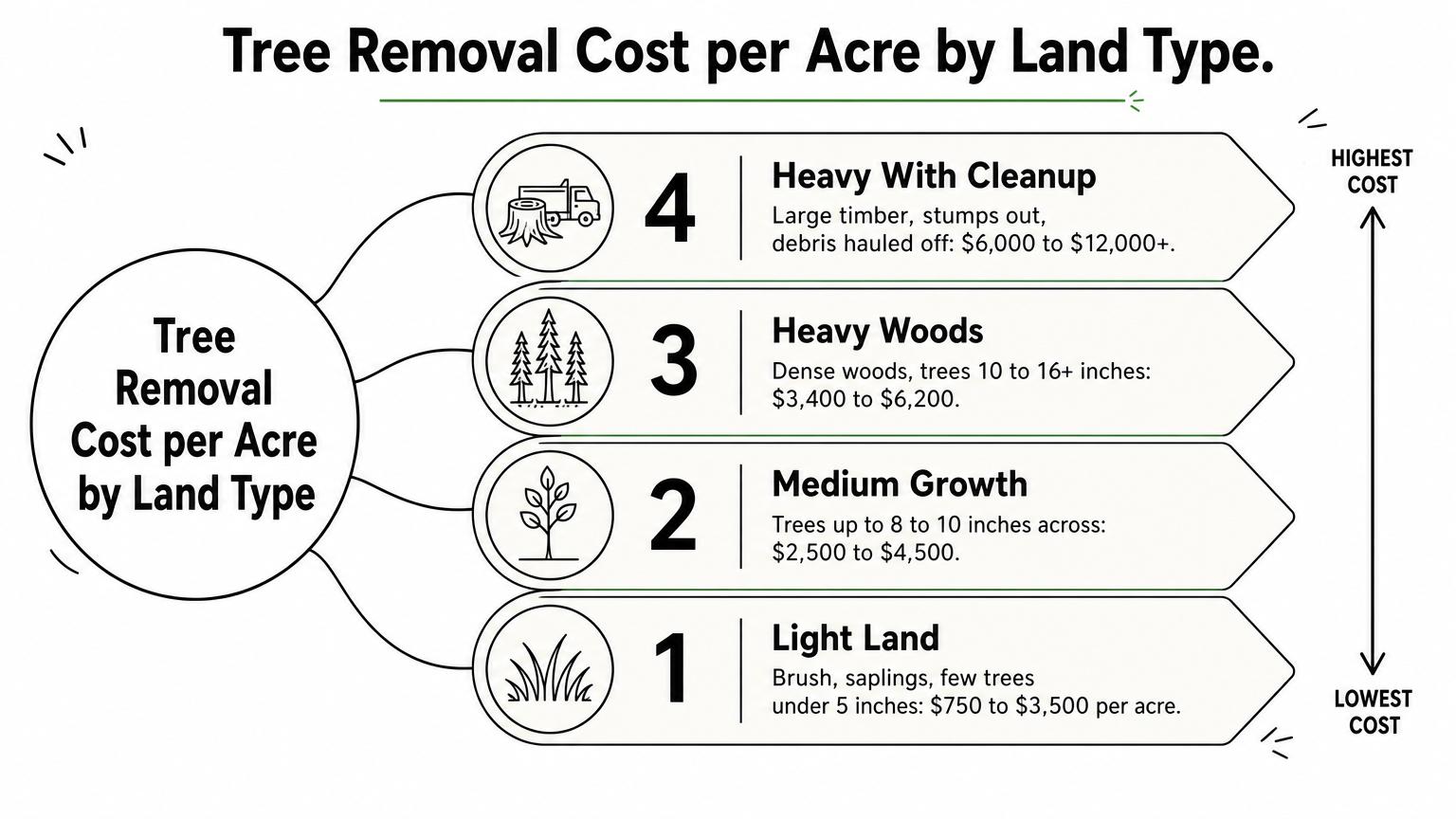
Density and trunk size drive the base price more than anything else. Walk the land and decide which row of this table fits best. These are national ranges that several pricing sources agree on closely, so use them as a starting range.
| Land type | What it looks like | Typical cost per acre |
|---|---|---|
| Light | Brush, saplings, a few trees under about 5 inches across | $750 to $3,500 |
| Medium | Thicker growth, trees up to 8 to 10 inches across | $2,500 to $4,500 |
| Heavy | Dense woods, trees 10 to 16+ inches across | $3,400 to $6,200 |
| Heavy with full cleanup | Large timber, stumps removed, debris hauled off site | $6,000 to $12,000+ |
Low-end figures assume the cut material stays on site. Do not assume you will land at the bottom of a band. A dense acre with big timber can reach five figures once everything must leave the property.
Step 2: scale the price to your acreage
Price does not scale in a straight line. Mobilization, meaning moving the equipment in and out, is a fixed cost, so small jobs cost more per acre. Larger jobs often earn a 10 to 20 percent volume discount once you pass about 5 acres. This table shows typical totals by lot size.
| Lot size | Light | Medium | Heavy |
|---|---|---|---|
| 1/4 acre | $500 to $1,000 | $800 to $1,750 | $1,500 to $3,000 |
| 1/2 acre | $800 to $1,500 | $1,500 to $3,000 | $2,500 to $4,500 |
| 1 acre | $1,500 to $2,500 | $3,000 to $4,500 | $4,500 to $6,000+ |
| 2 acres | $3,000 to $5,000 | $6,000 to $9,000 | $9,000 to $12,000+ |
| 5 acres | $7,500 to $12,500 | $13,500 to $20,000 | $20,000 to $30,000+ |
| 10 acres | $13,000 to $22,000 | $25,000 to $38,000 | $38,000 to $60,000+ |
| 20 acres (estimate) | $26,000 to $44,000 | $50,000 to $76,000 | $76,000 to $120,000+ |
The 20-acre row is extrapolated at the 10-acre per-acre rate: $1,300 to $2,200 for light, $2,500 to $3,800 for medium, and $3,800 to $6,000 for heavy. Treat it as a planning figure, because a job that size is always bid after a site walk.
Half-acre jobs follow the same logic in reverse. Half an acre of medium woods costs $1,500 to $3,000, which is not exactly half of the one-acre price. Many contractors also set a minimum job charge , so a quarter-acre clearing may cost close to the half-acre figure.
Step 3: check hourly and day rates
Some operators price by time instead of area. Forestry mulching, which grinds standing growth into mulch on site, runs about $150 to $250 per hour . A solo operator with a skid steer and mulching head typically charges $2,500 to $4,500 per day . A machine clears light brush in roughly 4 to 6 hours per acre, medium growth in 6 to 10 hours, and heavy timber in 10 to 16 hours or more.
You can use that to sanity-check a quote. A medium acre at 8 hours is one working day, so a bid near $2,500 to $4,500 matches the day rate. A bid of $9,000 for the same acre needs an explanation, such as hauling, stump removal, or tough access.
Estimate in three passes, then test the result against a day rate: density sets the band, acreage scales it, and time confirms it.
What raises or lowers the price per acre
Seven factors move the per-acre price: tree size and species, terrain, access, debris handling, finish level, location, and season. Knowing which ones apply to your land tells you whether to expect the low or high end of each band.
Tree size and species
Trunk diameter matters more than tree count. Trees under 6 inches mulch quickly. Trees from 6 to 12 inches slow the machine and wear its teeth. Trees over 12 to 16 inches often need an excavator or hand felling before processing.
Species matters too. Dense hardwoods like oak take much longer to process than pine or cedar. An acre with 50 mature oaks can cost two to three times as much as an acre of young pines. In South Florida, the tree mix is different , but the principle holds: heavy, dense wood costs more than soft, light wood.
Terrain, soil, and access
Flat, dry ground is the cheapest to work. Slopes over 15 to 20 percent slow equipment, and grades past 30 percent can add 30 to 50 percent to the base price. Wet or boggy ground may need low-ground-pressure machines or a dry-season schedule.
Access is the other half of this factor. If a trailer cannot reach the site, or the crew must build temporary access, expect higher mobilization fees. Remote parcels often add $500 to $2,000 or more for travel and setup. A tall tree beside a house, roof, power line, or pool enclosure is a different kind of access problem, and it often calls for crane support. That adds equipment and crew time on top of the base price.
Debris handling and finish level
This is often the single largest swing on an otherwise identical acre. Mulching in place keeps material on site and costs the least. Hauling logs, brush, and chips to a landfill or transfer station adds $500 to $2,000 or more per acre. If you want a completely clean site with no mulch, stumps, or debris left, plan on paying 25 to 40 percent above the base clearing price.
Location and season
Urban and suburban work costs 20 to 40 percent more than similar rural work, because of noise limits, tighter working space, and mandatory haul-off. Rural jobs tend to run 10 to 25 percent cheaper. Regions with high labor costs and strict rules run higher still.
Timing matters as well. Late fall and winter can save 10 to 20 percent where contractors have open schedules. In Florida, the wet season from roughly May through October can slow heavy equipment on soft ground, and hurricane season tends to tighten crew availability after a storm.
Debris handling and tree diameter swing the price more than acreage does.
Clearing methods and what each costs
The method sets both the price and the result you get. Forestry mulching is usually the cheapest full-clearing method, and manual felling is the most expensive per acre. This table compares the main options.
Comparing the main methods
| Method | Cost per acre | Typical speed | Best for |
|---|---|---|---|
| Forestry mulching | $1,800 to $4,000 | 0.5 to 2 acres per day | Brush and small to medium trees |
| Excavator clearing | $2,500 to $6,000 | 0.5 to 1.5 acres per day | Large trees, stump removal, grading prep |
| Dozer or pushover | $2,000 to $5,000 | 1 to 3 acres per day | Big flat parcels, total clearing |
| Manual and chainsaw | $3,000 to $8,000 | 0.25 to 0.5 acres per day | Steep or tight sites, selective clearing |
| Controlled burn | $200 to $800 | 5 to 20+ acres per day | Large rural parcels where permitted |
Speeds depend on crew size and growth density. Burning is cheap but legal only where local rules allow it, and it is rarely an option on suburban lots.
Which method fits which job
Mulching suits most residential and rural jobs. It handles cutting and disposal in one pass, leaves a layer of mulch that limits erosion and weeds, and keeps soil mostly undisturbed. The catch is that mulching grinds stumps low but does not pull them out. If you are pouring a foundation or trenching utilities, you will want them removed.
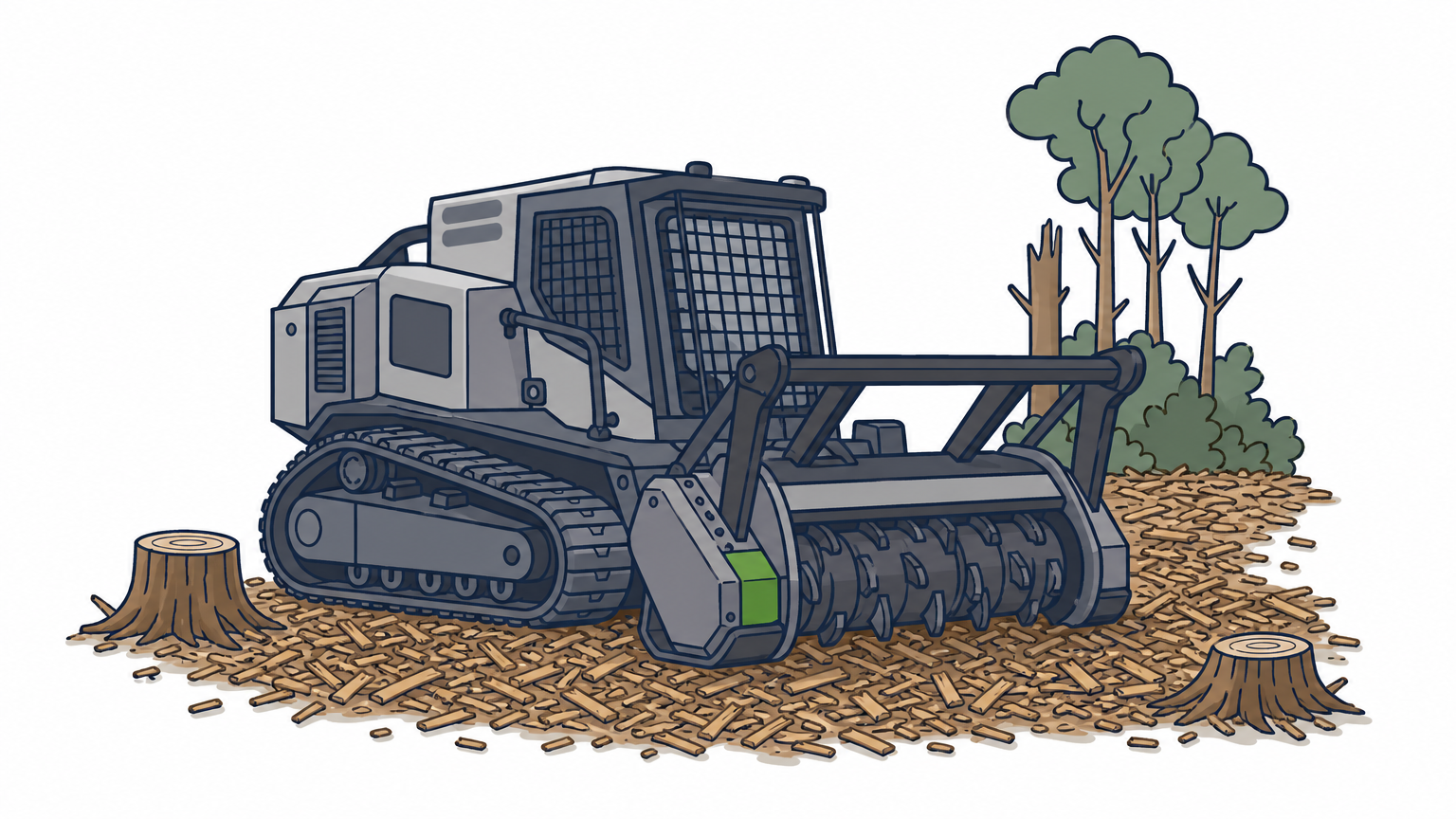
Excavators and dozers cost more per acre in some cases and less in others. A dozer is fast on big flat parcels, but it disturbs topsoil and leaves grading and erosion control to pay for afterward. An excavator costs more per day, but it pulls stumps, rakes roots, and does rough grading in the same visit. Manual felling is the fallback for steep ground, tight access, or selective removal near structures, and the high labor content explains the price.
Match the method to your end use: mulch for open land, excavator work for a building pad.
Costs outside the per-acre price
Many quotes list a base clearing price and leave several line items out. Stump work, haul-off, grading, erosion control, permits, and surveys are the usual ones, and together they can add 30 to 50 percent to the base price. Ask about each before you compare bids.
Add-ons to budget for
| Add-on | Typical cost | When you need it |
|---|---|---|
| Stump grinding | $150 to $500 per stump | Lawn, garden beds, building site prep |
| Full stump removal | $250 to $800 per stump | Foundations, utility trenches |
| Debris hauling | $500 to $2,000 per acre | No-burn areas, clean-site requirement |
| Rough grading | $1,000 to $3,000 per acre | Building pad, driveway |
| Erosion control | $500 to $2,000 | Slopes, waterways, permit conditions |
| Land survey | $300 to $1,000 | Boundary clearing, neighbor lines |
| Permits | $50 to $500+ | Municipal tree and clearing rules |
| Mobilization | $300 to $1,500 | Long travel, remote or tight sites |
Grinding takes the stump below the soil surface, which is enough for new grass or planting. Full removal takes the root mass too, which matters under concrete or pavement. Our tree removal work can cut stumps flush to the ground or remove them completely, and the choice changes the price, so state which one you want.
A worked example for one acre
Take one acre of medium woods that you want ready for a build, with 15 stumps removed, debris hauled off, and a permit. The base clearing price is $3,000 to $4,500.
| Line item | Low | High |
|---|---|---|
| Base clearing, medium woods | $3,000 | $4,500 |
| 15 stumps at $150 to $500 | $2,250 | $7,500 |
| Debris hauling | $500 | $2,000 |
| Permit | $50 | $500 |
| Total | $5,800 | $14,500 |
The spread is wide because the stump count and haul distance vary so much. Even so, the example shows why a $3,000 base price can become a $6,000 to $14,000 project. If you only want pasture or a trail, you can skip stump removal and hauling and stay near the base figure.
Always ask what sits outside the base price, because stumps and haul-off often cost as much as the clearing itself.
Clearing trees in Jupiter and Palm Beach County
In Palm Beach County, your cost depends on small lot sizes, fast regrowth, storm debris, and municipal permit rules more than on the national averages above. Use the national bands as a baseline and expect local bids to reflect local conditions.
Local conditions that shape quotes
Most residential properties here are under an acre, so you will see per-tree and per-job quotes far more often than per-acre ones. For a lot that size, the per-acre table is mainly a way to judge whether a multi-tree quote is reasonable. Divide the quote by the share of an acre you are clearing, then compare it to the table.
South Florida also grows back fast. Invasive species such as Brazilian pepper, melaleuca, and Australian pine are common targets for clearing, and they return if roots and seedlings are left behind. A cleared acre may need follow-up work within a couple of years, so budget for that if you want it to stay clear. Hurricane season adds a second cost driver: after a storm, tree crews and haulers book up, and debris-heavy jobs get more expensive.
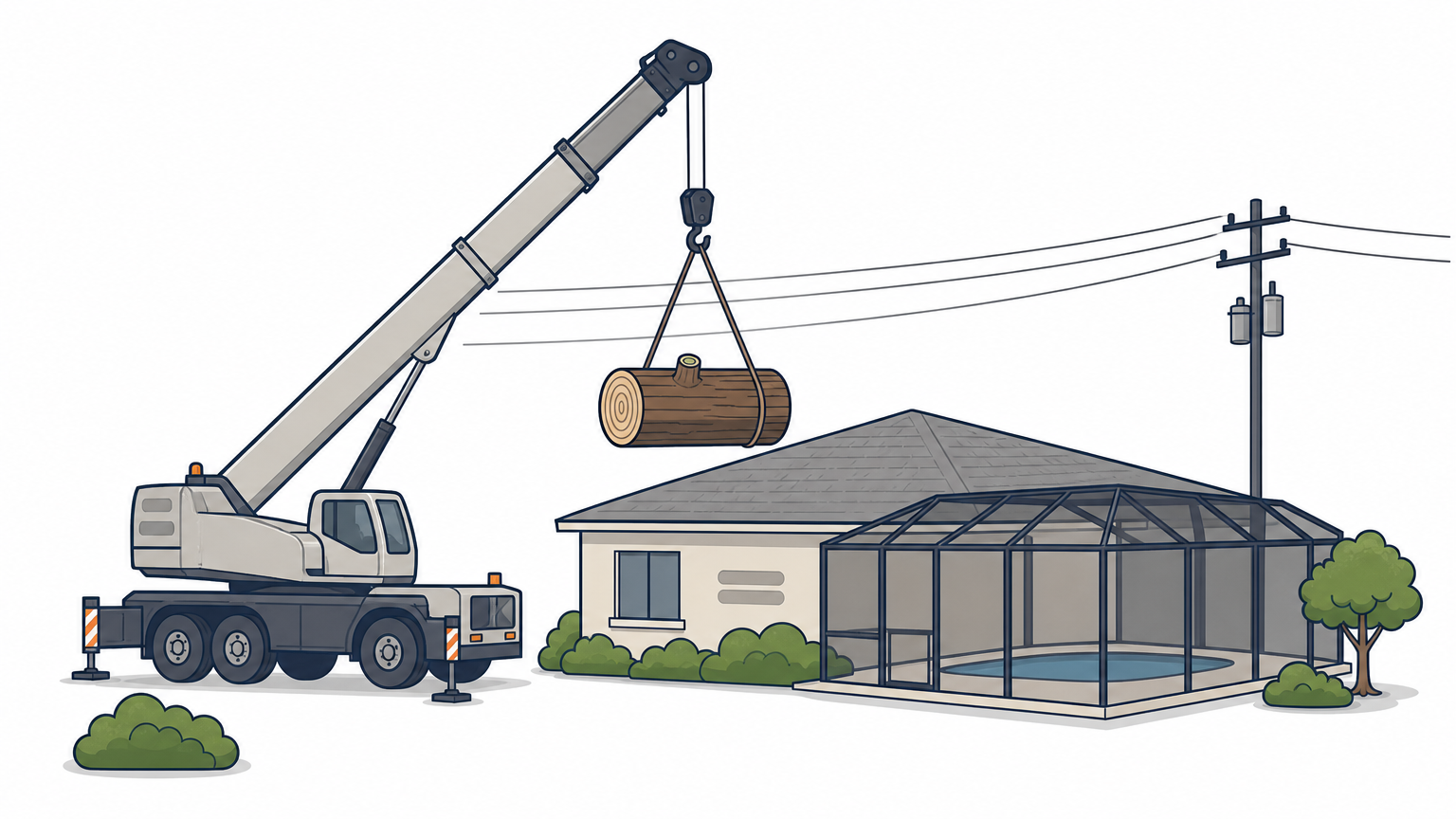
Tall trees close to houses, screened pools, and overhead lines are common in this area. Those jobs often need crane support to lower heavy sections safely, and our crane service lifts timber over roofs, power lines, and pool enclosures. Price that as a separate line item. It can cost more than the cutting itself on a tight lot.
Permits and rules to check first
Tree and land-clearing rules in Florida are set largely by cities, towns, and the county, so what applies in one municipality may not apply in the next. Check these before work starts:
- Your town or county rules on removing protected, specimen, or native trees
- Any approval needed for trees near wetlands, canals, or the coast, including mangroves, which Florida protects
- HOA or community association approval, if your property has one
- Utility marking: call 811 before any stump grinding or digging, and the markings are free
- Who is responsible for pulling permits, you or the contractor
For commercial sites, permit support is often part of the job when it is required, and it should be named in the scope. Ask the same question on a residential job.
On a typical Palm Beach County lot, expect per-tree pricing, crane costs, and permit rules to matter more than the per-acre average.
How to judge a quote and pay less
A good quote is written, based on a site visit, and specific about trees, stumps, debris, and cleanup. Start by getting at least three quotes from contractors who walk the property, then compare them line by line. The cheapest number is usually the one that leaves the most unstated.
What a complete quote states
A usable quote covers each item below. If one is missing, ask for it in writing before you compare prices.
- Acreage and boundaries: how the area was measured and what is excluded
- Tree size cutoff: the maximum trunk diameter the price covers
- Method: mulching, felling, excavator, or a mix
- Stumps: left, ground low, cut flush, or fully removed
- Debris: mulched on site, cut into logs for storage, or hauled away
- Permits and utility marking: who handles them and who pays
- Cleanup and finish: what the site looks like when the crew leaves
- Insurance: proof of general liability and workers' compensation coverage
At Integrity Landscape, wood is cut into measured logs for storage or disposal to your specification, and we give same-day quotes with next-day service. Whoever you hire, the point is the same: every one of those eight lines should be settled before work begins.
Red flags to walk away from
Be cautious of a quote given by phone with no site visit, because the contractor has not seen the trees, slope, or access. A price 50 percent or more below the others usually means something is left out or the company is uninsured. A large deposit demanded up front, no written scope, and no proof of insurance are further warnings. An uninsured crew leaves you responsible if a tree lands on a roof or a worker is hurt.
Ways to lower the bill
Several legitimate steps can cut 15 to 35 percent from a total:
- Clear only what you need, such as the building footprint, driveway, septic area, and a buffer, and keep mature trees elsewhere
- Schedule in the off-season when crews have open dates
- Keep mulch on site instead of paying for haul-off
- Bundle clearing with grading or driveway work under one contractor
- Mark the trees you want to keep with ribbon to avoid disputes
- Sell valuable timber, since large hardwoods or pines can offset costs
Light prep helps too. Removing trash, old fencing, and small brush before the crew arrives saves machine time. Leave large trees to the professionals, because the injury risk is high and the savings are small.
Compare scope first and price second, since an incomplete quote is only cheap until the extras arrive.
What to do before you request quotes
Tree removal cost per acre comes down to three things: how dense your trees are, how much of the ground you clear, and what happens to the debris and stumps. A lightly wooded acre can cost under $2,000. A dense acre with big timber, stump removal, and haul-off can cost well past $10,000. Use the density table to find your band, scale it by acreage, and add the extras before you judge any bid.
Walk your land, count the large trees, decide how clean the finished site needs to be, and write those answers down before anyone visits. That gives every contractor the same scope to price. If you are in Jupiter or elsewhere in Palm Beach County and want a written estimate on trees, stumps, or crane-assisted removals, you can request a free estimate from Integrity Landscape.