Cost of Fallen Tree Removal in Jupiter, FL: What to Expect
The cost of fallen tree removal is what a tree service charges to cut up a tree that is already on the ground, clear it and haul it away. Most yard trees cost from a few hundred dollars to about $1,500 to remove, and a very large one can reach $3,600 or more. If the tree has landed on your roof, a pool enclosure or a power line, expect that number to double or triple.
Removing a fallen tree costs less than taking down a standing one, because the crew skips the climbing and rigging. Even so, the final bill swings with tree size, access, damage, timing and cleanup. This guide gives you price ranges by size, explains each factor that moves the price, walks through a worked budget and covers when insurance pays.
Integrity Landscape clears fallen trees in Jupiter and across Palm Beach County, so the factors below are the ones that matter on Florida properties. The dollar ranges are typical U.S. figures from published tree service price guides. Treat them as a starting point and confirm them with a local quote.
Why fallen tree removal costs vary so much
Fallen tree removal costs vary because you pay for crew time, equipment and disposal, and all three grow with the size and position of the tree. A downed tree is not a standard job with a standard price.
Typical price ranges by tree size
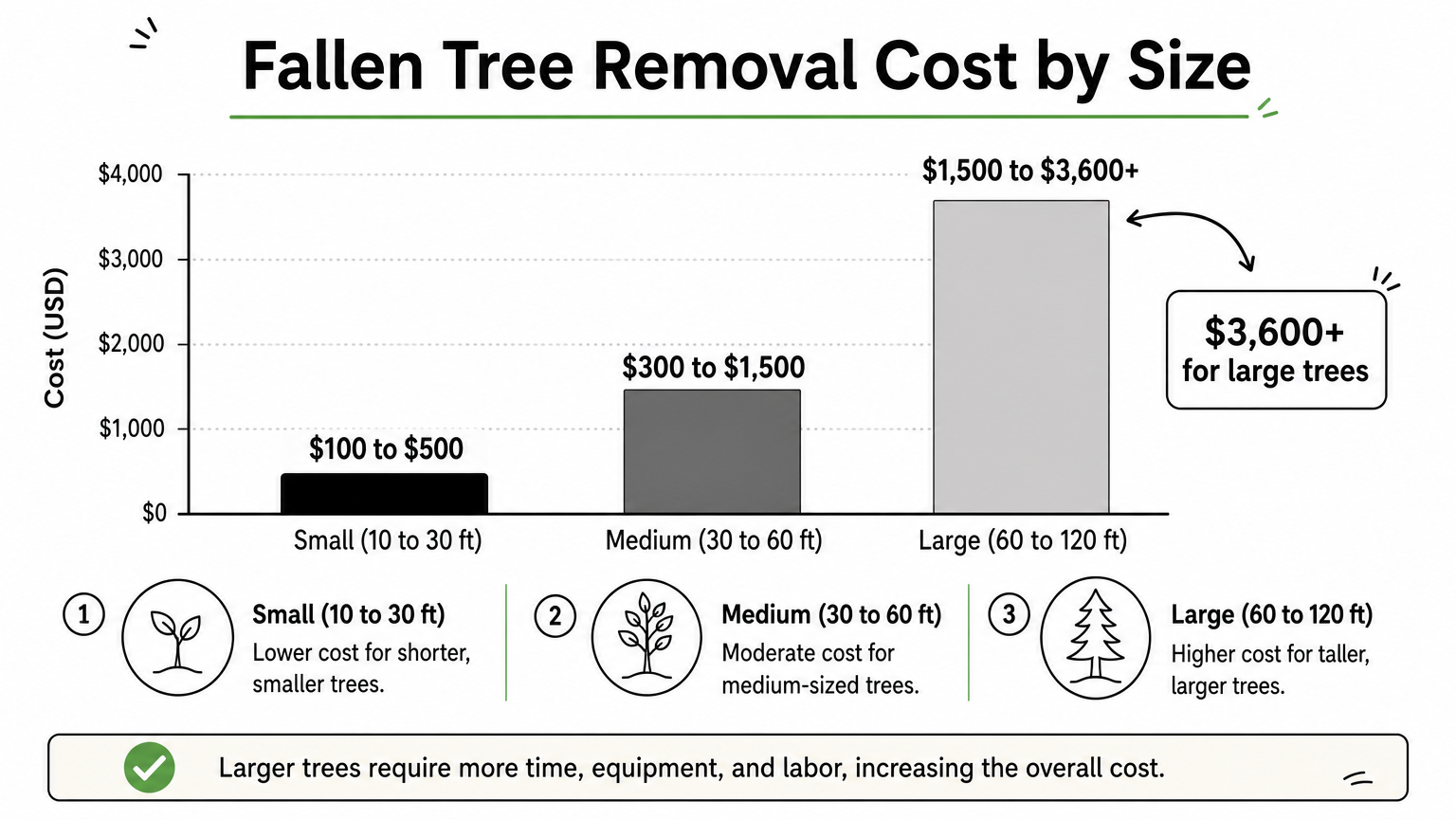
Size is the biggest driver. Published guides agree closely on the small, medium and large tiers below. The low end of each tier covers easy jobs and the high end covers hard ones.
| Tree size | Typical height | Typical cost when fallen |
|---|---|---|
| Small | 10 to 30 ft | $100 to $500 |
| Medium | 30 to 60 ft | $300 to $1,500 |
| Large | 60 to 120 ft | $1,500 to $3,600 or more |
Two common questions fit this table. A 30-foot tree sits at the top of the small tier and the bottom of the medium one, so expect roughly $300 to $500. A 100-foot tree sits in the large tier, and you should budget toward the top of that range , because a crane or an extra crew often comes into play.
A single fallen limb costs the least. Some companies bill it by the crew hour, and published guides quote $200 to $300 per hour . Species matters far less than size, so an oak and a palm of the same height land in the same tier.
Size sets the base price, and every other factor adds to it.
Why a fallen tree costs less than a standing one
A tree on the ground needs cutting, chipping and hauling, but no climbing, rigging or controlled lowering. One published guide puts a small standing tree at $450 to $800, against $300 to $500 for the same tree already on the ground .
Partly fallen trees are the exception. A tree hung up on a fence, leaning on another tree or snapped with part of the trunk still standing can shift without warning. Crews cut it in a controlled sequence and price it closer to a standing removal.
What the quote usually includes
Read the scope line by line before you compare prices. Two quotes with the same total can cover very different work.
- Usually included: cutting the trunk and limbs into pieces, chipping branches and small debris, and cleaning up the immediate work area.
- Often extra: grinding the stump or root plate, hauling away large wood, and permits where a city requires them.
Ask whether you want the wood hauled or left as logs. Integrity Landscape's tree removal cuts wood into measured logs for storage or disposal to your specification, which is the kind of detail worth confirming up front.
What raises the price of removing a fallen tree
Five things push a fallen tree quote above the base price: hard access, damage to property, nearby hazards, emergency timing and add-on work. Each one adds time, equipment or risk.
Access, damage and hazards
Access comes first. A tree behind a fence, past a narrow gate or beside a pool forces the crew to carry cut wood by hand or bring smaller equipment. Hard access typically adds 25% to 50% to the total.
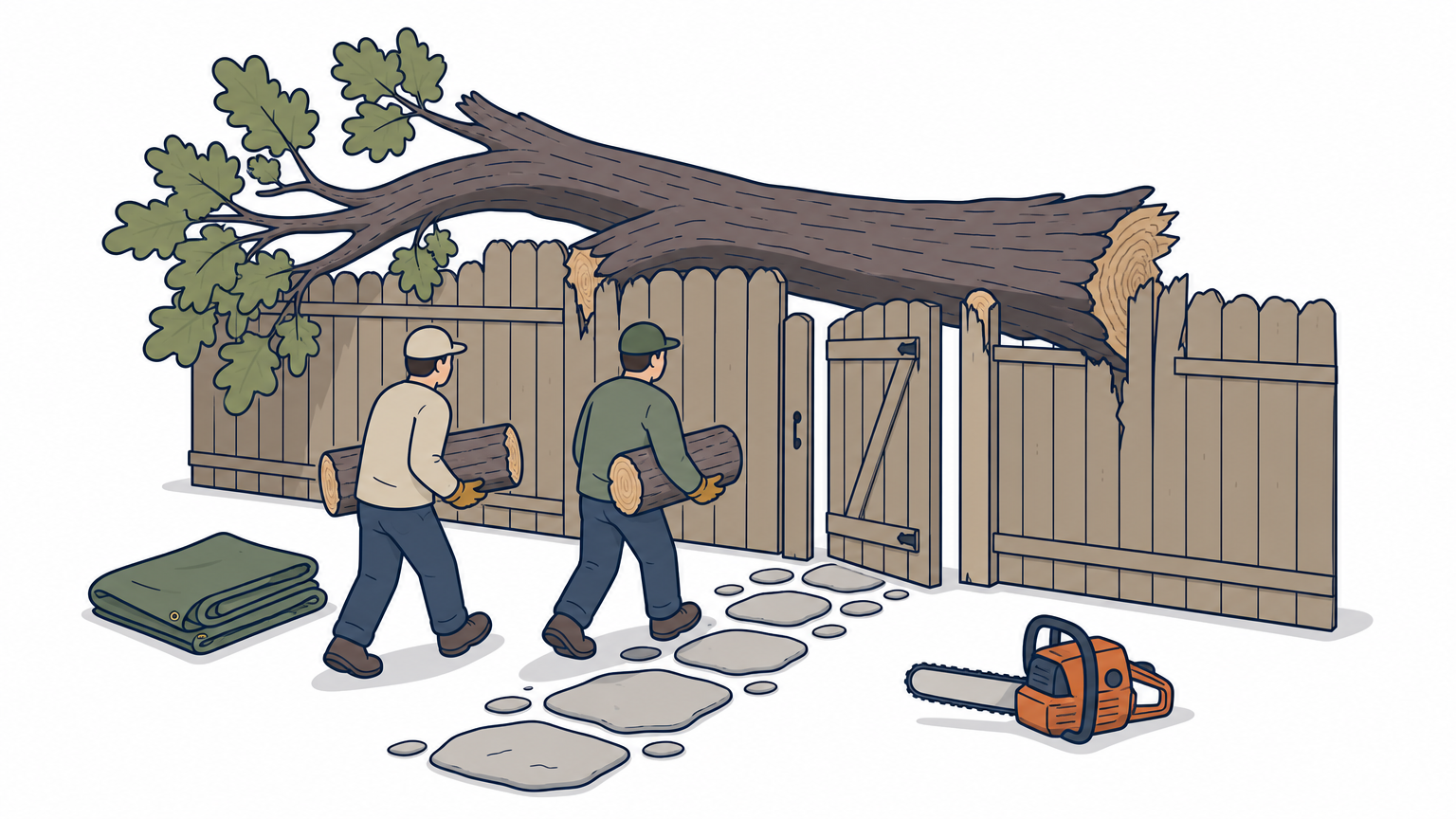
Damage to property raises the price more. A tree on a roof, deck, car or fence needs slow, careful rigging so the weight does not drop further. Published guides put these jobs at two to three times the price of the same tree lying in open yard.
Power lines add another layer. Stay well away from any downed line and call your utility first. A tree over a roof, a line or a pool enclosure is where crane support earns its cost, since the crane lifts heavy sections clear without dropping them. One guide puts the crane add-on at up to $500 for very tall trees, so ask for the exact figure for your site.
Emergency timing and hurricane season
Emergency calls cost more. After-hours, weekend and same-day work typically carries a 25% to 100% premium , because crews pay overtime and drop other jobs. Hurricane season runs June 1 to November 30 in Florida, and demand surges after any big storm.
If the tree is in an open yard and threatens nothing, waiting a few days outside the post-storm rush can lower the quote. If it is on your house, protect the property first and do not wait on price.
Surcharges and add-ons at a glance
| Item | Typical effect on the price |
|---|---|
| Hard access | Adds 25% to 50% |
| Emergency or after-hours service | Adds 25% to 100% |
| Tree on a structure | 2x to 3x the base price |
| Crane for very tall trees | Up to about $500 extra |
| Stump grinding | $100 to $150 for the first stump, about $50 for each extra |
| Hauling debris away | About $70 |
| Chipping to mulch | About $95 |
A tree on your roof costs two to three times what the same tree costs in open yard.
How to budget for fallen tree removal in Jupiter
Budget by making the site safe, documenting the damage, collecting two or three written quotes for the same scope, and adding the extras you expect. Doing this in order keeps the bill predictable.
Steps to a reliable quote
- Keep everyone away from the tree and from any power line touching it.
- Take photos from several angles before anything moves, and call your insurer first if the tree is on a structure or vehicle.
- Estimate the tree's height, and note gates, fences, pools and overhead lines in the way.
- Request two or three written quotes with the same scope: cutting, chipping, hauling, stump work and cleanup. A company like Integrity Landscape offers same-day quotes and next-day service, which helps when a tree blocks your driveway.
- Confirm the contractor is licensed and insured before you agree to a price.
A worked example for a typical yard tree
Say a 45-foot tree went down in your backyard and the crew has to work through a side gate. Assume a base quote of $900, which sits inside the medium range.
| Line item | Estimate |
|---|---|
| Base removal | $900 |
| Tight access, 25% to 50% | $225 to $450 |
| Haul-away | $70 |
| Stump grinding, first stump | $100 to $150 |
| Total | $1,295 to $1,570 |
If the same tree had landed on your roof, the base alone would run two to three times higher, or $1,800 to $2,700 , before haul-away and roof repairs.
Add up the base price, the access surcharge and the extras before you compare totals.
When DIY is not worth it
DIY looks cheap until you price the gear. Safety equipment runs about $185 to $305, a chainsaw rental $35 to $90 per day, and felling wedges $20 to $50, for $240 to $445 if you own nothing. Fallen trunks can also hold tension and roll or snap when cut. Leave any tree on a structure or near a line to professionals.
Does insurance cover fallen tree removal?
Homeowners insurance often pays for fallen tree removal when the tree damages a covered structure, and often does not when it falls in the yard and hits nothing. Your policy decides, so read it or call your agent before you hire.
What homeowners policies usually cover
Standard policies typically cover removal of a tree felled by wind when it damages your house or another covered structure , or blocks your driveway. Many cap that debris removal at modest amounts, often around $500 per tree and $1,000 in total. A tree that falls harmlessly in the yard is usually your cost.
Insurers may also question trees that were already dead or rotting. Keep photos or an arborist's note showing the tree's condition before the storm.
Deductibles and claim steps
Florida policies often carry a separate hurricane deductible , usually a percentage of your dwelling coverage. A $1,300 tree bill can fall well below that figure, so compare the deductible with your quote before you file.
If you do file, call the insurer before removal when the tree is on your house or car, since an adjuster may need to see it. Photograph everything, keep every receipt, and ask your contractor to itemize the work so the claim matches the invoice.
Compare your deductible with the tree quote before you file a claim.
Getting a fair price for your fallen tree
A fair price follows from the tree's size, how hard it is to reach, what it damaged and how fast you need it gone. Small yard trees run in the low hundreds, medium trees up to about $1,500, and large trees $1,500 to $3,600 or more, with surcharges on top for tight access, structure damage and emergencies.
Document the damage, compare written quotes with matching scope and check your insurance before you commit. If a tree is down on your Jupiter or Palm Beach County property, you can request same-day fallen tree removal from Integrity Landscape and get a clear scope, price and timeline.