
Paver Patio vs Deck Cost: What Each Costs per Square Foot
A paver patio vs deck cost comparison usually ends the same way: the paver patio costs less to install and less to own. Published installed prices run about $10 to $25 per square foot for pavers and $15 to $50 for a deck. Pressure-treated wood sits at the low end of the deck range and composite at the high end. A top-tier paver job can still match a wood deck, and a basic deck can undercut a premium patio.
The comparison covers more than the sticker price. It means putting the cost of a paver patio next to the cost of a deck on the same footprint, then adding what each one needs over its life: upkeep, repairs, permits, and what a buyer will pay for it later. Two quotes only compare fairly when they cover the same scope.
This article gives you the working ranges, a method for pricing your own yard, and a ten-year cost comparison. It also covers the Florida factors that shift the numbers and the resale math. Integrity Landscape builds paver patios in Jupiter and across Palm Beach County, so the Florida notes come from the kind of lots and weather we work with. The cost framework applies to a deck as well.
Why price per square foot misleads when you compare
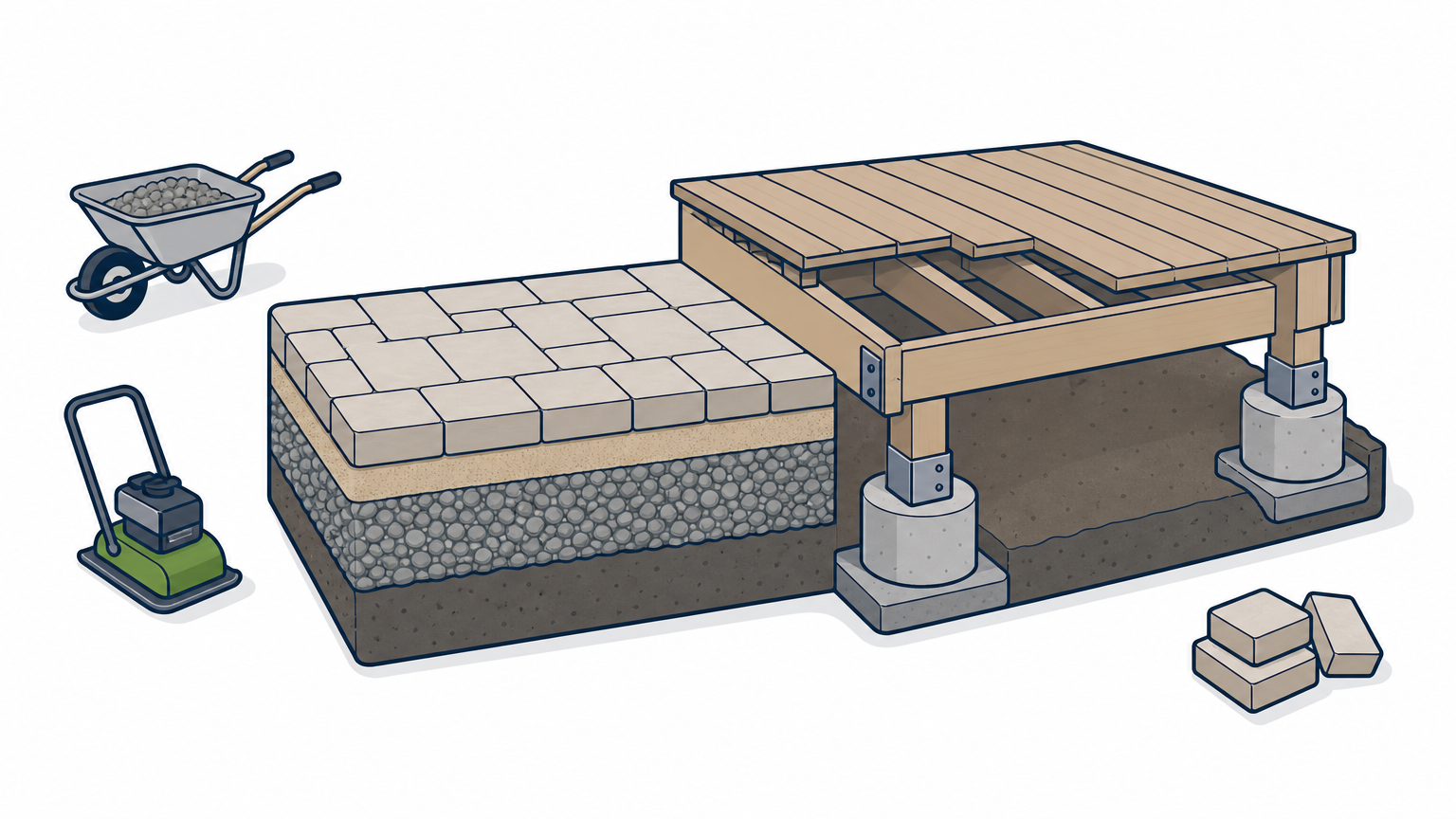
Price per square foot misleads because a patio and a deck are built from different parts. The same dollar figure buys a different structure in each case. A paver patio is an excavated, compacted base with a bedding layer and a surface. A deck is footings, framing, decking boards, and usually stairs and a railing.
What the published ranges say
Cost guides disagree on exact figures, but the pattern repeats. Here is how the ranges line up when you set them side by side.
| Option | Typical installed cost per sq ft | What pushes you up or down |
|---|---|---|
| Poured concrete patio | $5 to $15 | Thickness, finish, stamping, site prep |
| Paver patio | $10 to $25 | Paver grade, pattern, base depth, edging, curves |
| Pressure-treated wood deck | $15 to $25 | Height, railing, stairs, board grade |
| Composite deck | $25 to $50 | Brand, color, railing, stairs, substructure |
Treat these as planning ranges, not quotes. Local labor rates and site conditions move every line, so use the table to sanity-check a bid rather than replace one.
A deck costs more per square foot because it has more parts to build, not because the surface itself is fancier.
Why the sources disagree
Some guides quote materials only, and others quote the finished job. As a rule of thumb, labor roughly doubles a materials-only number, so a $6 per square foot figure can turn into $12 or more once installation is included. Decks also pick up line items that pavers rarely do, such as a railing, stairs, and a permit fee .
The grade you pick matters just as much. One homeowner comparison found a basic composite deck with no railing and a premium paver patio landing at about $13,000 versus $15,000 . Cheap pavers are far less expensive than that, and a fully railed composite deck costs far more. Compare quotes only when the size, finish level, and extras match.
How to estimate your own paver patio or deck cost
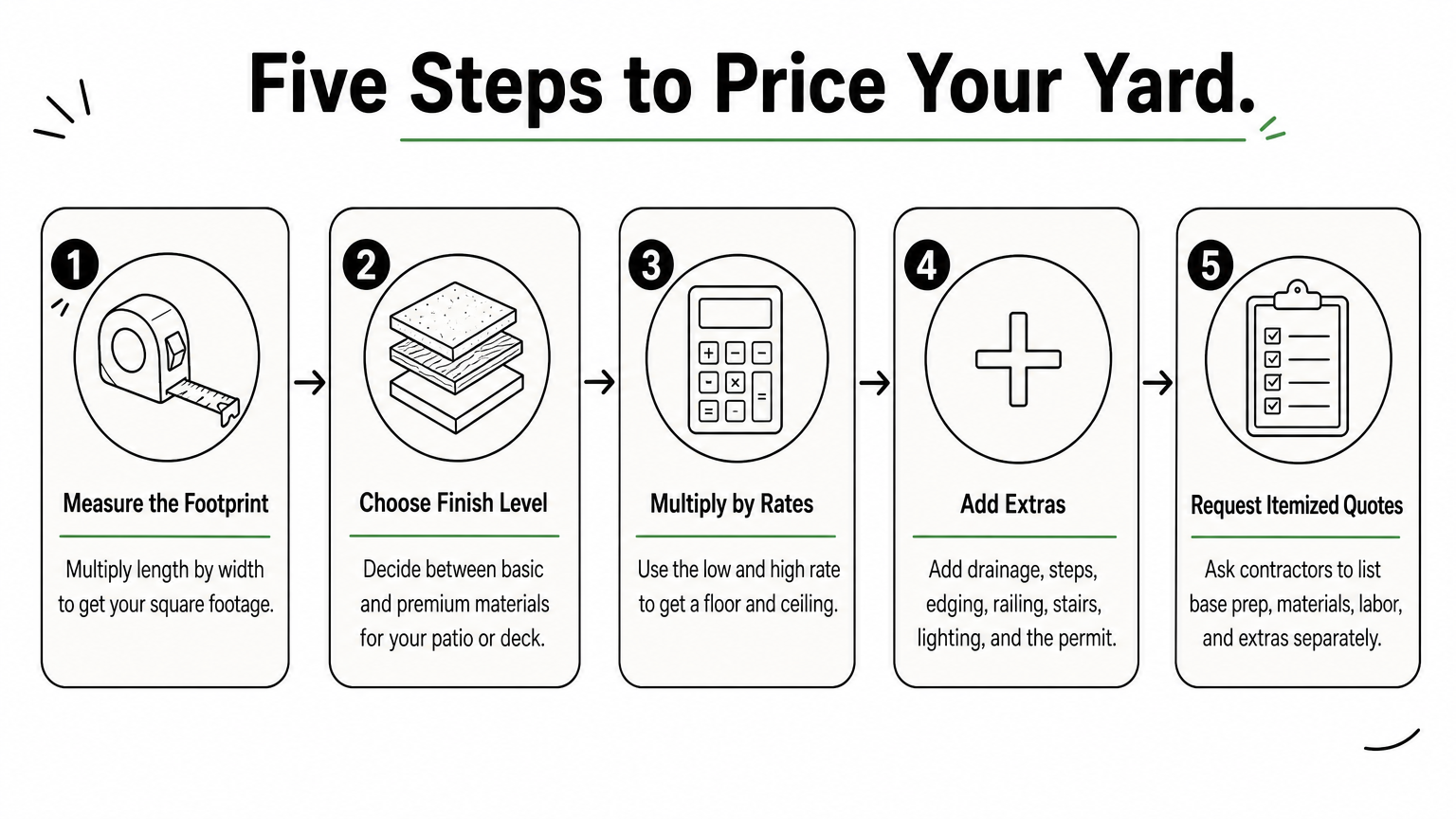
To estimate your cost, multiply your square footage by the low and high rate for each material, then add the extras that sit outside the per-foot price. The whole exercise takes about ten minutes and gives you a range to check against any contractor's number.
Step-by-step estimate
- Measure the footprint. Multiply length by width. A 16 by 20 foot space is 320 square feet.
- Choose a finish level. Decide between basic and premium. Standard concrete pavers sit near the low end of the range, and large-format or natural stone pavers sit near the top. For a deck, pressure-treated wood sits low and composite sits high.
- Multiply by the low and high rates. Use the table above to get a floor and a ceiling for each option.
- Add extras. For a patio, think excavation, drainage, steps, seat walls, and edging. For a deck, add railing, stairs, lighting, and the permit.
- Request itemized quotes. Ask each contractor to list base prep, materials, labor, and extras separately so you can compare line by line.
If you want a paver quote, Integrity Landscape offers same-day quotes when you text a picture of your yard, and the estimate is free.
Worked example: a 320 square foot space
Here is the 16 by 20 foot space priced three ways, using the ranges above.
| Option | Rate per sq ft | Total for 320 sq ft |
|---|---|---|
| Paver patio | $10 to $25 | $3,200 to $8,000 |
| Pressure-treated wood deck | $15 to $25 | $4,800 to $8,000 |
| Composite deck | $25 to $50 | $8,000 to $16,000 |
Size changes the picture fast. A 300 square foot paver patio runs about $3,000 to $7,500. A 20 by 20 foot patio at 400 square feet runs about $4,000 to $10,000. Notice that the top of the paver range equals the top of the wood deck range . A deck vs paver patio cost comparison therefore turns on which grade you choose, not just which structure.
Price both options at the same size and finish level, and a paver patio costs less than a composite deck in nearly every case.
Deck vs paver patio cost over ten years
Over ten years, the paver patio stays the cheapest option, and the gap between a wood deck and a composite deck narrows. Upfront cost is only the first payment. Upkeep and replacement make up the rest of the bill.
What each surface needs to stay in shape
Pavers need sweeping, hosing, and an occasional top-up of the joint sand to keep weeds out. If a paver cracks or a section settles, a crew lifts and replaces just that area. Published lifespans run 25 to 30 years or more for a well-installed patio.
Wood decks need washing and sealing or staining every couple of years to slow rot, and a pressure-treated deck typically lasts 10 to 20 years . The cost to stain a deck averages about $775. Florida sun and humidity push you toward the shorter restaining interval.
Composite decks skip staining and sealing, and need only cleaning to prevent mold and mildew. They last 25 to 30 years or more , and a damaged board gets swapped individually.
Ten-year totals for 320 square feet
This table adds upkeep to the upfront cost. It assumes a wood deck is restained three to five times at the $775 average. The ranges are estimates, not quotes.
| Option | Upfront | Upkeep over 10 years | Ten-year total |
|---|---|---|---|
| Paver patio | $3,200 to $8,000 | Sweeping, joint sand top-ups, occasional re-leveling | Close to upfront cost |
| Wood deck | $4,800 to $8,000 | $2,325 to $3,875 in staining | $7,125 to $11,875 |
| Composite deck | $8,000 to $16,000 | Cleaning only | Close to upfront cost |
The wood deck looks cheap on day one and then catches up with composite on ownership cost. The paver patio is the lowest at both ends of the range. A deck vs paver patio cost comparison that stops at the installation invoice overstates the deck's advantage.
A wood deck costs less to build than a composite one, but staining closes much of that gap within a decade.
Florida factors that change the cost of a paver patio vs deck
In Jupiter and the rest of Palm Beach County, heat, rain, termites, and permit rules tilt the cost of paver patio vs deck toward pavers. They don't rule out a deck, but they add ownership costs that you should price in.
Heat, humidity, and storms
Humidity and termites are hard on wood, so a wood deck in South Florida needs sealing and inspection more often than one in a dry climate. Composite resists rot and insects but gets hot underfoot in direct sun, especially in dark colors. Pavers also absorb heat. Lighter tones stay more comfortable on bare feet for both materials.
Heavy rain tests any base. A washed-out section of pavers can be lifted and reset. Storm damage to a deck's frame is a structural repair and usually costs more. Either way, a properly compacted base with sound drainage matters more than the surface you pick.
Permits, HOAs, and terrain
| Factor | Paver patio | Deck |
|---|---|---|
| Permit | Often not required at grade, but check | Usually required, with inspections |
| HOA approval | Often needed for materials and layout | Often needed for size, height, and railing |
| Terrain | Needs flat or leveled ground | Works on uneven or sloped ground |
| Repairs | Replace individual pavers | Replace boards, sometimes framing |
Rules vary by municipality, so confirm with your town's building department and your HOA before you sign anything. Permit and inspection fees can add cost and waiting time to a deck, and a patio with drainage work or retaining walls may need one too. Also ask about lot coverage and drainage rules, because hardscape can count against them.
In Florida, the paver patio's biggest edge is not the install price but the lower upkeep and the simpler permitting.
Which option gives you better value for your yard
A paver patio is the better value for most flat, ground-level Florida yards. A deck is the better value when your home sits above grade, your lot slopes, or you want an extension of an upper floor. Cost comes first, but fit decides the result.
Resale value and net cost
Published return-on-investment estimates put a deck at about 70% of its cost recouped at sale and a patio at about 50%. Those figures vary by market and build quality, so use them for direction only. The math is worth running, because a higher percentage does not mean a lower net cost. Take an $8,000 deck and a $5,000 paver patio. The deck recoups about $5,600, for a net cost of $2,400. The patio recoups about $2,500, for a net cost of $2,500. The two come out almost even, and the patio had the lower upfront bill and lower upkeep.
Buyers in a coastal market also tend to value a durable, finished outdoor space , and a well-built paver patio adds curb appeal that a tired wood deck does not.
Quick decision rules
- Choose pavers if your yard is flat, you want the lowest ten-year cost, or you want minimal maintenance.
- Choose a composite deck if your home sits above grade, the lot slopes, or you want a raised space tied to an upper floor.
- Choose a wood deck only if you accept restaining every few years and the extra termite vigilance.
- Choose the premium finish only where you'll see and feel the difference, such as the main seating area.
Pick the structure that fits your terrain first, then pick the material that fits your budget.
Making the call between a paver patio and a deck
The paver patio vs deck cost question has a clear shape. Pavers cost roughly $10 to $25 per square foot, a wood deck $15 to $25, and a composite deck $25 to $50. Pavers stay the cheapest option once upkeep is counted, and in Florida the heat, humidity, termites, and permit rules widen that gap. A deck still earns its place on sloped or raised properties.
Your next step is to measure the space and set your finish level. Then compare itemized quotes with the same scope. If a paver patio is on your list, text Integrity Landscape a picture of your yard for a same-day, free estimate and see how your numbers compare to the ranges above.