Cost of Tree Removal Near Me: What Pros Charge and Why
The cost of tree removal near me is the full price a local crew charges to cut down one tree, clear the debris, and leave your property safe. For most homeowners, one average tree costs $450 to $1,450 . A small tree under 30 feet can run as low as $150. A large tree over a roof or power line can pass $10,000.
This guide shows why prices swing so widely, how to estimate your own number from height, trunk width, and access, and what Pennsylvania and Florida homeowners typically pay. You also get a clear way to compare quotes and a short list of ways to lower the bill.
Integrity Landscape handles tree trimming, removal, stump grinding, and crane-assisted jobs in Jupiter and across Palm Beach County. We build these quotes for homeowners and property managers regularly, so the explanations below follow how a crew actually prices a job.
Why the cost of tree removal varies so much
Tree removal prices vary because crews charge for risk, labor, and equipment, not just for the tree. Anyone searching for the cost of tree removal near me will see quotes from $150 to $10,000, and both ends can be honest numbers for different jobs.
What a single tree typically costs
National cost surveys land in the same zone. One reports a normal range of $200 to $2,000 with a $750 average . Another reports $450 to $1,450 as the typical range. A third puts the average at $850 inside a $385 to $1,070 band.
| Job type | Typical price | What it usually involves |
|---|---|---|
| Small tree under 30 ft, open yard | $150 to $500 | Small crew, chipper, a few hours |
| Average residential tree, 30 to 60 ft | $450 to $1,450 | Reasonable access, standard rigging |
| Large or hard-to-reach tree | $1,500 to $3,300 | Over 60 ft, wide trunk, tight space |
| Complex or hazardous job | $3,500 to $10,000+ | Power lines, over a house, crane needed |
Most homeowners fall in the middle two rows. The top row is a tree a crew can drop in one piece. The bottom row is a job where one wrong cut damages a house.
Why two quotes for the same tree can differ
Labor drives most of the price. A crew that climbs, rigs, and lowers a tree in sections needs more people and more hours than a crew felling one in open space. Many companies also price by the foot, so height moves the number first. Equipment such as a chipper, bucket truck, or crane comes next.
Insurance and cleanup explain the rest. A very low quote often leaves out haul-away or comes from a crew without liability coverage . If a limb lands on your fence, that missing coverage costs far more than the few hundred dollars you saved.
A fair price matches the tree's size, access, and condition, not a national average.
Why local pricing matters
National averages hide large gaps. Published state averages run from roughly $350 to $650 in Colorado up to $750 to $1,500 in Florida. Local labor rates , fuel, permit rules, and disposal fees all feed that spread. Rural homeowners may also pay about $0.50 per mile, or a flat $50 to $200, for crew travel.
Use a national figure to set expectations, then replace it with real local quotes. Later sections show how Pennsylvania and Florida compare and how to adjust for your own address.
How to estimate your tree removal cost step by step
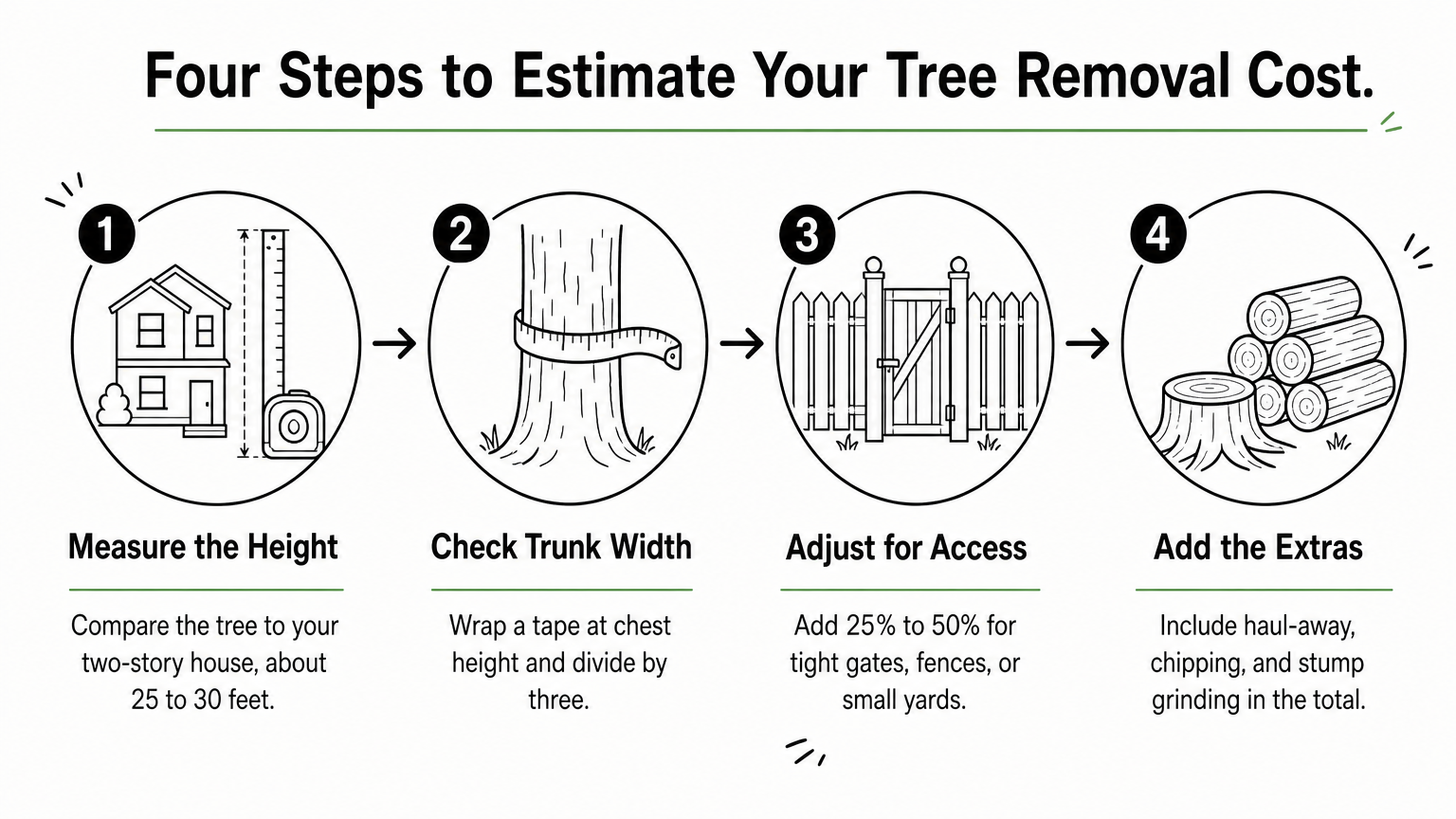
You can estimate the price in four moves. Measure height, check trunk width, adjust for access and condition, then add extras. This turns the cost of tree removal near me from a guess into a range you can test against any quote.
Start with tree height
Height is the first number every crew asks for. If you cannot measure it, compare the tree to your two-story house, which is roughly 25 to 30 feet tall. Then find your tree in this table, which sets national figures beside typical Pennsylvania ranges.
| Tree height | National range | Pennsylvania range |
|---|---|---|
| Up to 30 ft | $150 to $450 | $150 to $700 |
| 30 to 60 ft | $450 to $1,200 | $450 to $1,500 |
| 60 to 80 ft | $800 to $1,500 | $800 to $2,000 |
| Over 80 ft | $1,000 to $2,000 | $1,500 to $3,000 |
Above 80 feet, crews usually bring in a crane, which adds around $500 or more. Dense hardwoods such as oak and maple also take longer to cut and process than softwoods, which pushes them toward the top of each band.
Add trunk width and canopy
Height tells you how much tree there is. Trunk diameter and canopy spread tell you how heavy it is. Wrap a tape around the trunk at chest height and divide by three to get the diameter in inches.
| Trunk diameter | Canopy under 30 ft across | Canopy over 30 ft across |
|---|---|---|
| Under 12 in | $226 to $596 | $359 to $946 |
| 12 to 24 in | $517 to $1,364 | $808 to $2,132 |
| 24 to 36 in | $976 to $2,573 | $1,562 to $4,117 |
These figures include labor and equipment but not stump grinding. A wide canopy means more limbs to rig and lower, so it raises the price even when the trunk is the same size.
Adjust for access, condition, and species
Now correct the base number for the conditions on your property. Use these adjustments as a starting point:
- Tight or unsafe access: add 25% to 50%. Fences, narrow gates, and small yards slow the crew.
- Power lines or a structure in the fall zone: expect extra rigging labor. A tree hanging over a roof can cost far more than the same tree in open ground.
- Poor health: structural problems can account for up to 15% of the price. A dead tree with soft wood sometimes costs less, around $400 to $900.
- Tree already on the ground: often $75 to $150 for a simple one, or $300 to $500 if it was uprooted.
- Species: hardwoods cost more than softwoods, and palms are heavy enough to run $650 to $1,500.
Where the tree can fall matters more than what kind of tree it is.
A worked example
Take a 45-foot oak in a backyard behind a narrow gate. The height table gives a base of $450 to $1,200. Tight access adds 25% to 50%, which moves the range to about $560 to $1,800.
Add $70 to $95 for haul-away and chipping, plus $100 to $150 for stump grinding. The realistic total is about $730 to $2,050 . If a company quotes $4,000 for that job, ask what the extra money covers, because a crane or a permit report would need to explain it.
Tree removal costs in Pennsylvania and Florida
Pennsylvania homeowners usually pay $400 to $2,000 per tree, and Florida homeowners usually pay $750 to $1,500. The cost of tree removal near me depends heavily on your state's wood types, weather, and local rules.
Pennsylvania prices
Regional guides put most Pennsylvania jobs between $400 and $2,000. Small trees under 30 feet run $300 to $700, mid-size trees from 30 to 60 feet run $700 to $1,500, and large trees over 60 feet cost $1,500 to $3,000 or more. A regional pricing database lists a standing tree under 30 feet at about $424. Complex removals near power lines or buildings can exceed $10,000.
Permits cost $50 to $150 where required, and historic districts have stricter rules that can delay work. Winter and early spring are slower seasons, so some crews cut rates to keep people working. Emergency removal costs 40% to 60% more than scheduled work.
Florida and Palm Beach County prices
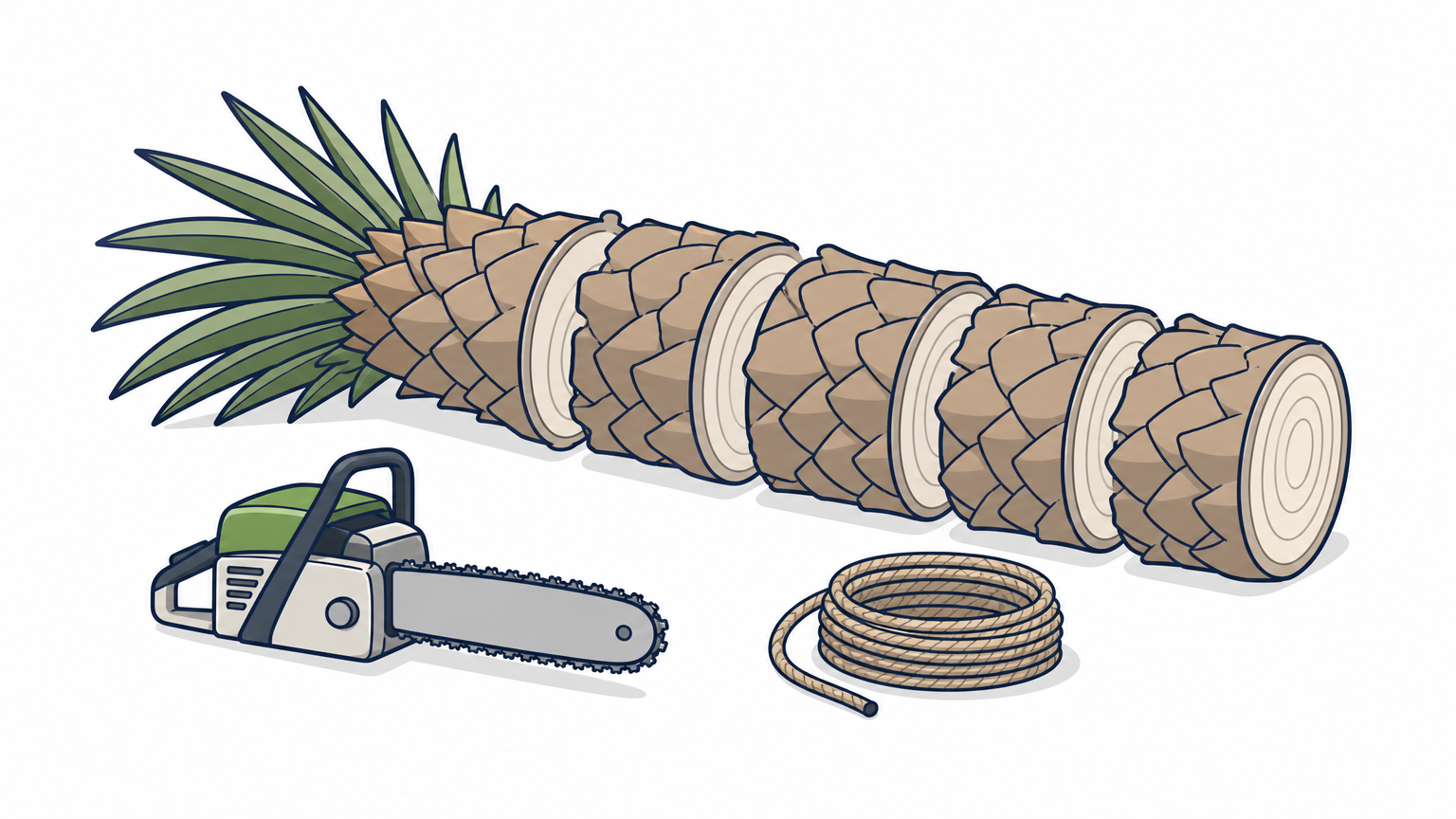
Florida averages $750 to $1,500 per tree. Palm removal runs $650 to $1,500 because palms are heavy and the trunk has to come down in controlled pieces. Hurricane season runs from June 1 to November 30, and demand jumps after any storm. Emergency calls in those periods can reach $5,000.
Rules matter here too. Many Florida cities and towns regulate removal of larger or protected trees, and mangroves are protected under state law. Confirm requirements with your municipality before anyone cuts. A reputable crew will ask, and often handles the paperwork.
How to adjust these figures for your area
Start with your state range, then place your tree inside it. A small, healthy tree in an open yard belongs near the bottom. A large tree over a structure belongs near the top, or above it.
| Area | Typical range per tree | What shifts the price |
|---|---|---|
| United States | $450 to $1,450 | Height, trunk width, access |
| Pennsylvania | $400 to $2,000 | Hardwoods, permits, winter slowdown |
| Florida | $750 to $1,500 | Palms, storm demand, city rules |
Call two local crews to calibrate. If both land inside your estimated range, you have a realistic budget.
Use the state range to set your budget and local quotes to confirm it.
Extra charges that change the final tree removal price
Beyond the cut itself, extras can add $200 to $1,500 to the bill, so ask about each one by name. The cost of tree removal near me often looks cheaper on paper than it turns out to be, because cleanup, stumps, and permits sit outside the headline price.
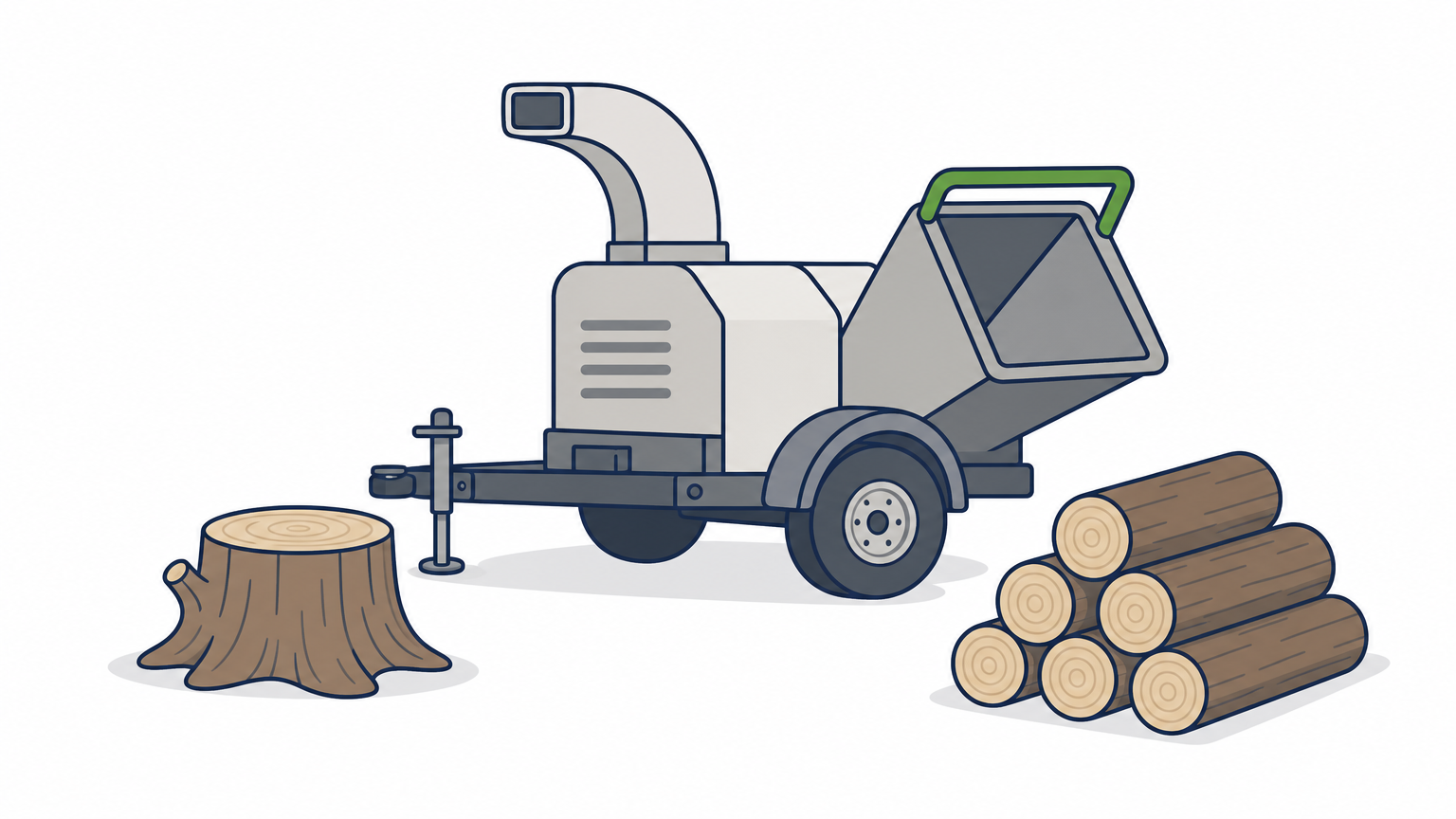
Typical add-on prices
Published figures vary by source, so these are ranges, not fixed rates.
| Add-on | Typical cost | Notes |
|---|---|---|
| Cleanup and haul-away | $70 to $500 | Depends on the volume of wood |
| Wood chipping | About $95 | Crew-chipped; a two-hour rental runs $150 to $250 |
| Stump grinding | $100 to $500 | Priced per stump or by diameter |
| Permit | $60 to $150 | An arborist report, if required, averages about $860 |
| Crane | $250 to $1,000 per day | Hard jobs can reach $6,000 to $7,000 |
| Rural travel | $0.50 per mile or $50 to $200 flat | Applies to distant properties |
| Emergency premium | 40% to 60% extra | Storm calls can reach $5,000 |
Why stump grinding quotes disagree
Some guides list $100 to $150 for the first stump and about $50 for each one after. Others price by diameter, from roughly $267 for a small stump to $494 for one 36 to 48 inches wide. Minimum fees and machine transport explain much of the gap.
The simplest fix is to ask for one bundled price. One national data set puts cutting a tree and grinding its stump together at $884 to $1,627. Also ask whether the grindings stay on site or get hauled away.
Crane and emergency premiums
Crane work shows up when a tree exceeds about 80 feet, sits over a structure, or cannot be climbed safely. Daily rates and the truck, operator, and extra crew all stack up. Emergency premiums apply after storms, when every crew is booked and the work is urgent.
If a tree has hit your house, photograph the damage and call your insurer before anything is hauled away. Removal may be covered after storm damage, depending on your policy, and an adjuster may need to see the scene first.
Ask for every extra as a separate line item so you can compare quotes fairly.
How to compare tree removal quotes from local companies
Compare quotes by scope, not by the bottom line. Collect three written estimates that list the same tasks, then check each crew's insurance. This is the surest way to judge the cost of tree removal near me when the numbers do not match.
What a complete quote includes
A usable quote leaves no room for surprises. Look for these items in writing:
- Tree species, height, and location on the property
- Removal method, such as climbing, bucket truck, or crane
- Cleanup scope: haul-away, chipping, or wood left on site
- Stump grinding included or excluded, and who hauls the grindings
- Permit handling and who pays the fee
- Total price, deposit, and expected timeline
- Proof of liability and workers' compensation insurance
At Integrity Landscape, estimates are free, same-day quotes are standard, and a project manager oversees each job site. Whichever company you hire, expect that level of detail.
Red flags to avoid
Door-to-door vendors who appear after a storm are the most common trap. They often lack insurance, push for quick decisions, and ask for large deposits before any work starts. Some disappear after collecting payment or leave property damage with no coverage behind it.
Before hiring anyone, verify their insurance, ask for references, and confirm how long they have worked locally. If you are unsure the tree needs removal at all, an ISA Certified Arborist can inspect it and give an independent opinion.
The cheapest quote is only cheaper if it covers the same work and the same risk.
How to lower your tree removal bill
You can often cut the bill by 10% to 20% through bundling trees, choosing your timing, and preparing the site. Do not try to save money by cutting the tree yourself. Lowering the cost of tree removal near me is about preparation, not shortcuts.
Timing and bundling
These four moves save the most money:
- Bundle trees. Several trees in one visit can save 10% to 20% per tree, because the crew sets up once.
- Choose a slow season. In colder states, winter and early spring are quieter. In Florida, avoid the weeks right after a named storm.
- Get three quotes. Competing written estimates show you the fair range for your tree.
- Act before an emergency. A tree that fails during a storm costs 40% to 60% more than one removed on schedule.
Prepare the site and skip risky DIY
Clear fences, bird baths, planters, and brush from the work area before the crew arrives. Easier access can trim the 25% to 50% access premium. You can also keep the logs as firewood, which saves roughly $100 to $300 on debris removal.
Leave the cutting to professionals for anything over about 15 feet. Falling trees injure people and damage property, and homeowner equipment and insurance rarely cover the risk. Small, healthy trees are the only reasonable DIY candidates.
Confirm the tree needs to go
The cheapest removal is the one you do not need. Removal is justified when:
- More than 25% of the branches are dead
- The trunk is hollow or has fungus or pest damage
- The tree leans 15 degrees or more
- It sits too close to power lines or a structure
Otherwise, pruning is cheaper. Pruning costs$75 to $1,500 depending on the tree's size.
Pay for removal when the tree is a hazard, and pay for pruning when it is only an annoyance.
Budgeting for your tree removal
A single tree usually costs $450 to $1,450, but your real number depends on height, trunk width, access, health, and extras like stumps and permits. Pennsylvania jobs commonly run $400 to $2,000, and Florida jobs run $750 to $1,500. Estimate first, then check it against three written local quotes.
Ask for every extra as its own line, confirm insurance, and be skeptical of any price far below the others. A clear quote protects you better than a low one.
If you are in Jupiter or anywhere in Palm Beach County, you can request a free estimate from Integrity Landscape and get a same-day quote with every cost itemized.