6 Smart Ways to Get Low Cost Tree Removal in Denton, TX
The cheapest way to get low cost tree removal is to collect three or four itemized written quotes from insured local crews, match the removal method to the tree, and handle the prep and cleanup you can safely do yourself. In the Denton and Dallas area, plan on roughly $300 to $800 for a small tree, $800 to $1,500 for a medium one, and $1,500 to $3,000 or more for a large one. Quote comparison suits owners of a single tree. Bundling and timing suit owners of several trees or a storm-damaged yard. Assistance programs suit seniors and anyone on a fixed income.
The hard part is that prices vary widely, and the lowest bid is often low for a bad reason. The crew may be uninsured, may skip cleanup, or may leave the stump for a second charge. You need to know what a fair number looks like and which levers actually lower it. This article gives you the price ranges first, then six ways to cut your bill without taking on risk.
We are Integrity Landscape, a licensed and insured company in Jupiter, FL. Our tree service covers trimming, removal, stump grinding, and crane support for large jobs across Palm Beach County. We can't send a crew to North Texas, but the pricing logic is the same everywhere, and these are the same questions we answer for our own customers.
What low cost tree removal costs around Denton
Low cost tree removal near Denton and Dallas typically means $300 to $800 for a small tree, and it is rare to find a real crew job under $300. A price far below the ranges here should make you ask what is missing, most often insurance, cleanup, or stump work .
Typical prices by tree size
| Job | Typical price | Why it costs that |
|---|---|---|
| Small tree (up to 30 ft) | $300 to $800 | Fewer tools, short job |
| Medium tree (30 to 60 ft) | $800 to $1,500 | May need a lift or rigging |
| Large tree (over 60 ft) | $1,500 to $3,000+ | Specialized equipment, longer job |
| Stump grinding | $100 to $400 | Depends on stump size and access |
| Trimming, two-person crew | About $120 to $150 per hour | Billed by time, not by tree |
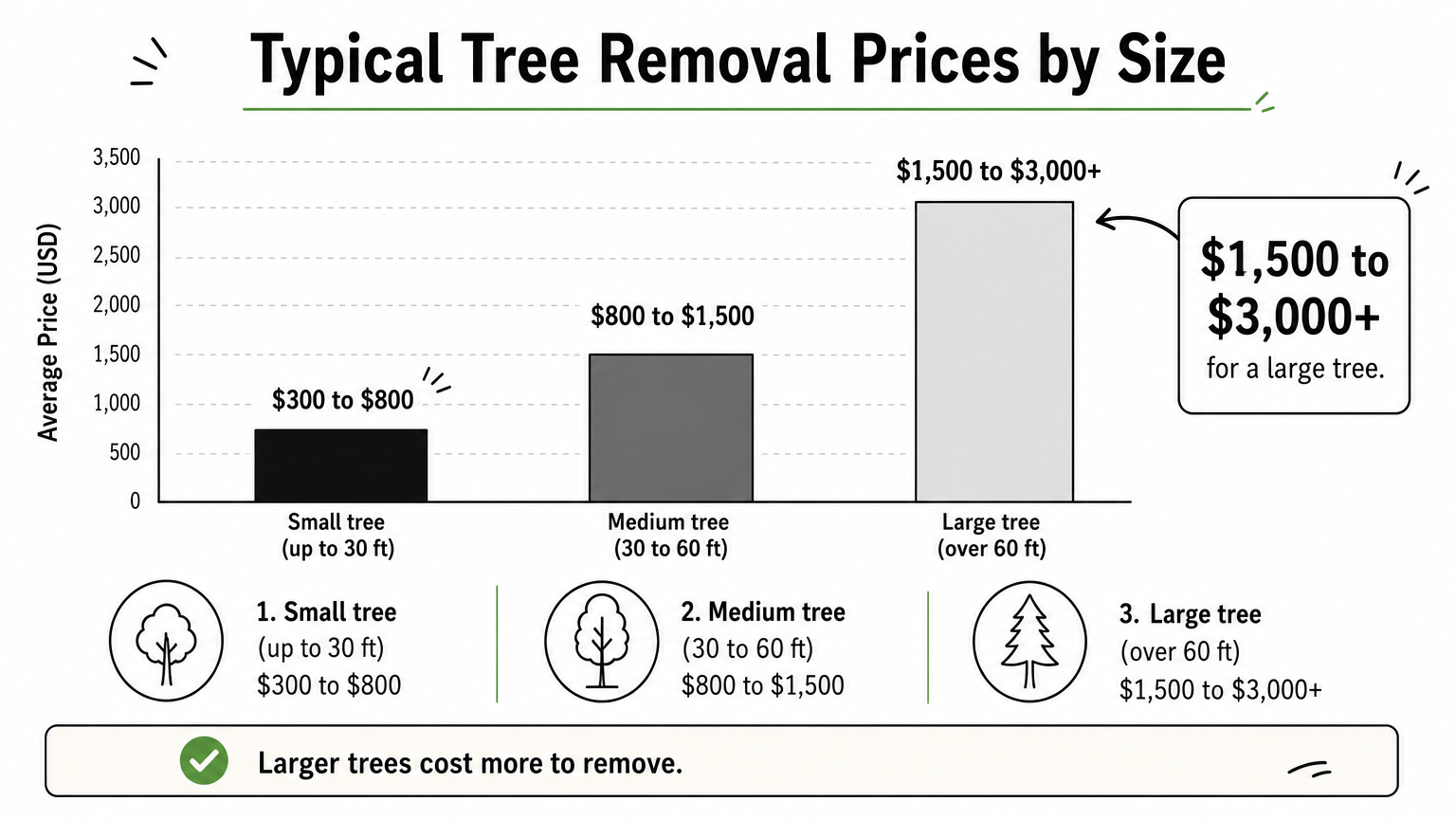
Treat every figure as a ballpark . Only a quote from someone who has looked at the tree is a real price.
A price given over the phone without anyone seeing the tree is a guess, not a quote.
What moves a quote up or down
Five things change the number more than anything else. Knowing them tells you where you can save.
- Size and species: Big trunks and dense canopies take more labor.
- Access: Tight gates, fences, and pools slow the crew and limit equipment.
- Hazards: Power lines and nearby structures force sectional removal.
- Condition: Dead or rotting trees are unstable, which raises risk and cost.
- Extras: Stump grinding, hauling, and emergency timing are the common add-ons.
1. Get three or four itemized written quotes
Getting three or four itemized written quotes is the single most reliable way to land low cost tree removal. Bids for the same tree often differ by hundreds of dollars, and you only see that spread if you ask.

How it works
Call three or four insured local companies and have each inspect the tree in person. Ask for a written quote with separate lines for removal, stump grinding, hauling, and cleanup. Itemizing lets you compare like with like, and it shows which crew hides cost in one line.
Ask every company the same questions:
- Is debris haul-off included?
- Is the stump included or extra?
- Is the quote good for 30 days?
- Does the price change if the tree turns out to be harder than expected?
Identical scope, written down, is what makes three quotes comparable.
What to watch for
Use the middle quote as your benchmark. A bid far below the rest usually leaves something out, and a bid far above it may include equipment your tree doesn't need. Be wary of large upfront deposits too. A modest deposit for scheduling is normal, but you should never pay the full amount before work begins.
2. Verify insurance and credentials before price
Checking insurance and credentials before you compare price protects you from the most expensive outcome of cheap tree removal: paying for damage or an injury yourself. Low cost tree removal only counts if the crew carries real coverage.
How it works
Ask for a certificate of insurance showing general liability and workers' compensation, and have it sent to you directly rather than shown on a phone. Ask whether anyone on the crew is an ISA Certified Arborist. That credential doesn't guarantee a low price, but it signals a company that plans jobs rather than improvises them.
Then confirm a few basics:
- A physical business address and a working phone number
- References you can call from recent jobs
- A written contract that names the work and the price
The cheapest quote from an uninsured crew is the most expensive one if anything goes wrong.
What to watch for
Be careful with door-to-door crews after a storm, cash-only demands, and anyone who offers to "top" a tree to save money. Topping harms the tree and often leaves a hazard behind. If a company can't send proof of coverage the same day, move on to the next bid.
3. Match the removal method to the tree
Matching the method to the tree keeps low cost tree removal low, because equipment is a large part of the bill. Climbing and rigging is the standard approach, and a crane is for cases where climbing isn't safe.
How it works
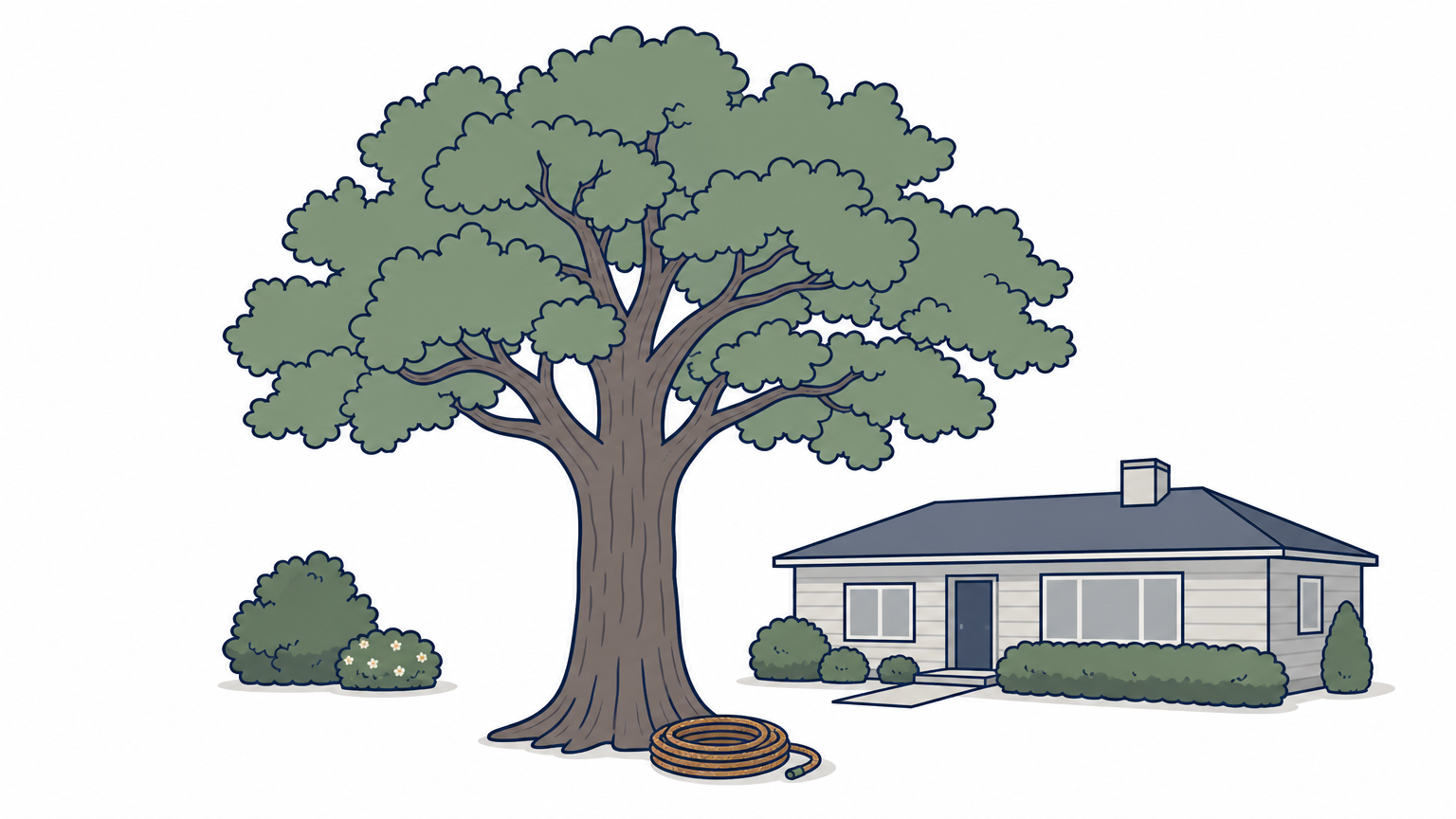
A tree in open space can often be felled in one piece , which is the cheapest scenario. A tree over a roof, fence, or pool has to come down in sections, lowered on ropes, and that takes more labor. A crane enters the picture when the tree is dead, rotted, split, or too weak for a climber, or when sections must be lifted over a house or power lines.
We use crane support on large Palm Beach County jobs for exactly those reasons, and the same logic applies in Texas. A crane day costs more up front, but it can cost far less than a repaired roof.
Pay for a crane only when the tree's condition or location truly demands one.
What to watch for
Ask each crew why they chose their method. If one bid includes a crane and the others don't, the answer tells you whether the tree is compromised or the crew is overbuilding the job. Never push a crew toward a cheaper method on a weak tree. That is how climbers get hurt and property gets damaged.
4. Handle the safe prep and keep the byproducts
Handling safe prep and keeping the byproducts is the easiest way to shave a low cost tree removal quote. Crews charge for time and haul-off, so every task you take off their plate can lower the price.
How it works
Before the crew arrives, clear the access path , move vehicles, unlock gates, and secure pets. Then decide what you want to keep. Wood can serve as firewood, and chips make useful mulch. Telling the crew to leave them can reduce hauling fees, so ask whether it changes the quote.
Stumps deserve a decision too. Stump grinding typically runs $100 to $400, and it is usually cheaper to do it during the same visit than to book a second trip. A stump you skip is still there, and it can sprout or trip someone.
Every task you take off the crew's plate is time you aren't billed for.
What to watch for
Keep your own work to ground-level tasks. Do not climb, do not run a chainsaw on a large trunk, and never work near power lines. Saving $200 isn't worth a trip to the emergency room, and a good crew will tell you where DIY stops being smart.
5. Time the job and avoid emergency pricing
Timing the job is a quiet way to get low cost tree removal, because emergency work costs more. Calling before a problem becomes a crisis gives you room to compare bids and pick a calm week.
How it works
Emergency calls after storms carry a premium, since crews work outside normal hours and demand spikes at once. Many crews are less busy in late fall and winter , and some will price more flexibly to fill their schedule. Ask whether a date a couple of weeks out lowers the quote.
If a tree is down but not dangerous, ask the crew to clear only what blocks access now, such as the driveway. You can schedule the rest at normal rates.
Waiting for a better price is smart. Waiting on a failing tree is not.
What to watch for
Don't delay on warning signs. Leaning, deep cracks, mushrooms at the base, and large dead limbs over a roof or car all mean you should call soon. A planned removal costs far less than the damage from a tree that fails on its own.
6. Look for assistance and check local rules
Looking for assistance and checking local rules can lower the cost of low cost tree removal for seniors and fixed-income homeowners, and it can keep you from paying a fine. Help varies by city, so a few calls are worth your time.
How it works
Start with your city's code compliance or neighborhood services office and ask whether any tree or yard-assistance programs exist. In Texas, dialing 2-1-1 connects you with local aid resources, and community groups or churches sometimes organize volunteer help. If branches touch power lines, stay away and call the utility, since lines are their responsibility.
Also call your homeowners insurance agent. Policies often help with removing a tree that has fallen on a covered structure , usually within limits, so ask before you pay out of pocket.
One phone call to your city or insurer can be worth more than a hundred-dollar discount.
What to watch for
Check your HOA rules and your city's tree ordinances before cutting a large tree, because a violation can cost more than the removal. Rules differ from city to city. Be skeptical of anyone offering "free" removal in exchange for the wood, since that deal often comes with no insurance and no cleanup.
Start with three quotes
Low cost tree removal comes from good process, not from the lowest number on the page. Get three or four itemized quotes, confirm insurance, match the method to the tree, handle safe prep, choose your timing, and check for help. Do those six things and you'll pay a fair price without gambling on your property.
If you're in Jupiter, Palm Beach, or Singer Island, request a free estimate from Integrity Landscape. We offer same-day quotes, next-day service, and a project manager on every job.