Cost of Brick Paver Patio: What to Budget in Jupiter, FL
The cost of brick paver patio installation is the full price of excavating the site, building a compacted base, laying the pavers, and finishing the joints and edges. For a professional job, published national figures land around $14 to $24 per square foot. That puts a typical 20x20 patio between roughly $5,600 and $9,600. Simple designs can come in lower and custom work can climb well past that range, so treat those numbers as a starting band, not a quote.
This guide shows where the money goes, how to calculate your own budget, which choices raise or lower the price, and how doing the work yourself compares with hiring a crew. It also covers the conditions that matter in South Florida, where sandy soil, summer rain, and HOA rules shape how a patio gets built.
Integrity Landscape builds paver patios, driveways, and retaining walls in Jupiter and across Palm Beach County. The advice below reflects how these jobs are priced and built on site. Use it to walk into your first estimate knowing what a fair number looks like.
Why the cost of a brick paver patio varies so much
The price swings because you are buying a construction project, not a pile of bricks. Two patios with the same footprint can differ by thousands of dollars once you count base depth, pattern, access, and add-ons.
What the average price per square foot looks like
Most professional installations land between $14 and $24 per square foot , labor and materials included. That is the usual answer for the average cost of brick paver patio per square foot, though published ranges run wider, from about $10 to $30 , because they blend simple and custom jobs. Some cost calculators set the baseline for a standard install near $20 to $26.
| Cost component | Typical range per square foot |
|---|---|
| Materials only (brick pavers, DIY) | $9 to $11 |
| Professional labor | $5 to $13 |
| Professional install, materials and labor | $14 to $24 |
| Wider published range for installed patios | $10 to $30 |
| Reclaimed or specialty brick, installed | $30 and up |
Size also moves the per-foot number. Larger patios cost less per square foot because bulk materials and fixed labor, such as mobilizing equipment, spread over more area. A small patio often costs more per foot than the table suggests.
Where your money goes
Labor takes roughly a third to a half of the installed price. The rest pays for everything that goes into and under the surface:
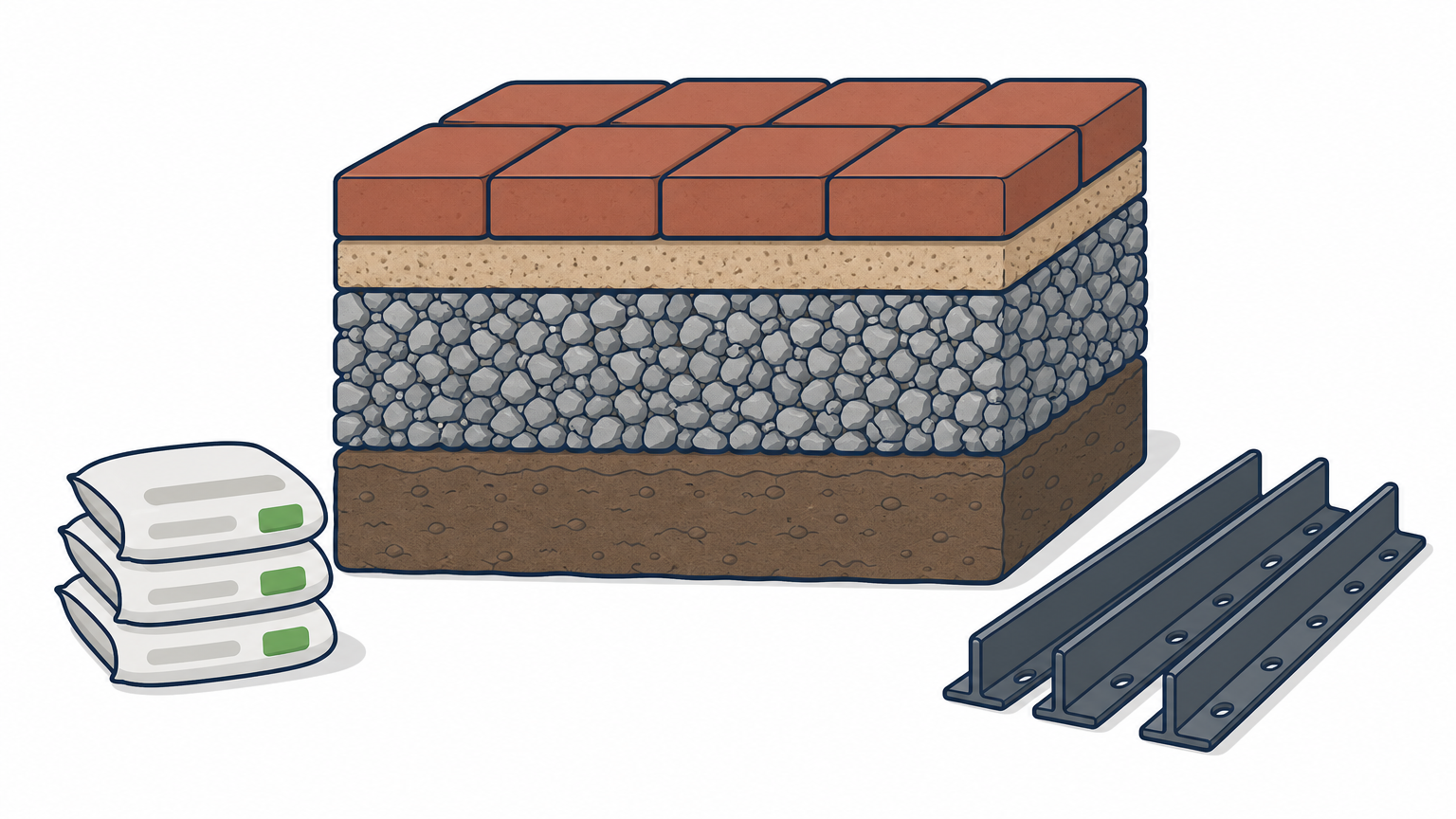
- Excavation and haul-off of the existing soil or sod
- Base aggregate, compacted in layers
- Bedding sand for leveling the pavers
- The pavers themselves, plus extra for cuts
- Edge restraints that lock the border in place
- Polymeric sand for the joints
- Compaction, cleanup, and final grading
Much of that list is invisible once the patio is finished. The base and the compaction decide whether the surface stays flat for decades, and they are where a low bid usually cuts corners.
Most of what you pay for in a paver patio is the work under the surface, not the bricks you see.
What "brick" means in your quote
"Brick paver" can mean fired clay brick or a concrete paver molded in a brick shape. Brick pavers generally cost more than concrete pavers and less than natural stone, so the material line in a quote matters. Ask which product is priced, who makes it, and how thick it is. A paver brick patio cost that looks low often hides a thinner or cheaper unit.
How to estimate the cost for a brick paver patio
You can build a reliable budget in about ten minutes with a tape measure and a calculator. The method is simple: multiply your area by a realistic per-foot band, then add extras and a cushion.
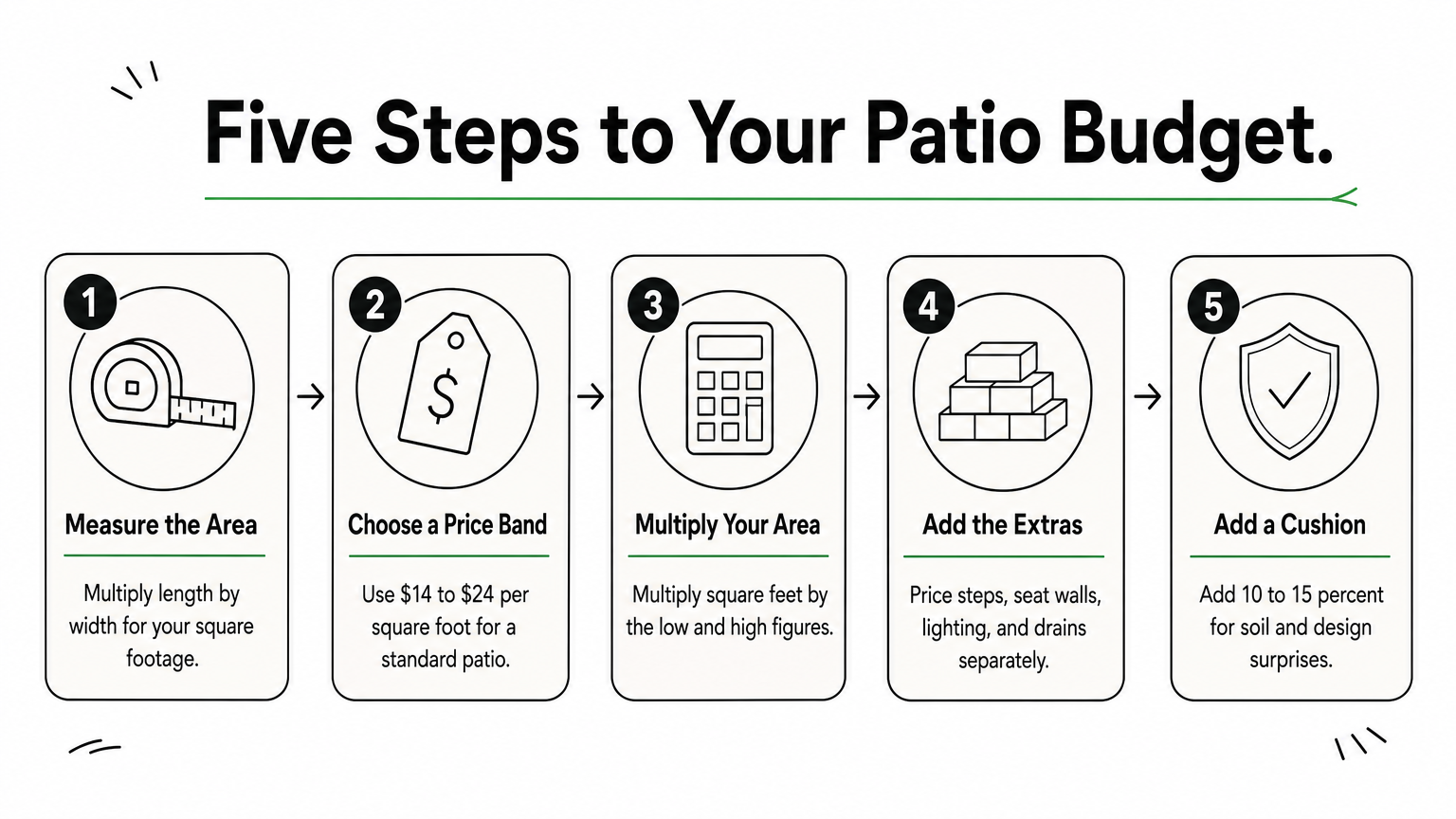
A step-by-step budget formula
- Measure the area. Multiply length by width. For a curved patio, measure the longest and widest points and use the average of the two dimensions.
- Choose a per-foot band. Use $14 to $24 for a standard rectangular patio with a straightforward base. Move toward the top for patterns, curves, or tight access.
- Multiply. Your area times the low and high figures gives a working range.
- Add the extras. Steps, seat walls, a fire pit pad, lighting, and drains are usually priced separately.
- Add a cushion of 10 to 15 percent. Hidden soil problems, extra base material, and design changes show up once digging starts.
For example, a 16x20 patio is 320 square feet. At $14 to $24 per square foot, that is $4,480 to $7,680. With a 10 percent cushion, plan for about $4,900 to $8,400 before any extras.
If you are ordering materials yourself, buy about 5 to 10 percent extra for a simple rectangle and 10 to 15 percent for herringbone, curves, or borders. Cuts and breakage use up more brick than most people expect.
Typical totals for common patio sizes
The table applies the same $14 to $24 band to the sizes homeowners ask about most. Treat the small sizes as the low end of what a contractor will accept, since very small jobs often carry a minimum charge.
| Patio size | Square feet | Estimated installed cost |
|---|---|---|
| 10x10 | 100 | $1,400 to $2,400 |
| 12x12 | 144 | $2,000 to $3,500 |
| 12x16 | 192 | $2,700 to $4,600 |
| 16x16 | 256 | $3,600 to $6,100 |
| 20x20 | 400 | $5,600 to $9,600 |
| 20x30 | 600 | $8,400 to $14,400 |
Published guides for a 20x20 patio often cite $4,000 to $12,000, which brackets this estimate on both sides. The low end assumes basic pavers and an easy site. The high end assumes upgraded brick, a pattern, or difficult conditions.
Multiply your square footage by a realistic per-foot band, then add a 10 to 15 percent cushion for surprises.
What pushes the price up or down
Six things move the number more than anything else: design, paver choice, base work, site conditions, add-ons, and permits. You control most of them, so this is where you can shape the budget without losing the look you want.
Design and material choices
A plain running bond in a rectangle is the cheapest layout because it needs few cuts and goes down fast. Herringbone, basket weave, curves, and multi-pattern designs take more labor and waste more brick. The same goes for borders and inlays, which look great and add hours.
Material is the other lever. Standard brick pavers fall in the $9 to $11 per square foot range for materials, concrete pavers cost less, and natural stone costs more. Reclaimed brick pavers run roughly $6 to $25 per square foot for the brick alone, and installed projects with reclaimed street brick often start around $30. Pick the material first, because it sets the floor for your cost of brick paver patio work.
Site conditions
Access, grade, and drainage change the labor hours. If equipment can drive to the work area, excavation goes quickly. If everything has to be carried through a gate or down stairs, you pay for the extra handling. A sloped yard may need steps or a retaining wall, and a patio that sits against the house needs grading that sends water away from the foundation.
Existing surfaces matter too. Removing an old concrete slab or tearing out roots and sod adds excavation and disposal costs that a quote for bare ground will not include. Ask the contractor to walk the site so these items appear in writing.
Add-ons and permits
Patios rarely stay just a patio. A fire pit pad, seat wall, outdoor kitchen base, steps, or low-voltage lighting each add a separate line item. Building them together with the patio usually costs less than adding them later, because the crew, equipment, and delivery are already on site.
Permits depend on your town or county and on what you build. An at-grade patio often has fewer requirements than a raised or structural one, but you should confirm with your local building department before work starts. Fees vary, so ask your contractor whether permitting is included in the quote.
The cheapest patio design is a simple rectangle on flat, accessible ground, and every curve, level, and feature adds labor.
DIY or professional installation: what each costs
Doing it yourself saves the labor portion, roughly $5 to $13 per square foot, but it does not make the project free or easy. A paver patio is a base-preparation job first and a bricklaying job second.
What a DIY brick paver patio costs
For a 400-square-foot patio, brick materials at $9 to $11 per square foot run about $3,600 to $4,400. A professional install at $14 to $24 would be $5,600 to $9,600. Your savings are the labor, which is roughly $2,000 to $5,200 on that size.
Tools and delivery narrow that gap. You will likely rent a plate compactor, and you may need a masonry saw, screed rails, levels, and a way to move heavy pallets. Base gravel and bedding sand are sold by the ton, and soil haul-off is a cost people forget. Budget for them, and budget your time, because even a modest patio takes several weekends.
Where DIY patios go wrong
The most common failure is a thin or poorly compacted base. A patio base is typically 4 to 6 inches of compacted aggregate, deeper under driveways or soft soil. Skip layers of compaction and the pavers settle, dip, and create trip hazards within a few years. Rebuilding costs more than doing it right once.
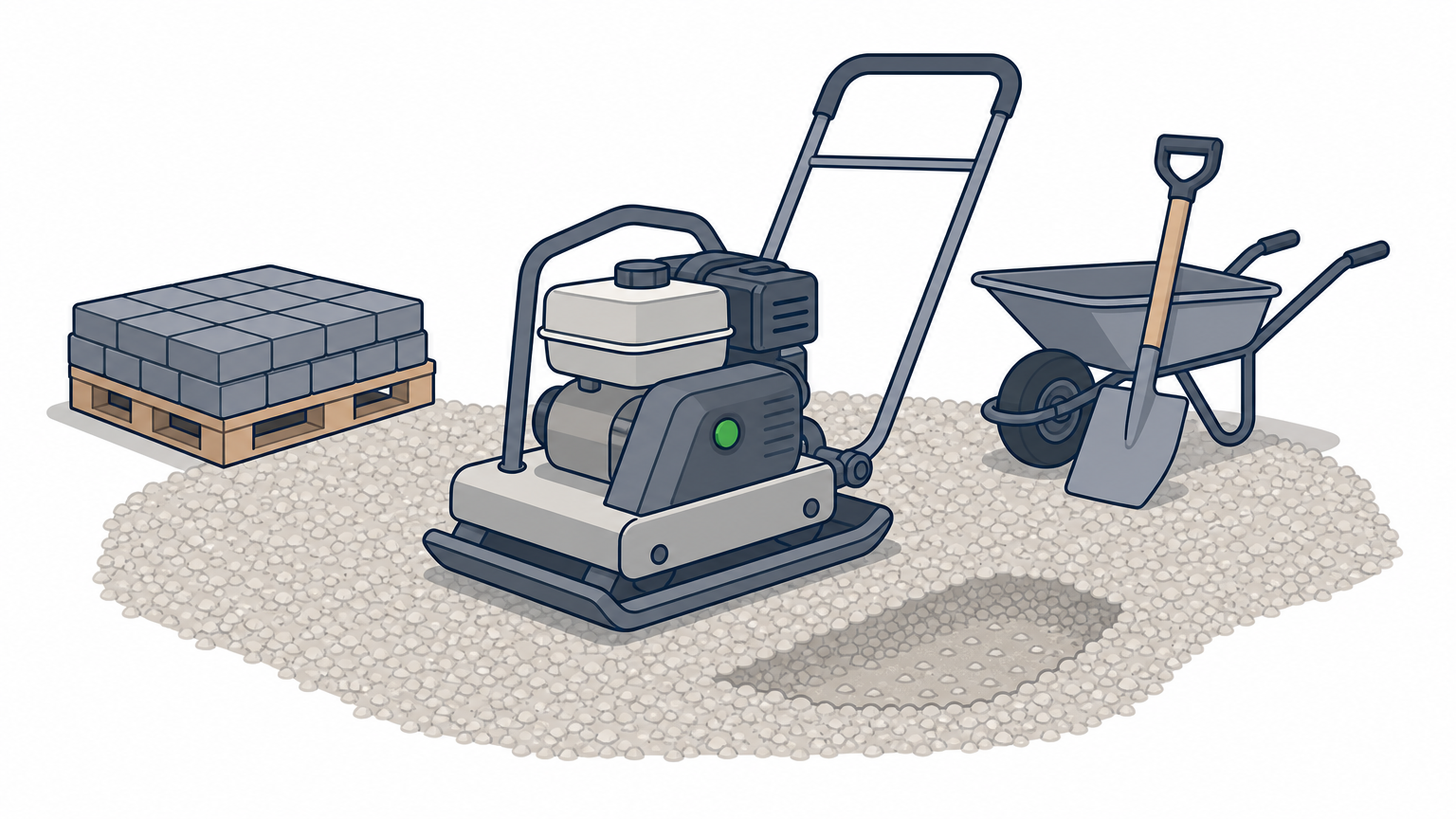
DIY makes sense for a small, flat patio away from the house, if you can rent equipment and handle physical work. Hire a pro when the site slopes, drainage is a concern, the patio ties into your home, or you want curves, patterns, or integrated features. If your materials alone are heading past $3,000, a contractor's warranty and experience usually justify the labor.
The money you save by laying pavers yourself is real, but a failed base can erase it.
Getting an accurate brick paver patio quote in Jupiter, FL
The national ranges give you a frame, but only a written, itemized quote tells you what your patio costs. Local conditions in Palm Beach County affect both the build and the number, so use them to judge each estimate.
How South Florida conditions affect the build
Much of coastal Palm Beach County sits on sandy soil with a shallow water table, and summer storms deliver heavy rain. That makes base compaction and drainage the priorities. A patio here should shed water away from the house without blocking any drainage swale on your lot. Joints filled with polymeric sand and sturdy edge restraints keep the sand and the border from washing out.
Salt air, strong sun, and humidity also shape upkeep, which we cover below. HOA rules are common in the communities around Jupiter, so check your approval requirements for materials, colors, and setbacks before you sign anything. Rainy season and hurricane season can also affect scheduling, so ask when the crew can realistically start.
What a good quote includes
Ask every contractor to quote the same specification so the bids compare cleanly. Look for these items in writing:
- Square footage and the per-foot price
- Paver brand, type, thickness, and color
- Base depth and the type of aggregate
- Edge restraints and the joint sand used
- Excavation, haul-off, and removal of any existing surface
- Drainage and grading work
- Permit handling and HOA paperwork, if needed
- License, insurance, and warranty terms
- Payment schedule and a start date
Gather at least three quotes. When the material and base are the same, differences between bids reflect labor, overhead, and how carefully each contractor scoped the job. A bid far below the others usually leaves something out, and the base is the usual suspect.
Ongoing costs to plan for
A paver patio is low maintenance, not no maintenance. Plan to sweep it regularly, wash it with mild soap and water, and top up joint sand as needed. Sealing every 2 to 3 years protects against stains and fading, which is a worthwhile expense in strong sun and humidity. Budget a small annual amount for this so the surface looks as good in year ten as it did on day one.
Ask for an itemized quote with the base specified, because the base is what separates a fair bid from a risky one.
What to take away before you call for estimates
For a professional job, the cost of brick paver patio work runs about $14 to $24 per square foot, with 20x20 patios typically landing between $5,600 and $9,600. Design, material, site conditions, and add-ons decide where you fall in that range. DIY saves the labor but puts the base, the most important part, in your hands.
Build your budget with the formula above, add a cushion, and compare itemized quotes for the same specification. If you want a clear number for your own yard, request a free estimate from Integrity Landscape and get a written quote for your Jupiter or Palm Beach County patio.