
Tree Removal Cost Near Me: What Twin Cities Homeowners Pay
Tree removal cost near me in the Twin Cities usually runs from a few hundred dollars for a small, easy tree to about $800 to $2,100 for a typical mature tree. Hazardous removals over homes or power lines can reach $5,000 or more. The final number depends on the tree's height, trunk diameter, distance from structures, condition, and what cleanup the quote includes.
A tree removal price is not a price for cutting. It bundles risk, labor, equipment, and disposal into one number. That is why two quotes for the same tree can differ by a thousand dollars, and why a bare "cost per tree" figure tells you very little.
Integrity Landscape runs tree service crews in Jupiter, FL, so we can't quote a Minnesota job. We do build removal estimates for a living, and the cost drivers are the same in St. Paul as in Palm Beach County. This guide pairs published Twin Cities figures with the way crews actually build a quote, so you can set a realistic budget before you call anyone.
Why local tree removal pricing matters for your budget
Local pricing matters because crews price site conditions, and Twin Cities conditions push costs above the national figure. National averages sit around $850, while Minneapolis runs roughly 5% higher because of tall older trees, tight urban lots, and a short working season . Budget from local numbers, not national ones.
What Twin Cities homeowners typically pay
Published ranges overlap but disagree at the top. One data set puts the normal Minneapolis range at about $210 to $2,100 , with an average near $790. A Minneapolis crew describes typical residential work as $800 to $5,000 and up . The gap comes from what each one counts. The lower figure includes small trees in open yards, and the higher one reflects mature trees near houses.
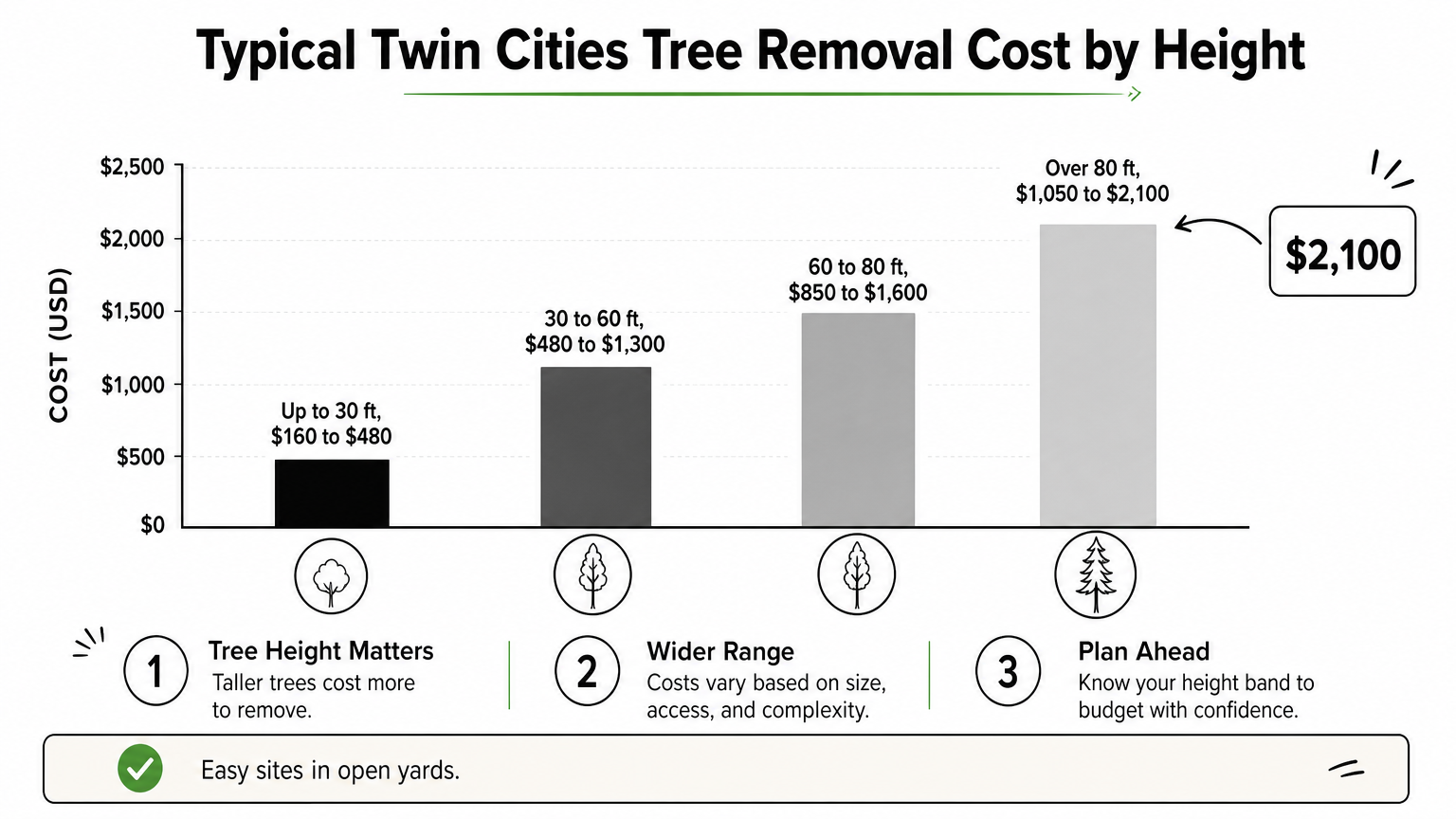
Use this table to place your tree:
| Tree height | Typical cost |
|---|---|
| Up to 30 feet | $160 to $480 |
| 30 to 60 feet | $480 to $1,300 |
| 60 to 80 feet | $850 to $1,600 |
| Over 80 feet | $1,050 to $2,100 |
Treat these as the floor for easy sites. A tree of the same height hanging over a roof costs far more than one in an open back yard.
Your tree's height gets you a ballpark, but its surroundings set the real price.
How prices compare across the metro
Prices do not change much from one suburb to the next. Access and tree size explain most of the differences you will see between St. Paul, Maplewood, Bloomington, and Eden Prairie. Maplewood sits in the east metro and follows the same size bands as neighboring St. Paul. Here is what has been reported around the area:
| Area | Reported figure | What it covers |
|---|---|---|
| Minneapolis | $210 to $2,100 (avg. about $790) | All tree sizes |
| St. Paul | $418 to $517 | Fixed fee, standing tree under 30 ft |
| Eden Prairie | $200 to $500 | Tree under 25 ft |
| Eden Prairie | About $1,500 | Tall tree, 75+ ft |
| Bloomington | $1,600 to $4,200 | Removal plus stump grinding |
| St. Paul (neighbor estimate) | $3,000 to $5,000 | Large, complicated tree |
The pattern is clear. Small trees cost hundreds, tall trees cost around $1,500, and complex or large trees cost several thousand dollars.
Why a national average misleads you
National ranges such as $385 to $1,070 blend sunny, open lots in warm states with cramped northern ones. Twin Cities crews also have fewer workable months . Cold weather runs from late fall into early spring, and demand bunches up in warm months. That lets contractors charge more in peak season.
How to estimate your tree removal cost
You can estimate your own cost by starting with a base price for the tree's size, then adding percentages for each complication. This is how many crews think about it, even when the final quote is a single number. A rough estimate before the first phone call also shows you quickly when a quote is out of line.
The factors that move the price
Six factors do most of the work. Check each against your tree:
- Height and trunk diameter. Taller, wider trees need more rigging, more cuts, and more time.
- Nearby structures. Trees over houses, garages, fences, or power lines need controlled lowering.
- Condition. Dead or storm-damaged wood is unpredictable, so crews slow down and price the risk.
- Access. Gates, slopes, and back yards that block a truck add labor hours.
- Crown complexity. Multi-trunk trees and heavy limb structures take more dismantling.
- Debris and stump. Hauling, chipping, and grinding are often priced separately.
A worked estimate you can copy
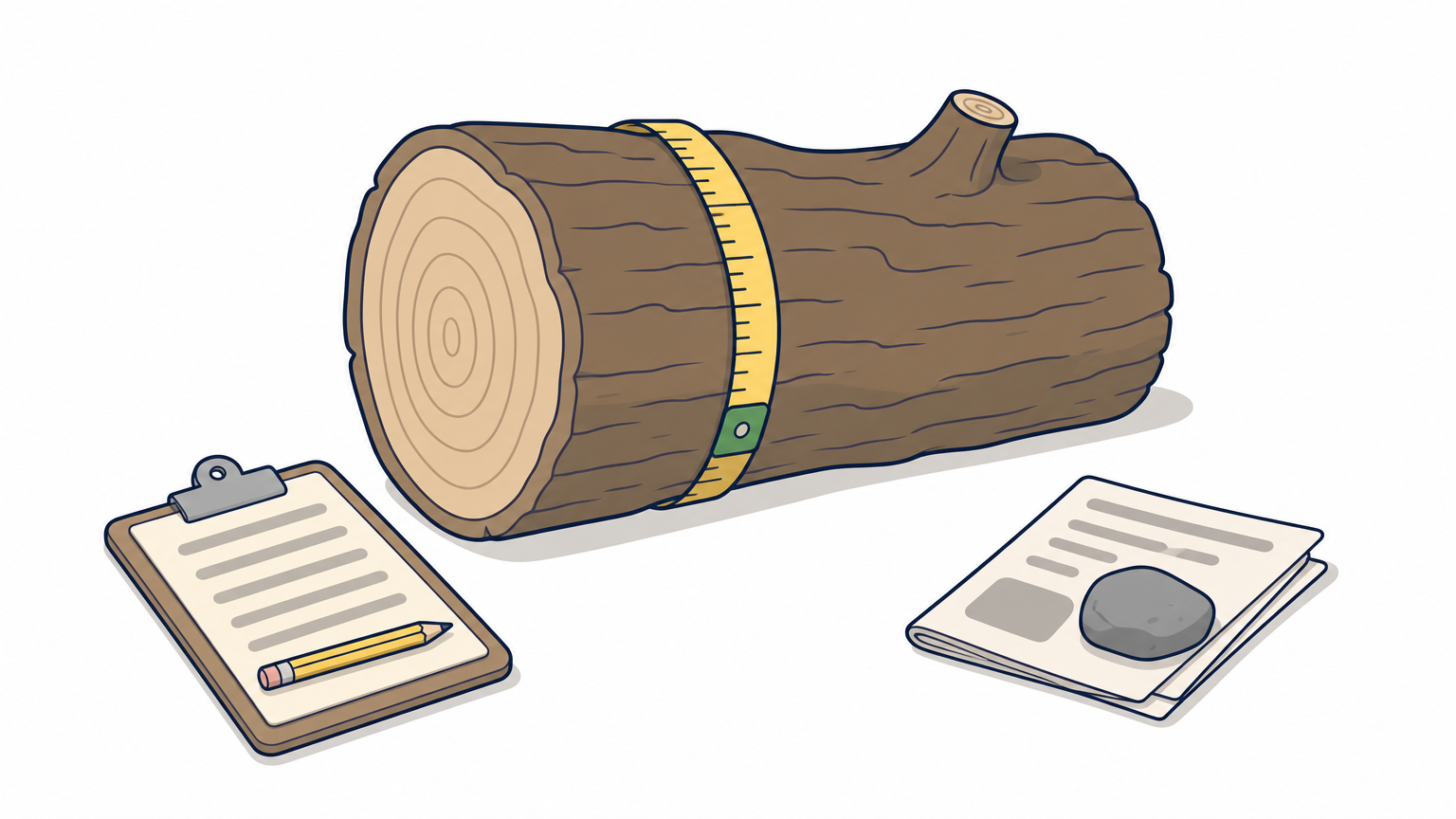
One Minneapolis-area crew shows how this adds up. The example starts with a base price of $850 for a 25 to 36 inch trunk. Then it adds percentages of that base. Disposal is a flat fee.
| Pricing factor | Impact |
|---|---|
| Base removal (25 to 36 in. trunk) | $850 |
| Tall height (40 to 60 ft) | +15% |
| Nearby structures | +25% |
| Dead or damaged tree | +10% |
| Access challenges | +10% |
| Multi-leader crown | +50% |
| Disposal and hauling | $300 |
| Estimated total | $2,085 |
To run your own numbers, use this formula:
 Estimate = base price + (base price x total adjustment %) + disposal
Example: 850 + (850 x 1.10) + 300 = 2,085
The percentages are one crew's example, not a standard rate card. Still, the method shows why a complicated tree lands at more than double its base price.
Cost per foot, per hour, and by height
Crews price by the job, not by the foot or the hour. As a sanity check, the size bands above work out to roughly $15 to $25 per foot for mid-size and tall trees. For a 40 or 50 foot tree, expect the 30 to 60 foot band of $480 to $1,300 . A 100 foot tree falls in the over-80 band of $1,050 to $2,100, and a crane adds about $530. Ask for a flat price. Hourly pricing hides how many people work and for how long.
Ask for a flat price per job, because per-hour and per-foot math only works as a rough check.
What extras add to a tree removal quote
Extras decide whether a quote is complete. Cutting the tree down is only part of a tree removal cost estimate, and cleanup, stump work, and equipment can each add $80 to several hundred dollars . Two bids that look 30% apart often differ only in what they include.
Hauling, chipping, firewood, and crane fees
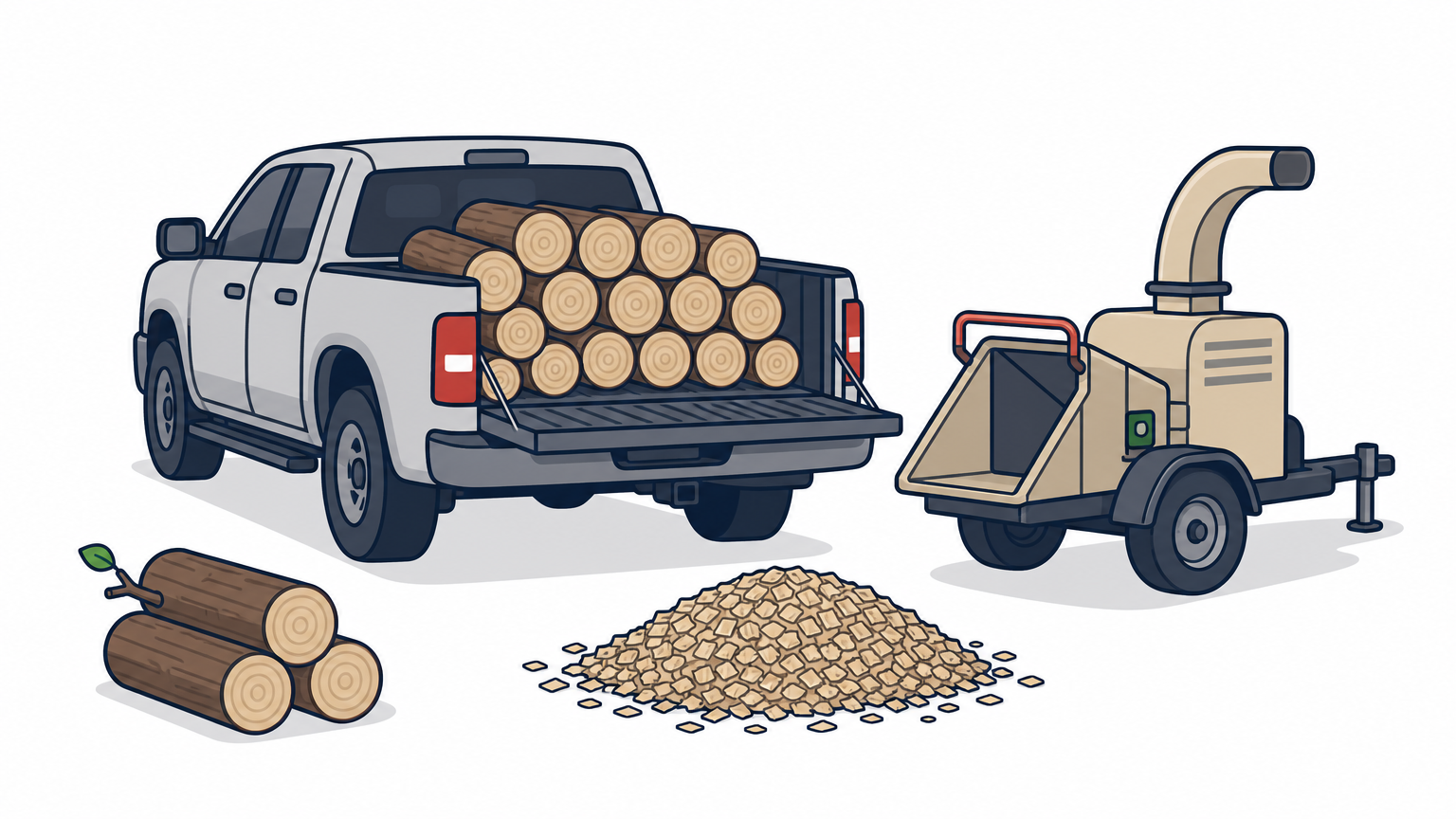
Here are the add-on costs for the work after the tree is on the ground:
| Add-on | Typical cost |
|---|---|
| Haul the tree away | About $80 |
| Run it through a chipper | About $100 |
| Split into firewood | About $80 |
| Crane with truck and extra crew | About $530 |
| Stump grinding | Often priced separately |
Stump grinding deserves its own line. One St. Paul price list shows about $3.58 to $3.85 per inch of stump diameter, so a 24 inch stump runs around $90 at that rate. Some crews quote a flat fee instead. Either way, confirm in writing whether the stump is part of the removal price.
Emergency and storm work
Emergency work costs more because crews drop other jobs and work in higher-risk conditions. A tree blocking a road or resting on a roof is priced for urgency. Large hazardous removals often run $5,000 to $15,000 or more . If the tree is stable and not threatening anything, wait for a normal appointment. If it is dangerous, safety comes first. Call your insurance company too, because storm damage may be covered.
Permits and city-owned trees
Check who owns the tree before you hire anyone. Boulevard trees between the sidewalk and the street often belong to the city, and cities can set rules for removing trees on private property too. A reputable crew will know your city's requirements. Taking this step early prevents delays and fines, and the cost of tree removal is not worth risking over a permit.
How to get quotes and lower the tree removal bill
Get at least three itemized written quotes, compare them line by line, and schedule the work outside peak season. These steps usually save more than any single trick. They also protect you from the real risks, which are uninsured crews and unclear scopes.
What to ask for in every quote
A good quote answers these questions before you ask:
- Does the price include hauling away the wood and cleaning up debris?
- Is stump grinding included, or priced separately?
- Does the company carry liability insurance and workers' compensation? Ask for proof.
- What happens if the tree damages your property?
- What is the date, and what is the weather-delay policy?
- Is the price fixed, or does it change if the job takes longer?
Ways to cut the cost
Timing is your biggest lever. Late winter, around February or March , is the dormant season, and crews are typically less busy. Peak summer and fall demand raise prices. You can also keep the wood for firewood, skip the stump grinding if you plan to replant elsewhere, and combine several trees into one visit. A crew that is already on site spreads its setup cost.
Free removal is rare. Some crews will take a tree with valuable lumber in exchange for the wood, but that applies to few trees. Free estimates are standard, and a cheap, fast offer often means skipped insurance.
Why the lowest bid can cost more
An extremely low bid usually means something was cut, such as insurance, equipment, or cleanup. If an uninsured worker is hurt or a limb hits your house, you may be left paying. A fair bid is one close to the others, with a clear scope and proof of coverage.
The lowest bid is only cheaper if the crew is insured and the scope matches the others.
Plan with ranges, then confirm with quotes
Tree removal pricing follows predictable rules. Size sets the base, proximity to buildings and tree condition add to it, and stumps, debris, cranes, and urgency come on top. In the Twin Cities, most homeowners should plan for a few hundred dollars for small trees and $800 to $2,100 for mature ones. Plan for several thousand dollars if the tree is large, damaged, or leaning over your home.
Use the formula in this guide to check your estimate, then collect three itemized quotes. If your property is in Jupiter or elsewhere in Palm Beach County, request a free estimate from Integrity Landscape and we will price your tree the same transparent way.