
Cost of Emergency Tree Removal: What You'll Pay and Why
The cost of emergency tree removal usually runs from about $300 for a small tree to $5,000 or more for a large one over a structure, and most storm jobs land between $1,000 and $3,000. Emergency tree removal means taking down a fallen or failing tree that threatens people, a roof, a driveway, or a power line. The crew has to work on your schedule instead of theirs, and that urgency is what you pay extra for.
This article explains why emergency jobs cost more than scheduled ones, how to estimate your own number from tree height and site conditions, and what pushes a quote higher. It also covers how homeowners insurance treats the bill, including the Florida windstorm deductible that catches many owners off guard.
Integrity Landscape handles tree removal, crane lifts, and stump grinding for homeowners in Jupiter and across Palm Beach County. The examples below reflect what property owners here face after tropical storms and summer squalls.
Why emergency tree removal costs more than a scheduled job
Emergency removal costs more because you pay for speed, risk, and equipment at once. Published guides put the emergency premium at roughly 25% to 100% above a scheduled job, and some quote it as $100 to $250 an hour on top of normal rates.
What counts as an emergency
A removal is an emergency when the tree is an immediate danger to people or property . That includes a tree on a house, pool enclosure, or car, a tree blocking your driveway or the only way out, a leaning tree with freshly lifted roots, and hanging limbs over a walkway or power line.
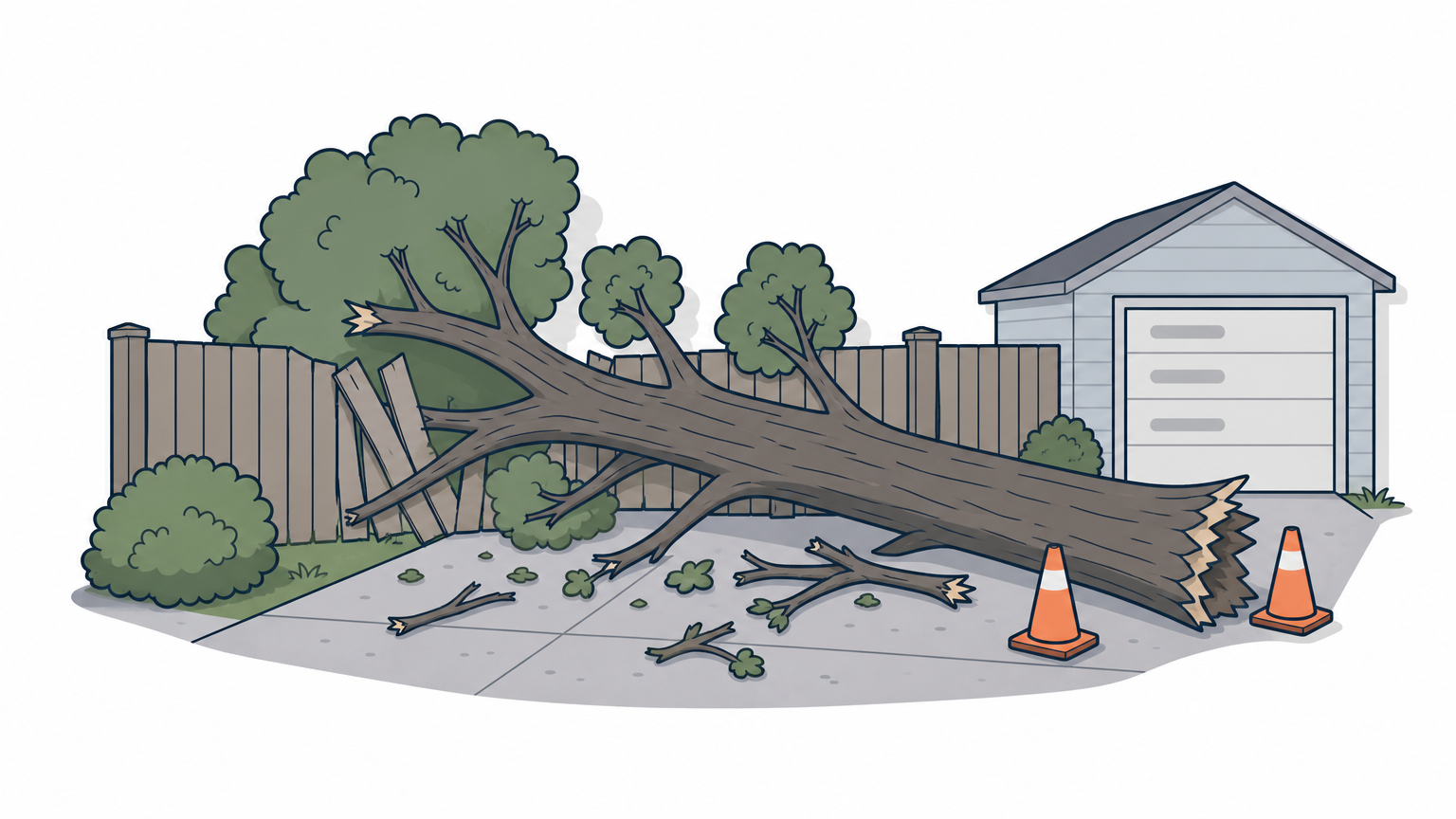
A tree that fell across an open lawn and touched nothing is different. It looks urgent, but it can usually wait a few days for a regular slot, and waiting is the cheapest way to cut the bill .
Where the premium comes from
Crews that take an emergency call rearrange scheduled jobs, pay overtime for nights and weekends, and send more people and heavier equipment. They also work in worse conditions, such as wet ground, wind, and debris hiding the real shape of the damage. A tree under tension can snap back when cut, so the work is slower and more careful.
You are not paying for the cutting. You are paying for a crew that drops everything to deal with a hazard.
How to estimate your emergency tree removal cost
Start with the tree's height, then adjust for what it landed on and how hard it is to reach. Height drives labor time, equipment, and the volume of wood to haul away.
Start with a price range by height
The ranges below reflect typical published emergency figures. Your quote will vary with access and local rates, so treat them as a budgeting floor and ceiling.
| Tree height | Typical emergency price | Notes |
|---|---|---|
| Under 30 ft | $300 to $800 | A 30-ft tree sits at the top of this row |
| 30 to 60 ft | $800 to $1,800 | A 40 or 50-ft tree falls here |
| 60 to 80 ft | $1,500 to $3,000 | Often needs a bigger crew and a loader |
| 80 ft and up | $2,000 to $5,000+ | A 100-ft tree usually needs a crane |
Those ranges are consistent with national averages. One widely cited guide puts the average emergency job near $3,000, with a low around $1,475 and a high around $4,500.
Work through an example
Say a storm drops a 45-foot tree across your driveway and fence. A scheduled removal of that tree might cost about $900. At a 25% premium, the emergency price is $1,125 . At a 100% premium, it is $1,800 . That matches the 30 to 60-foot row, so budget $1,100 to $1,800 before extras like stump grinding.
Get a written quote fast
Send the crew a photo and four facts: approximate height , trunk thickness, what the tree is touching, and how wide the access path is. Ask what the price includes, specifically cutting, hauling, and stump work. At Integrity Landscape you can text a picture to (561) 401-8980 for a same-day quote, and next-day service is available.
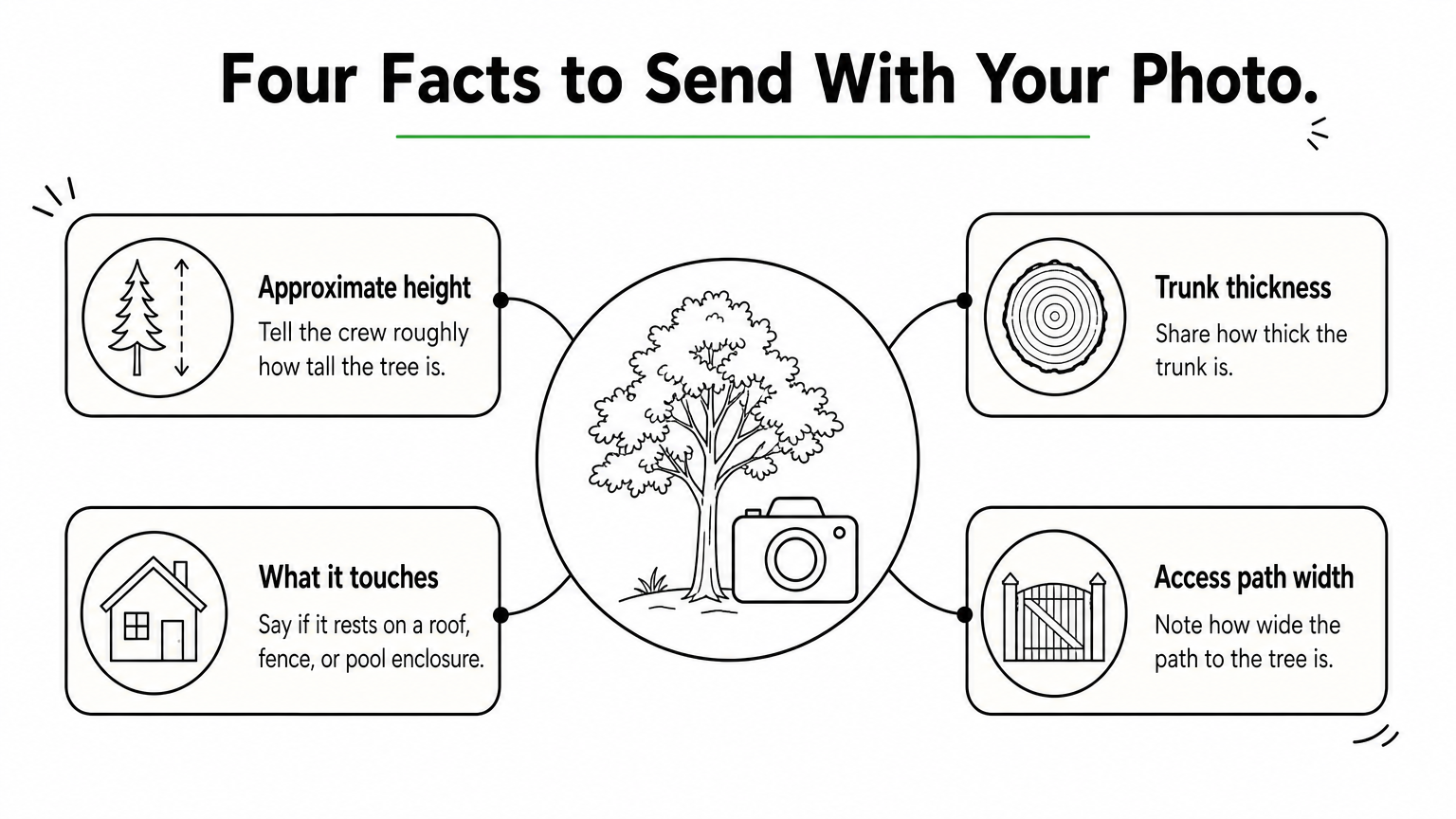
Height sets the base price. Damage and access decide how far above it you land.
What pushes an emergency quote higher
Three things move an emergency quote most: whether the tree is on a structure, whether a crane is needed, and what you add on top of the removal itself.
Structures, power lines, and cranes
A tree resting on a roof, pool enclosure, or fence needs precision rigging . Crews cut and lower sections piece by piece to avoid more damage, which takes far more time than felling a tree in open ground. Structural jobs are commonly priced at two to three times a yard-only removal.
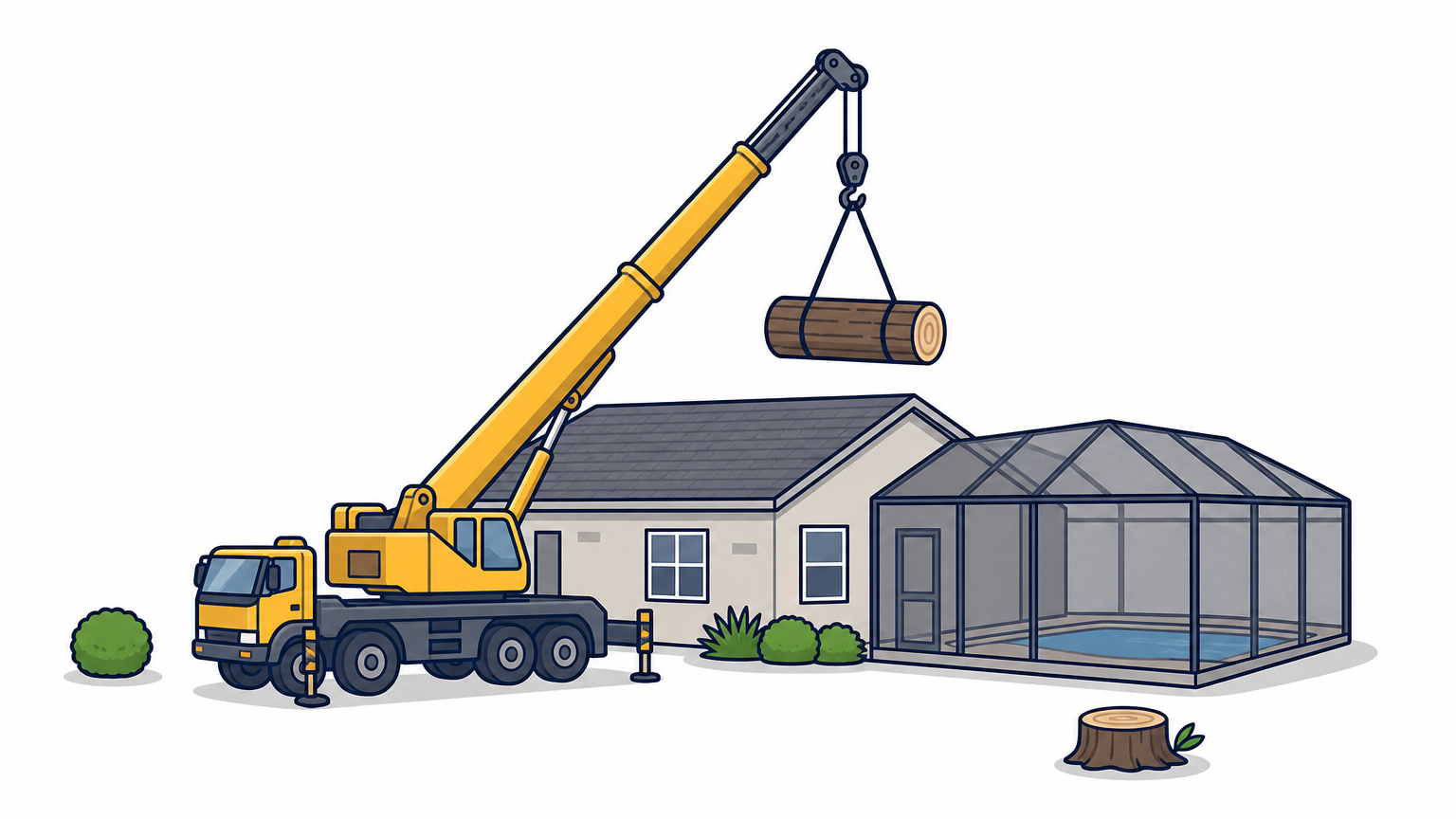
When the tree is too large or too close to a house to rig by hand, a crane lifts sections over roofs and pool cages. A crane adds a hard equipment cost, but it often saves money on tight Jupiter lots by preventing a second round of repairs. Integrity Landscape offers crane support for exactly this kind of job.
If a tree touches a power line, stay back and call 911 and your utility. No crew should cut near an energized line until the utility has cleared it.
Extras that appear on the bill
Many quotes cover only the tree itself. These items are often separate:
- Stump grinding , priced by stump size and access
- Debris and wood hauling , priced by volume
- Cutting wood into logs if you want to keep it
- Permits or notices , if your city requires them for the removal
Ask for each item as its own line so you can compare quotes fairly. If you want the stump gone too, grinding it in the same visit usually costs less than a second trip.
A low emergency quote that leaves out hauling and stumps is not low. It is incomplete.
Does homeowners insurance cover emergency tree removal?
Sometimes. Insurance usually pays when a covered storm brings the tree down onto an insured structure , such as your house, garage, or fence, or when it blocks your driveway. It usually does not pay when a tree falls without hitting anything, or when it was dead or diseased beforehand.
Caps and deductibles in Florida
Removal coverage is often capped at about $500 to $1,000 per tree , with an overall limit near $1,500 per claim. On a $3,000 removal, that leaves you roughly $2,000 to $2,500 to cover yourself.
Florida adds a second hurdle. Many policies carry a separate hurricane deductible, set as a percentage of your dwelling coverage, commonly 2% to 5%. At 2% on a home insured for $500,000, the deductible is $10,000 . A $3,000 tree removal alone will not clear it. A flat deductible of $1,000 is a very different situation, so read your declarations page before storm season, which runs June through November.
What to do before the crew starts
Take photos of the tree, the damage, and the surrounding area before anything moves. Cover exposed roofing or openings to prevent further damage, and keep every receipt. Call your insurer before major cleanup if you can, and ask what your policy says about tree removal and debris.
If insurance does not pay
Ask your crew about payment options. Some cities and counties run assistance programs for hazardous trees, including help for seniors or low-income owners, so check with local government. Pruning and inspecting trees before storm season is the cheapest protection against an emergency bill.
Check your deductible type and removal cap now, because the policy decides what you will actually recover.
Plan for the number before the storm
Emergency tree removal costs more because speed, risk, and heavy equipment arrive together. Most storm jobs run $1,000 to $3,000, small trees cost less, and structural or crane jobs cost more. Insurance helps only when a covered event hits a structure, and Florida deductibles often swallow the claim.
If a tree is down or leaning on your property, send photos and get a written, itemized quote. Get a same-day quote from Integrity Landscape and find out what removal, crane support, and stump grinding will cost before you commit.