15 Landscape Design Ideas to Inspire Your Yard
You know your yard has potential, but staring at a blank patch of grass or an overgrown flower bed doesn't tell you what to actually do with it. Every homeowner in Jupiter and along the Palm Beach coast hits this wall at some point: too many Pinterest boards, not enough clarity on what fits your lot, your climate, and your budget. Finding the right design landscape ideas starts with seeing real examples that work in South Florida conditions, not generic inspiration pulled from a cooler climate.
That's exactly what this list delivers. We've pulled together 15 landscape design ideas that range from low-maintenance native plantings to full hardscape overhauls with pavers, fire features, and synthetic turf. Each one is grounded in what actually thrives here, sandy soil, salt air, and intense sun included.
Whether you're planning a weekend refresh or a complete home landscape design overhaul, you'll find concepts here you can hand straight to a contractor. As a company that's built patios, installed turf, and designed full yards across Jupiter and Palm Beach County for over a decade, we've seen which ideas hold up and which ones look great for a season and fade. Read on for the ones worth your investment.
1. Work with a professional landscape designer
Before you pick plants or patio patterns, the smartest move is bringing in someone who can see the whole property at once. A professional handles the parts homeowners usually get wrong: drainage, sun exposure across seasons, root systems near foundations, and how hardscape and softscape actually fit together. This is less an "idea" than a decision that shapes every other idea on this list, and it's why we lead with it.
What it looks like
A real landscape design process starts with a site visit, not a catalog. The designer walks your lot, notes where water pools after rain, checks soil type, and asks how you actually use the space, whether that's hosting family on weekends or just wanting a yard that looks sharp from the street. From there you get a layout: a scaled plan showing plant beds, hardscape zones, lighting runs, and irrigation, often with a 3D rendering so you're not guessing what it'll look like in two years.
A good designer saves you more money in avoided mistakes than the design fee ever costs.
Best for
This approach suits homeowners tackling a home landscape design overhaul rather than a single flower bed swap. It's the right call if you're combining multiple projects, say a paver patio, new plant beds, and lighting, into one cohesive plan instead of three disconnected purchases. Commercial properties and HOAs also benefit here, since a unified design plan for offices, retail centers, and large properties keeps everything looking consistent as different sections get updated over time.
Key plants and materials
A designer's real value is matching plants and materials to your specific microclimate rather than a generic Florida plant list. Expect selections based on your soil pH, salt exposure if you're near the coast, and how much shade your mature trees actually cast. Materials get chosen the same way: paver types rated for South Florida heat and rain, edging that won't heave in sandy soil, and sprinkler and drip irrigation zones sized to plant water needs instead of one blanket schedule.
Maintenance and cost considerations
Design fees vary by scope, but a full residential plan typically runs a few hundred to a couple thousand dollars, which usually gets credited toward installation if you hire the same company to build it. At Integrity Landscape, every custom yard design and build project gets a dedicated project manager overseeing design through installation, so nothing gets lost between the drawing and the dirt. That upfront investment cuts long-term maintenance costs too, since a well-planned yard needs fewer corrections down the road.
2. Create a tropical Florida garden
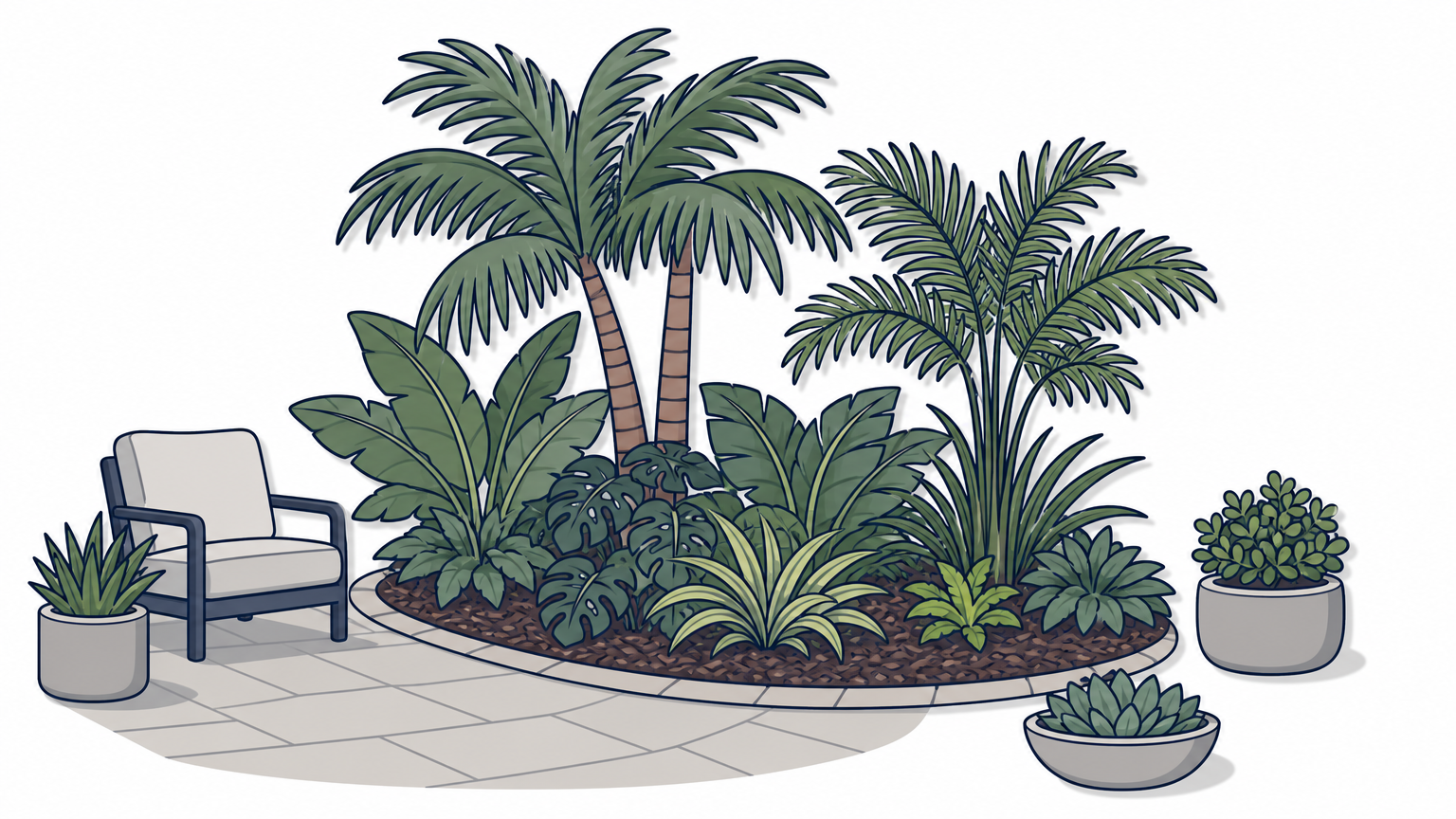
Nothing says you live in Jupiter quite like a yard that leans into the climate instead of fighting it. A tropical Florida garden turns humidity, heat, and bright sun into an asset, layering broad leaves, bold color, and lush texture that a temperate-climate yard simply can't replicate. This is one of the most popular landscape garden design ideas for coastal Palm Beach County properties because it works with what the land already gives you.
What it looks like
Picture layered plantings with varying heights, tall canopy trees, mid-height palms, and dense groundcover, arranged to create depth rather than a flat row of shrubs along the foundation. Curved bed lines replace straight edges, and color comes from foliage as much as flowers, deep greens against variegated leaves and the occasional burst of red or orange from hibiscus or bird of paradise.
A tropical garden should feel like it grew there naturally, not like it was installed last Tuesday.
Best for
Homeowners who want their yard to read as distinctly South Florida, rather than a generic suburban lawn, gravitate toward this style. It also suits properties near the water on Jupiter Island or Singer Island, where salt tolerance matters as much as looks.
Key plants and materials
Go-to choices include queen and pygmy date palms, ti plants, crotons, philodendron, and travelers palms for structure, backed by mulch beds instead of turf in shaded corners.
Maintenance and cost considerations
Expect moderate upkeep: seasonal pruning, mulch refreshes, and irrigation tuned to each plant's water needs rather than one blanket schedule keeps this look thriving year-round.
3. Add a Mediterranean-inspired landscape
Swap the lush jungle look for something drier and more architectural, and you land on Mediterranean style. This approach borrows from Spain, Italy, and coastal Greece, leaning on stucco, terracotta, and silvery foliage instead of broad tropical leaves. It's one of the more distinctive garden landscape design ideas for Jupiter properties, especially those with Spanish-influenced architecture already in place.
What it looks like
Think gravel or decomposed granite paths, terra cotta pots grouped near entryways, and low stone walls dividing planting beds. Olive trees or similar silver-leafed specimens anchor the layout, while a fountain or simple tiled water feature often becomes the focal point.
Mediterranean design works because it pairs dry-climate plants with formal structure, not because it copies a tropical palette.
Best for
This style fits homes with Spanish, Tuscan, or Mission-style architecture, where the landscaping should echo the building rather than contrast it. It also appeals to homeowners tired of constant tropical pruning and wanting a landscape design and ideas approach with a drier, more structured feel.
Key plants and materials
Common choices include:
- Olive trees and Italian cypress for vertical structure
- Rosemary, lavender, and santolina for fragrant groundcover
- Bougainvillea trained along walls or arbors
- Terracotta pavers or gravel instead of turf
- Stucco or stone accent walls
Maintenance and cost considerations
Once established, Mediterranean plantings tolerate Florida's dry stretches better than lush tropical beds, cutting irrigation needs. Expect occasional pruning to keep shapes tight, plus periodic gravel or mulch top-offs, but overall upkeep runs lower than a full tropical garden.
4. Design a low-maintenance, drought-tolerant yard
Some homeowners just want their weekends back. A drought-tolerant yard trims irrigation, mowing, and fertilizing down to the essentials while still looking intentional, not neglected. Among landscape design ideas , this one saves the most water and time over a ten-year span, which matters as Florida water restrictions tighten in dry season.
What it looks like
Turf shrinks to a small accent area or disappears entirely, replaced by mulched beds, drought-tolerant groundcover, and gravel pathways. Plant groupings cluster by water need, so you're not running irrigation to a whole yard just to keep one thirsty section alive.
The less turf you fight to keep alive, the more yard you actually get to enjoy.
Best for
This suits homeowners tired of weekly mowing bills or anyone managing a home landscape design on a rental or second property where upkeep visits are infrequent. It also works well for HOAs looking to cut common-area maintenance costs without sacrificing curb appeal.
Key plants and materials
Reliable choices for Palm Beach County include:
- Muhly grass and fountain grass for texture without heavy watering
- Coontie and dwarf yaupon holly for structure
- Succulents and agave in sunny beds
- Mulch or gravel instead of turf in low-traffic zones
- Drip irrigation on a separate zone from any remaining grass
Maintenance and cost considerations
Upfront installation can cost more than sod alone, since you're paying for mulch, edging, and targeted irrigation. But according to the EPA's WaterSense program, landscaping that reduces turf can cut outdoor water use significantly, which shows up directly in your utility bill within the first year.
5. Build a resort-style pool landscape
Your pool deserves better than a plain concrete slab and a chain-link fence. A resort-style pool landscape wraps the water in plantings, stone, and shade structures so the whole backyard feels like a vacation instead of a utility area. Of all the landscape ideas and design approaches on this list, this one delivers the biggest jump in how often a family actually uses their backyard.
What it looks like
Expect a paver or travertine deck instead of plain concrete, layered tropical plantings screening the pool cage or fence line, and shade structures like a tiki hut or pergola positioned near the loungers. Lighting tucked into planting beds extends use into the evening, and a raised spa or sun shelf often anchors one end.
A pool surrounded by bare concrete and a fence looks like a chore. A pool surrounded by plantings and stone looks like a getaway.
Best for
Homeowners who already have a pool but never quite finished the surrounding yard are the best fit here, and a pool deck and surround upgrade is usually where that work starts. It also suits families entertaining regularly, since the added seating and shade turn the pool deck into real living space rather than just a place to swim laps.
Key plants and materials
Common choices include:
- Traveler's palms and clusia hedges for privacy screening
- Bromeliads and crotons tucked into deck-edge planters
- Travertine or brushed paver decking that stays cooler underfoot
- Pergolas or tiki structures for shade
Maintenance and cost considerations
Plan for regular pruning near the pool edge so debris doesn't end up in the water, plus periodic pressure washing to keep pavers from staining. Costs scale with deck size and material choice, but the payoff shows up in resale value as much as daily enjoyment.
6. Add a paver patio or walkway
A cracked concrete slab or a patchy grass path does nothing for a yard, no matter how good the plantings around it look. Swapping either for pavers is one of the most practical landscape design ideas on this list because it solves a functional problem (mud, cracks, uneven footing) while instantly upgrading the look of the whole property.
What it looks like
Pavers come in dozens of patterns, herringbone, running bond, basketweave, and colors that range from warm tan to charcoal gray. Most Jupiter homeowners choose a walkway that curves gently from driveway to front door, paired with a patio extension off the back for seating or a grill station. Border edging in a contrasting paver color helps define the space without needing a separate retaining wall build.
A well-laid paver patio outlasts concrete and looks better doing it.
Best for
This fits nearly every property type, from a modest front walkway refresh to a full commercial entrance for an HOA clubhouse. It's especially valuable for homeowners dealing with standing water or erosion along a dirt path, since proper base prep solves drainage that grass never could.
Key plants and materials
Common material choices for full landscape construction with pavers include concrete pavers, travertine, and clay brick, each set over a compacted gravel base with polymeric sand locking the joints. Low border plantings like dwarf firebush or liriope soften the paver edges without overtaking the walking surface.
Maintenance and cost considerations
Expect occasional resanding of joints and periodic sealing to prevent staining, but otherwise upkeep is minimal compared to concrete, which cracks under Florida's freeze-thaw swings and heat expansion. Costs vary by material and square footage, though pavers typically pay for themselves through durability and resale appeal.
7. Create an outdoor living room with a fire pit
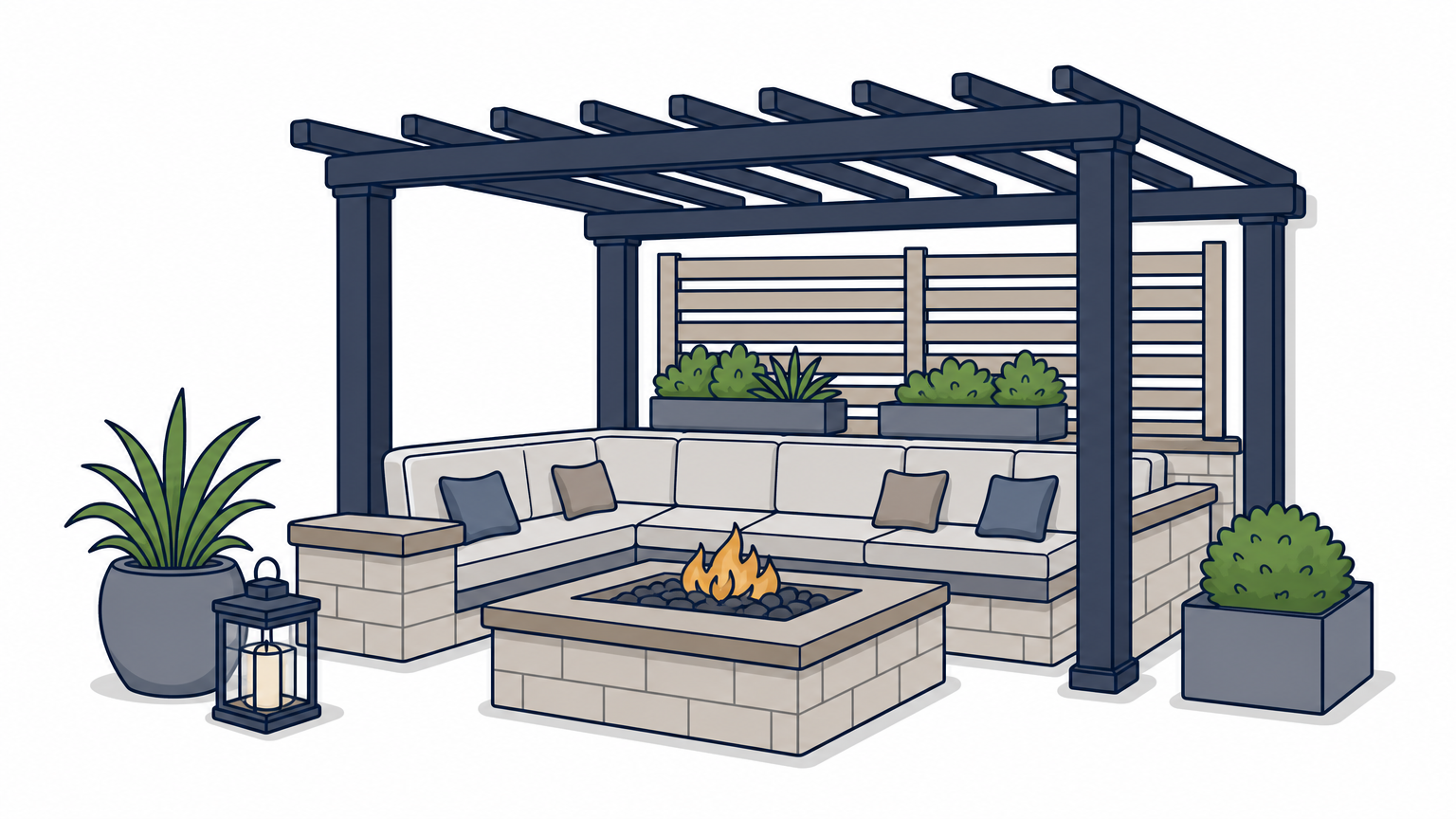
Jupiter evenings cool off just enough to make outdoor seating worth it most of the year, so why let your patio sit empty after sunset? An outdoor living room built around a fire pit turns unused backyard square footage into the spot where everyone actually gathers. Among landscaping ideas landscape design enthusiasts request most often, this one consistently ranks as the highest-use addition once it's built.
What it looks like
Expect a defined seating area, built-in bench seating or a cluster of outdoor sofas, arranged around a gas or wood-burning fire pit set into a paver or travertine surface. Overhead, a pergola or shade sail often frames the space, and an outdoor rug or distinct paving pattern marks the boundary so the area reads as a room rather than a leftover patch of yard.
A fire pit doesn't just add heat, it gives people a reason to stay outside after dark.
Best for
Families who entertain regularly get the most mileage from this setup, since it extends usable hours well past dinner. It also suits homeowners without a pool who still want a dedicated outdoor gathering space, giving the backyard a clear purpose instead of just open lawn.
Key plants and materials
Common builds include a gas fire pit with a paver or coquina shell surround, weather-resistant furniture, and low plantings like dwarf firebush or clusia screening the perimeter for privacy without blocking the view of the fire.
Maintenance and cost considerations
Gas fire pits need occasional line inspection, while wood-burning versions require ash cleanup after each use. Costs depend heavily on whether you run a new gas line, so budget for that early in planning rather than as an afterthought.
8. Add a water feature
Silence isn't always what you want in a backyard. The right water feature masks street noise, adds movement to an otherwise static bed, and gives birds and dragonflies a reason to stick around. Of all the landscape design ideas on this list, a water feature does the most to change how a yard sounds, not just how it looks.
What it looks like
Options range from a small bubbling urn tucked into a foundation bed to a full pondless waterfall built into a raised berm near the patio. Some homeowners choose a formal reflecting pool with a single spillway, while others prefer a stacked-stone waterfall that feeds a hidden basin, recirculating water without the mosquito risk of standing ponds.
A water feature earns its keep by covering the noise you don't want with the sound you do.
Best for
This fits properties near busy roads in Jupiter where traffic noise carries into the backyard, and it also suits homeowners who want a focal point for a garden bed that otherwise reads as flat. Anyone drawn to garden and landscape design ideas centered on relaxation, rather than entertaining, tends to gravitate here first.
Key plants and materials
Common builds pair natural stone or precast basalt columns with a submersible pump, moisture-loving plants like dwarf papyrus or canna lilies at the edges, and river rock hiding the plumbing.
Maintenance and cost considerations
Budget for periodic pump cleaning, algae control, and occasional water top-offs during dry stretches, plus a winter check before storm season since debris clogs pumps fast in Florida's summer rains.
9. Design with landscape lighting
A yard that looks great at noon but disappears at dusk is only half finished. Landscape lighting stretches your outdoor living hours into the evening and adds a layer of security most homeowners underestimate until a delivery driver trips over a step they couldn't see. Among design ideas landscape professionals recommend most, lighting delivers the biggest visual payoff for the smallest footprint of work.
What it looks like
Well-placed lighting combines several layers rather than one flood light bolted to the eave. Path lights guide feet along walkways, uplights wash palm trunks and architectural columns from below, and moonlighting fixtures mounted high in oak canopies scatter dappled light across the lawn like real moonlight.
Good landscape lighting makes a yard feel finished after dark, not just lit up.
Best for
Homeowners who entertain in the evening or simply want their property to feel secure after sunset benefit most here. It also suits anyone whose landscape ideas and design plan already includes a patio, pool, or fire pit, since lighting ties those separate features into one cohesive nighttime layout instead of isolated bright spots.
Key plants and materials
Most systems run on low-voltage LED pathway and accent lighting wired to a transformer, with brass or copper housings holding up best against Jupiter's salt air compared to plastic alternatives. Uplights typically target palms, oaks, and architectural corners, while path lights space every six to eight feet along walkways.
Maintenance and cost considerations
LED fixtures last years with minimal upkeep beyond an occasional lens cleaning and bulb swap. Budget for periodic transformer checks each spring, since a single failed connection can knock out an entire lighting zone.
10. Plant for privacy with hedges and trees
Close neighbors and busy roads make privacy one of the top requests we get from Jupiter homeowners. Living screens solve this without the cold, boxed-in feel of a PVC, wood, or aluminum privacy fence, and they double as a windbreak during storm season. This is one of the landscape design ideas that pays off twice, once for privacy and once for curb appeal.
What it looks like
Expect a layered screen rather than a single row of shrubs along the property line. Taller canopy trees anchor the back, mid-height hedges fill the middle, and a lower flowering layer softens the front edge so the whole planting reads as intentional rather than a green wall.
A privacy hedge should block the view of your neighbor's window, not the sky above it.
Best for
This fits homeowners on tight lots in neighborhoods like Abacoa or Jupiter Farms, where side yards sit close to the next house. It also suits anyone bordering a busy road who wants a garden landscape design that muffles noise along with sightlines.
Key plants and materials
Reliable choices for South Florida screening include:
- Clusia or podocarpus for a dense, fast-growing hedge
- Green buttonwood or live oak for canopy height
- Viburnum or ligustrum for a tighter, formal edge
- Silver buttonwood as a salt-tolerant coastal option
Maintenance and cost considerations
Fast growers like clusia need trimming two to three times a year to hold their shape, while slower canopy trees need little beyond occasional structural tree pruning. Costs scale with plant size at installation, since mature hedges cost more upfront but deliver privacy immediately instead of after several growing seasons.
11. Grow a native, pollinator-friendly garden
More homeowners are asking us for yards that do more than look nice, they want beds that actually support local birds, butterflies, and bees. A native, pollinator-friendly garden swaps ornamental imports for species that evolved alongside Florida's soil and rainfall patterns, which means less babying and more life buzzing through your beds. It's one of the more meaningful landscape gardening design ideas for anyone tired of spraying pesticides just to keep imported plants alive.
What it looks like
Beds mix wildflowers, native grasses, and flowering shrubs in loose, naturalistic drifts rather than tidy rows. Milkweed and coneflower patches draw monarchs and swallowtails, while a shallow birdbath or brush pile gives smaller wildlife somewhere to shelter.
Plant what already belongs here, and the wildlife shows up on its own.
Best for
This suits homeowners who want a garden landscape design ideas approach rooted in sustainability rather than pure aesthetics, plus anyone in an HOA with rules favoring naturalized, low-water plantings. Families with kids also gravitate here, since watching butterflies land in your own yard beats any store-bought bird feeder.
Key plants and materials
Strong native picks for Palm Beach County include:
- Milkweed and blanket flower for pollinator draw
- Beautyberry and firebush for berries birds rely on
- Muhly grass for texture and erosion control
- Coontie as a larval host for the rare atala butterfly
Maintenance and cost considerations
Once established, native beds need little beyond seasonal deadheading and minimal irrigation, since these plants survive on rainfall alone most of the year. Installation costs run comparable to standard ornamental beds, but water and fertilizer savings add up fast over a few seasons.
12. Try a formal, symmetrical garden design
Some homeowners want a yard that looks deliberate the moment you pull into the driveway, and nothing signals that faster than symmetry. A formal, symmetrical garden design mirrors elements on either side of a central axis, so the whole property reads as balanced and intentional. Among landscape design garden ideas , this one photographs the best because the eye instantly recognizes order.
What it looks like
Picture a straight center path leading to the front door, flanked by matching planting beds, matching urns, and identically trimmed hedges on each side. Boxwood or podocarpus gets clipped into clean geometric shapes, and any focal point, a fountain, statue, or specimen tree, sits dead center rather than off to one side.
Symmetry works because your eye stops hunting for what belongs where.
Best for
This style suits homeowners with classical or colonial-style architecture, where a mirrored layout echoes the lines of the house itself. It also fits anyone who wants their ideas for garden landscape design to feel formal and polished rather than casual, particularly on properties with a prominent front entrance that deserves the attention.
Key plants and materials
Common choices include boxwood, podocarpus, or dwarf yaupon holly clipped into matching shapes, paired with matching topiary or standard trees flanking an entry. Straight paver or brick pathways reinforce the central axis better than curved stone.
Maintenance and cost considerations
Formal hedges demand frequent, precise trimming, often monthly during growing season, since any asymmetry stands out immediately. Budget for regular maintenance visits rather than seasonal check-ins, since this look only works when both sides stay perfectly matched.
13. Add a rock or gravel garden
Some yards fight too many battles at once: patchy turf under oak canopy, standing water after every storm, or a side yard nobody bothers mowing. A rock or gravel garden turns that trouble spot into a deliberate feature instead of a problem you keep ignoring. It's one of the more underused landscape design ideas in Jupiter, mostly because homeowners assume gravel means a barren yard rather than a textured, dry garden.
What it looks like
Expect a layered bed of crushed shell, river rock, or decomposed granite set around boulders and drought-tough plantings, often replacing turf entirely in shaded or drainage-poor areas. Edging in steel or paver strips keeps the gravel contained, and a dry creek bed design doubles as functional drainage during Florida's summer downpours.
A gravel garden solves drainage problems that grass never could, while looking better doing it.
Best for
This suits homeowners battling deep shade under live oaks where grass thins out no matter what, and anyone dealing with a low spot that pools water after every storm. It also fits xeriscape-minded owners who already like the drought-tolerant direction but want more visual texture than mulch alone provides.
Key plants and materials
Common combinations include decorative stone or crushed shell laid over landscape fabric, boulders as focal anchors, and structural plants like agave, yucca, or dwarf sabal palms rising out of the gravel.
Maintenance and cost considerations
Once installed, upkeep drops to occasional weeding and raking rock back into place after heavy rain, with none of the mowing or fertilizing turf demands. Initial cost runs higher than sod per square foot, but it pays off fast in avoided water bills and repair-free drainage.
14. Install synthetic turf or a putting green
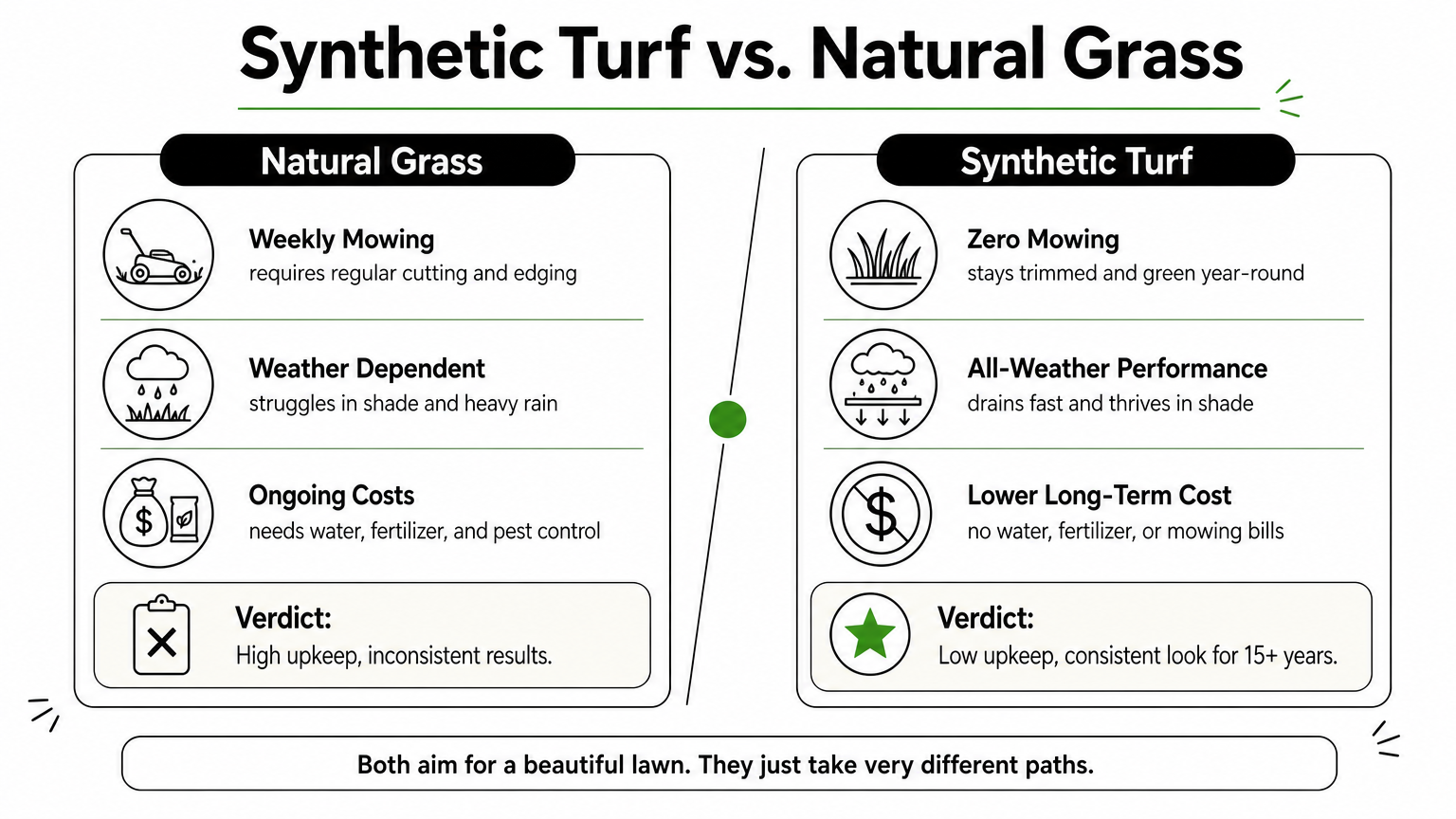
Real grass struggles in shaded yards, high-traffic dog runs, and anywhere Florida's summer rains keep the ground soggy for days. Synthetic turf solves all three at once, giving you a lawn that stays green year-round without a single mowing bill. It's one of the fastest-growing landscape design ideas we install across Jupiter, especially for backyards that never quite recovered from last summer's drought stress.
What it looks like
Modern turf blends multiple blade lengths and shades of green so it doesn't read as plastic from the curb. Homeowners often pair a putting green section near the patio with standard turf across the rest of the yard, or install turf strips between pavers for a clean, gap-free look.
A well-installed lawn substitute looks like grass, drains like gravel, and never needs a mower.
Best for
This fits pet owners tired of mud tracked indoors, busy families who want a home landscape design with zero weekend upkeep, and shaded lots where real grass has always struggled. Putting greens specifically suit golfers who want practice time without leaving the property. See our artificial grass and putting green options for backyard builds.
Key plants and materials
Quality installs use a compacted base, weed barrier, and infill sand or rubber crumb beneath UV-stabilized turf fibers rated for Florida heat.
Maintenance and cost considerations
Upkeep drops to occasional rinsing and brushing fibers upright, with no water, fertilizer, or mowing costs going forward. Turf costs more upfront than professionally graded and laid sod, but it pays back through eliminated lawn care over its 15-plus year lifespan.
15. Layer foundation plantings for curb appeal
The strip of dirt hugging your house's foundation gets ignored more than any other part of the yard, yet it's the first thing anyone sees from the street. Layered foundation plantings fix that by building height and texture right against the walls instead of leaving bare mulch or one thin row of shrubs. It's a simple landscape ideas and design move that changes how the whole front elevation reads.
What it looks like
Expect three tiers working together: taller shrubs anchoring the corners of the house, mid-height plantings filling the run along the walls, and a low flowering or groundcover layer softening the edge where beds meet lawn or walkway. Windows stay clear of tall growth, but the gaps between them fill in so the house doesn't look like it's floating on grass.
Layered foundation beds make a house look grounded instead of plopped onto the lot.
Best for
This suits nearly every home, but it matters most for newer builds in Jupiter subdivisions where builder-grade landscaping left thin, single-row beds. It's also a fast way to boost resale appeal without touching the backyard at all, especially when paired with small front yard landscape design ideas.
Key plants and materials
Reliable choices include dwarf ixora or firebush for mid-height color, liriope or dwarf jasmine as a groundcover edge, and a taller anchor like podocarpus or viburnum at the corners. Mulch beds finish the look and suppress weeds between plantings.
Maintenance and cost considerations
Upkeep stays light: seasonal trimming, an annual mulch refresh, and spot fertilizing keep beds full. Costs run low compared to hardscape projects, making this one of the better return-on-investment updates on this list.
Choosing the right design for your yard
No single idea on this list works for every property, and that's the point. Your lot size, sun exposure, and how you actually use the space should drive the choice, not whichever photo catches your eye first. A shaded lot under live oaks calls for gravel and native plantings, not a resort-style pool deck. A busy family that entertains often gets more value from a fire pit and lighting than a formal symmetrical garden that demands monthly trimming to look right. The best landscape design ideas are the ones matched to your soil, your budget, and how you'll actually live outside once the work is done.
If you're weighing a few of these options and want someone to walk your property and tell you what fits, ask Integrity Landscape for a free landscape design estimate and start with a plan built for your yard, not a generic one.