
Paver Patio Cost Calculator: How to Estimate Your Project
You have a patio size in mind and you want a number. Before you call anyone, you want to know how many pavers to buy, how much base gravel and sand you need, and what the whole job should cost. A cost calculator for paver patio projects gives you that, but only if you feed it the right measurements and know what it leaves out.
Here is the short answer. Multiply length by width to get square footage, add 5 to 10 percent for cuts and waste , then price pavers, base, sand, and edging per square foot. In Palm Beach County, expect roughly $15 to $30 per square foot installed , depending on paver type, pattern, and site prep. DIY materials alone run far less, but labor and equipment add up fast.
Below, we walk through the math step by step: measuring your space, calculating pavers and base depth, and pricing materials versus professional installation. At Integrity Landscape, we have built paver patios around Jupiter for over 10 years, so we also point out the hidden costs that calculators often miss, like drainage, sandy soil, and removal of old surfaces.
What goes into a paver patio cost estimate
Every patio paver cost calculator, whether it is a web tool or a spreadsheet you build yourself, adds up the same handful of line items. Know them and you know which inputs deserve your attention. Patio area drives almost every quantity, and paver material drives the price per square foot.
The core line items
Most estimates split into materials, site prep, and labor. Materials are the easy part, because you can price them from any supplier's list. Site prep and labor are where quotes diverge, since they depend on your yard and your crew. Use this table to see what moves each line.
| Line item | What drives the cost |
|---|---|
| Pavers | Material (concrete, travertine, porcelain), size, pattern, waste allowance |
| Base gravel | Patio area and compacted base depth |
| Bedding sand | Area, at roughly 1 inch deep |
| Polymeric sand | Joint width and paver size |
| Edge restraints | Linear feet of perimeter |
| Excavation and hauling | Dig depth, soil type, equipment access |
| Labor and equipment | Pattern complexity, crew size, plate compactor, saw |
What a calculator can't see
The number a tool returns is only as good as the site it assumes. A calculator prices a flat, clean rectangle with easy access. Real yards in Jupiter have sandy soil that needs extra compaction , grades that must be corrected for drainage, old concrete or sod to remove, and tight gate access that slows hauling. Each one can add hundreds to a few thousand dollars.
A calculator prices the patio you drew, not the yard you actually have.
Plan for that gap before you commit to a budget. Add a 10 to 15 percent contingency on top of the calculated total, and treat the result as a baseline when you estimate paver patio cost, not as a final bid. The next four steps build that baseline one input at a time.
Step 1. Measure your patio and calculate square footage
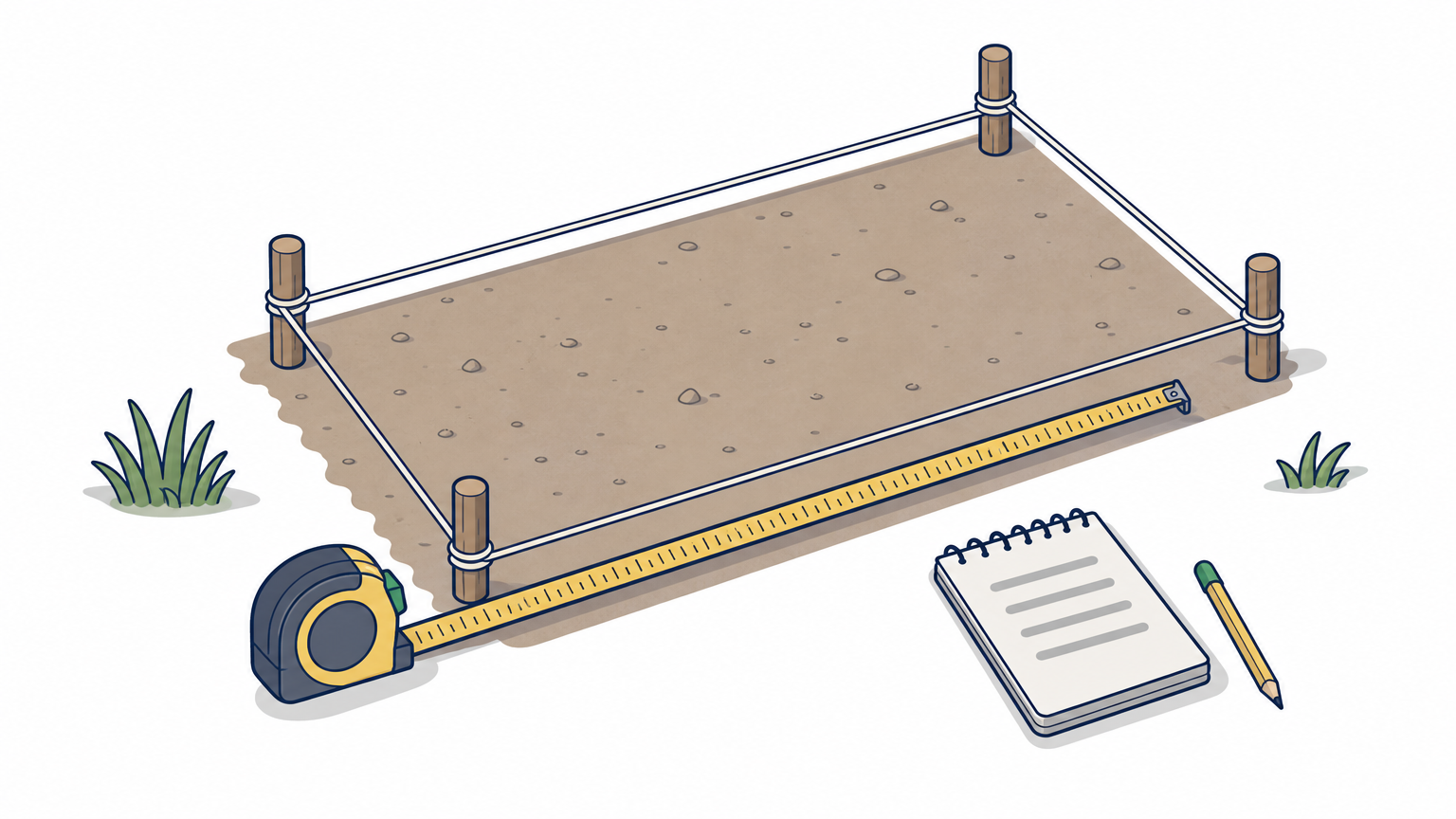
Square footage is the first input any cost calculator for paver patio projects asks for, and every later quantity is multiplied from it. You need a 100-foot tape, stakes, string, and a notepad. Mark the outline on the ground before you measure anything.
Measure the shape
Start by staking the outline with string or marking paint, then measure each side in feet. For a rectangle, multiply length by width. For curves or L-shapes, split the patio into simple pieces , calculate each one, and add the results.
| Shape | Formula | Example |
|---|---|---|
| Rectangle | length x width | 16 x 12 = 192 sq ft |
| Triangle | 0.5 x base x height | 0.5 x 10 x 6 = 30 sq ft |
| Circle | 3.14 x radius x radius | 3.14 x 6 x 6 = 113 sq ft |
Measure twice, because every quantity that follows is multiplied from this one number.
Capture the other numbers
Next, measure the perimeter in linear feet . You need it to price edge restraints, and many tools ask for it. Also note any walls, steps, or planters that cut into the footprint.
Round each measurement up to the nearest half foot. If your 16 by 12 patio is really 16.3 by 12.2, you want the larger figure on paper. Write down the total square footage and the perimeter, because Step 2 starts with them.
Step 2. Calculate how many pavers you need
Your square footage now becomes a paver count. Add a waste allowance first, then divide by the coverage of a single paver . Any paver patio cost estimator runs these two moves behind the scenes.
Add waste for cuts
Pattern decides how many pavers end up as scrap. Multiply your area by the factor below.
| Pattern | Waste | Multiplier |
|---|---|---|
| Running bond or stack bond | 5% | 1.05 |
| Herringbone or basket weave | 10% | 1.10 |
| Curves, circles, diagonals | 15% | 1.15 |
Convert area to pieces
Take the 192 sq ft patio from Step 1 in a herringbone pattern.
- Add waste: 192 x 1.10 = 211.2 sq ft.
- Find one paver's coverage. A 6 x 9 inch paver is 54 sq in, or 0.375 sq ft (54 / 144).
- Divide: 211.2 / 0.375 = 563.2, so order 564 pavers .
Suppliers sell by the pallet, not the piece. Check the coverage per pallet on the spec sheet, then round up to a full pallet. Buying a few extra pavers now also saves you from a dye-lot mismatch if you need repairs later.
Order by square foot with waste included, never by the exact count.
Large-format travertine and porcelain pavers follow the same math, but their cuts waste more material, so lean toward the higher multiplier.
Step 3. Estimate base, sand, and polymeric sand
Base gravel
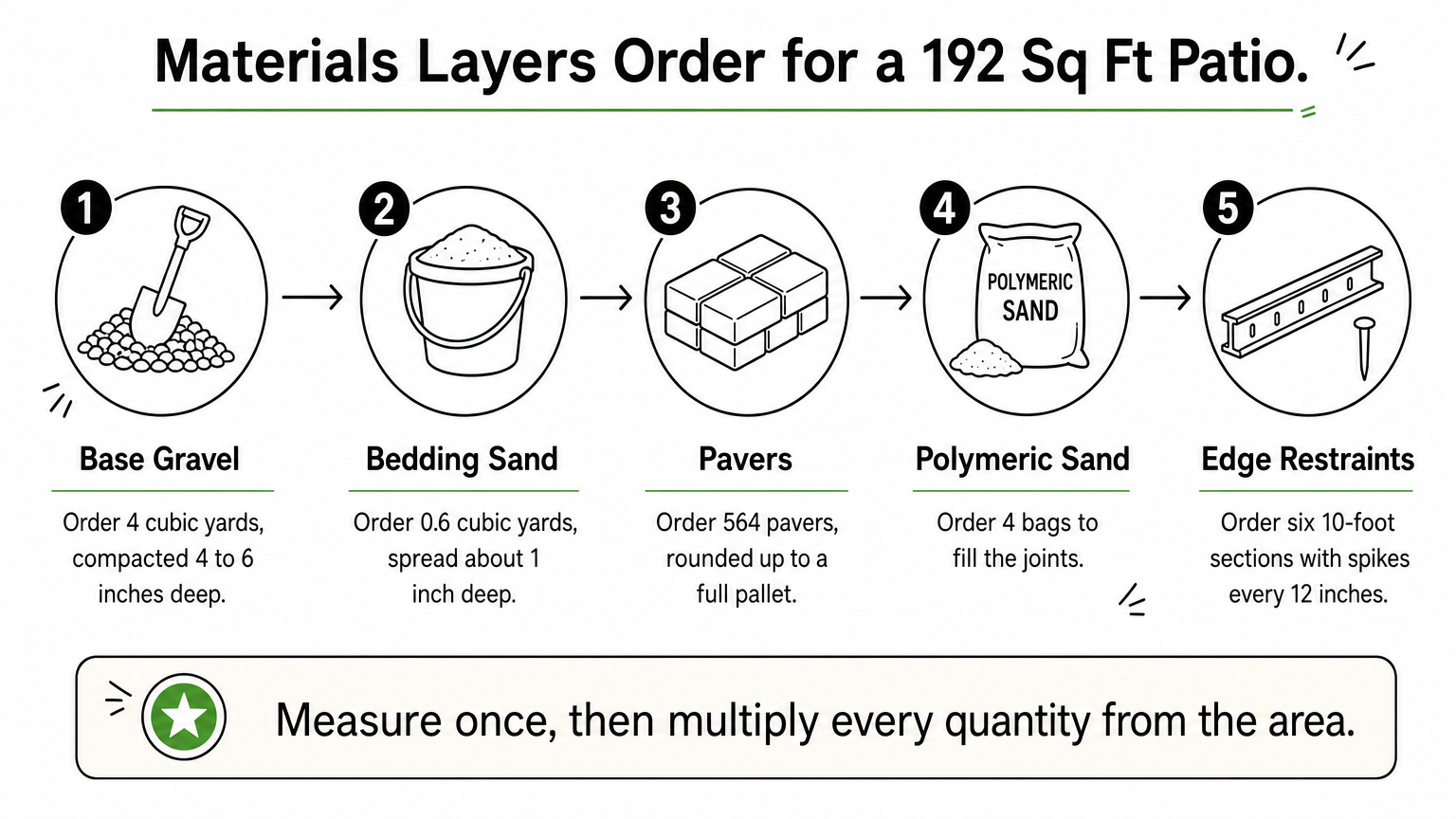
Base is the biggest volume line in any patio paver cost estimator, and the one people underbuy. Plan on 4 to 6 inches of compacted base , and go to 6 on sandy Jupiter soil. Multiply area by depth in feet, divide by 27 for cubic yards, then add 10 percent for compaction .
For our 192 sq ft patio, that is 192 x 0.5 ft = 96 cu ft. Divide by 27 to get 3.56 cu yd, multiply by 1.10, and you land near 3.9. Order 4 cubic yards .
Skimp on base depth and the patio will settle, no matter how good the pavers are.
Sand and joint material
Bedding sand goes down about 1 inch deep , which works out to 16 cu ft, or roughly 0.6 cubic yards, for this patio. Polymeric sand coverage varies with joint width and paver size, so read the bag. A 50 lb bag typically covers 50 to 80 sq ft , so plan on 4 bags to be safe.
| Material | Calculation | Order |
|---|---|---|
| Base gravel | 192 x 0.5 ft / 27 x 1.10 | 4 cu yd |
| Bedding sand | 192 x (1/12) / 27 | 0.6 cu yd |
| Polymeric sand | 192 sq ft / about 60 per bag | 4 bags |
| Edge restraints | 56 ft perimeter / 10 ft sections | 6 sections |
Finally, use the perimeter from Step 1 for edging. A 16 by 12 patio has 56 linear feet, so you need six 10-foot restraints plus spikes every 12 inches. Enter these quantities into your calculator, and you have a complete materials list.
Step 4. Add it up: DIY vs. professional cost
Price your DIY materials
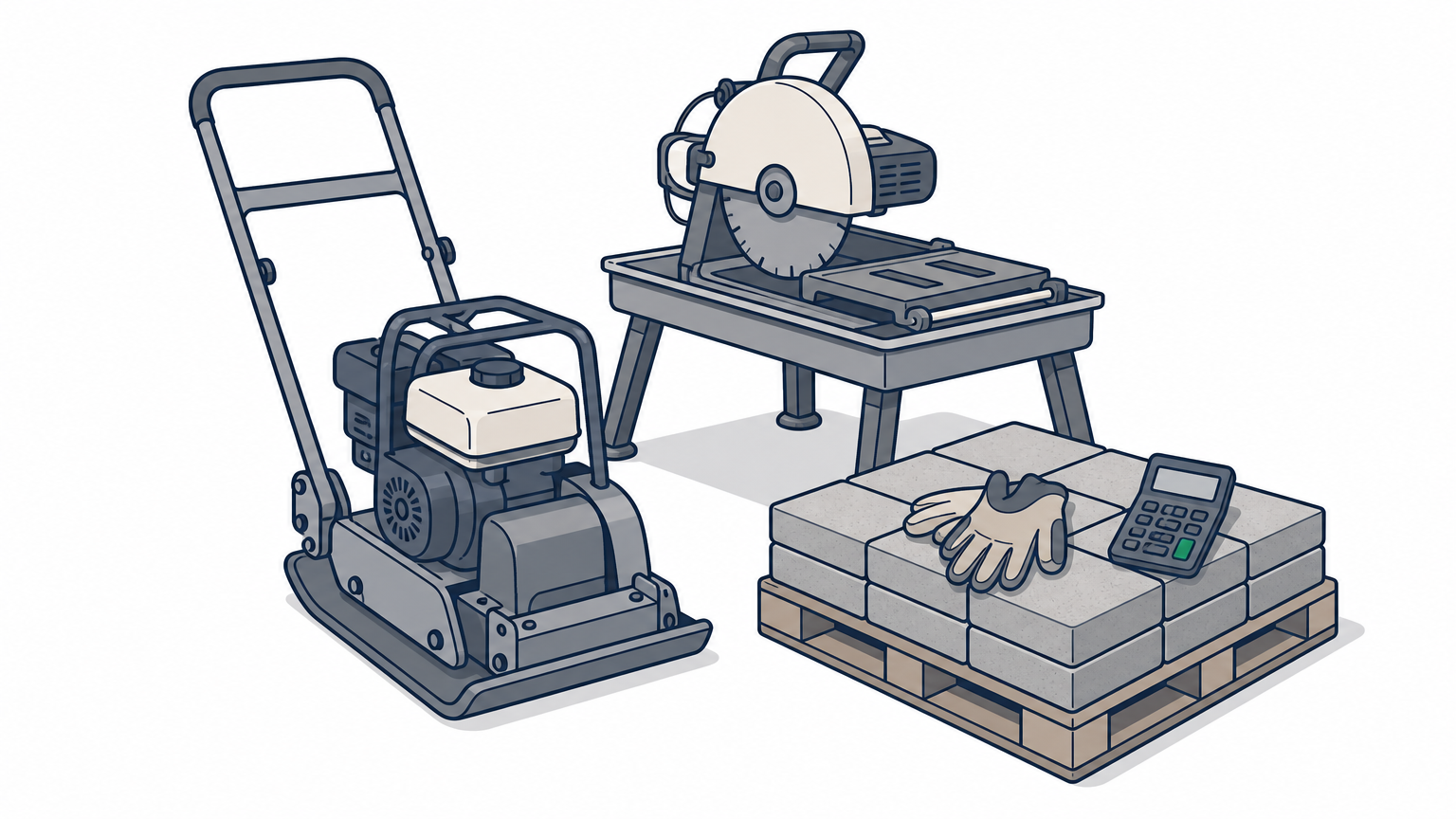
Multiply each quantity from Steps 2 and 3 by your supplier's price. For the 192 sq ft herringbone patio, DIY materials run about $1,100 to $2,000 , and renting a plate compactor and wet saw adds $200 to $400 . Any paver patio cost calculator should land in this range for concrete pavers.
| Cost line | DIY | Professional |
|---|---|---|
| Materials | $1,100 to $2,000 | Included |
| Equipment rental | $200 to $400 | Included |
| Labor | Your own, 3 to 4 days | Included |
| Subtotal | $1,300 to $2,400 | $2,880 to $5,760 |
Compare it with professional installation
At $15 to $30 per square foot, the same patio costs $2,880 to $5,760 installed . That rate bundles excavation, hauling, compaction, and cleanup, which is why a paver patio installation cost calculator usually uses one blended number.
Then apply the 10 to 15 percent contingency from the start of this guide. It lifts the DIY range to about $1,500 to $2,800 and the professional range to roughly $3,200 to $6,600.
DIY saves you the labor line, but it costs you the weekends and the risk of a settled patio.
Finally, be honest about your skills. A crooked base or poor compaction costs more to tear out than a crew would have charged to build it right.
Turning your estimate into a real quote
A cost calculator for paver patio projects gives you a solid baseline . Measure the area, add waste, size the base, and compare materials against labor, and you know what a fair number looks like before anyone knocks on your door.
Still, a baseline is not a bid. Drainage, sandy soil, old concrete, and tight access only show up when someone walks your property . Bring your square footage, perimeter, paver choice, and pattern, and ask for an itemized quote. Then compare it line by line against your range, including the 10 to 15 percent contingency .
If you would rather hand the work to a crew, Integrity Landscape is licensed, insured, and offers free estimates around Jupiter. Send us your numbers and request a free paver patio quote from Integrity Landscape. We will turn your estimate into a firm price with a project manager on site.