
Cost of Paver Patio vs Stamped Concrete: What You Pay
The cost of paver patio vs stamped concrete comes down to this: stamped concrete is cheaper to install, usually $15 to $30 per square foot against $25 to $50 for pavers. On a 20x20 patio, that is roughly $6,000 to $12,000 for stamped concrete and $10,000 to $20,000 for pavers. Pavers tend to last longer and cost less to repair, so the gap shrinks over the years.
Comparing the two costs means looking at two numbers. The first is the installed price you pay once. The second is the upkeep and repair bill you pay over the next few decades. A stamped concrete patio is a poured slab pressed with a pattern and sealed. A paver patio is made of individual interlocking units set over a compacted base. They fail in different ways, and that changes what each one really costs.
This guide gives you the price per square foot, worked totals for common sizes, and the durability and maintenance tradeoffs. It also shows how to pick based on your budget and your site. Integrity Landscape builds patios and hardscapes in Jupiter and across Palm Beach County, so the Florida conditions that affect both materials are covered too.
Why stamped concrete costs less upfront than pavers
Stamped concrete is cheaper to install than pavers in nearly every case, typically by 25% to 40%. The gap comes from labor and materials, not from one surface being better built.
Cost per square foot and total price
Contractor price guides put stamped concrete at about $15 to $30 per square foot installed and pavers at about $25 to $50 per square foot installed . Prices shift by region and by year. Premium work, such as natural stone, travertine, or intricate patterns, usually lands at the top of these ranges or above them. Treat the table as a planning range, not a quote.
| Surface | Per sq ft installed | 400 sq ft (20x20) | 600 sq ft |
|---|---|---|---|
| Stamped concrete | $15 to $30 | $6,000 to $12,000 | $9,000 to $18,000 |
| Paver patio | $25 to $50 | $10,000 to $20,000 | $15,000 to $30,000 |
A worked example for a 20x20 patio
A 20x20 patio is 400 square feet. At the midpoint of each range, stamped concrete costs about $22.50 per square foot, or $9,000 total . Pavers cost about $37.50 per square foot, or $15,000 total . That is a $6,000 difference, about 40% less for stamped.
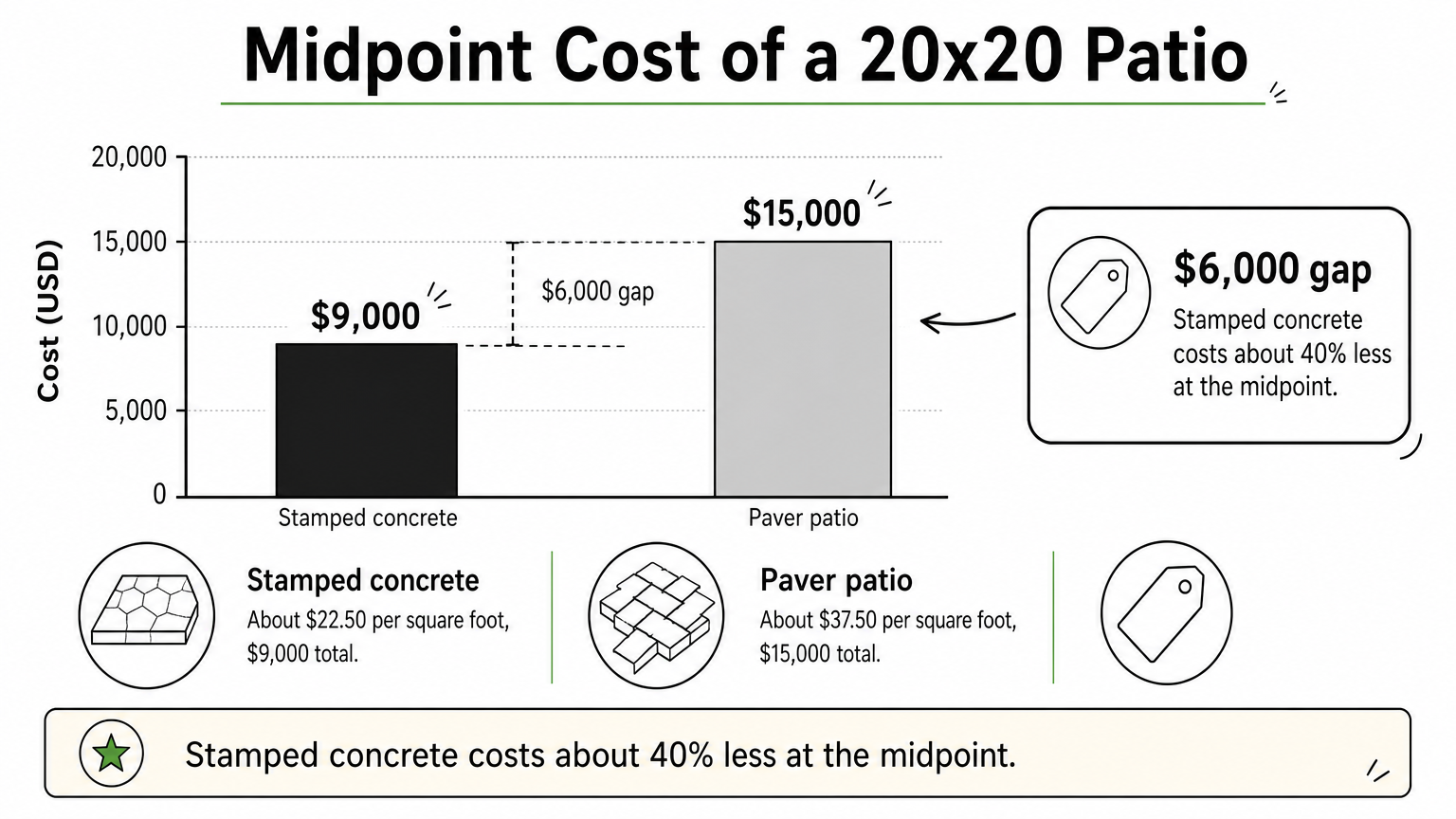
If your budget for a 400 square foot patio is $10,000, stamped concrete fits comfortably, with room left for a fire pit or lighting. Pavers fit only at the very bottom of their range, with a simple pattern and basic units.
Why pavers cost more to install
Pavers are labor-heavy. Crews compact the base in layers, set each unit by hand, cut the edges, install edge restraints, and sweep in joint sand. Stamped concrete is poured and finished in a day or two, but it still needs a skilled crew for color, texture, and sealing. Both depend on good base preparation, so a cheap bid on either one usually cuts corners underground.
Stamped concrete usually saves 25% to 40% up front, and the real question is what that saving costs you later.
How durability and upkeep change the long-term cost
Pavers usually cost more up front but less over time, because a paver patio is repaired one unit at a time while a cracked slab cannot be fixed invisibly.
Lifespan and cracking
A properly installed stamped concrete patio is often quoted at 25 to 30 years. Control joints guide cracks to planned lines, but hairline cracks still appear on many slabs as the ground moves. Once a slab cracks, the repair is a patch that rarely matches the original color and texture.
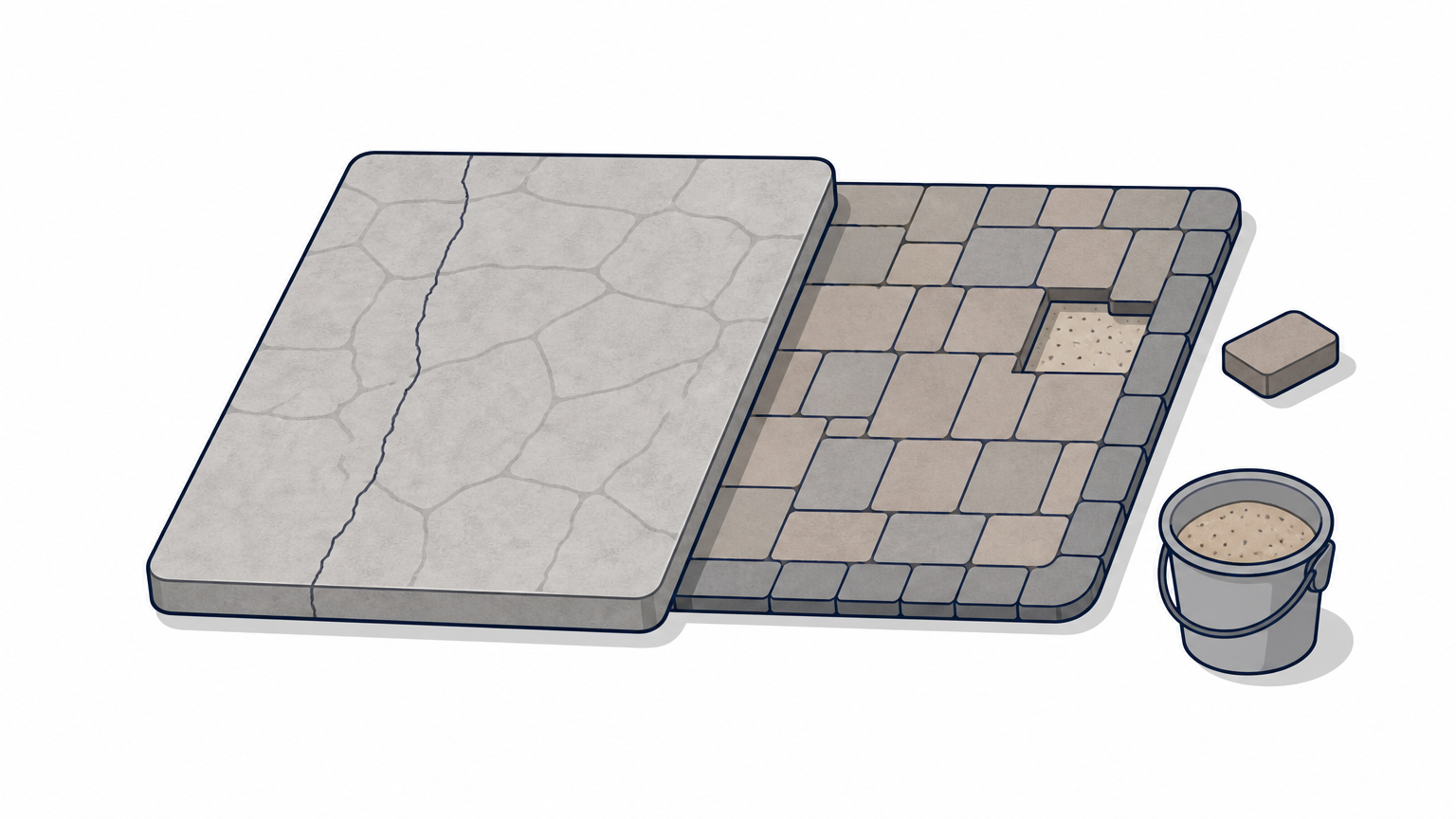
Pavers flex with small ground movements because each unit moves independently. A well-built paver patio commonly lasts as long as or longer than a slab , provided the base was done right.
Maintenance you will pay for
Both surfaces need upkeep, just different kinds.
| Item | Stamped concrete | Paver patio |
|---|---|---|
| Sealing | Reseal every 2 to 3 years to protect color and surface | Optional, mainly for stain resistance |
| Joints | Control joints only | Refill joint sand periodically, pull weeds |
| Fading | Sun wears the sealer and fades the color | Color usually runs through the unit |
| Repairs | Patch or replace a slab section | Lift and reset or replace single pavers |
What the gap looks like over time
That $6,000 midpoint saving on a 400 square foot patio would take a lot of sealer to erase. The gap closes when a slab cracks badly or needs replacing, or when you want to lift the surface for irrigation or utility work. Pavers can be pulled up and relaid. A slab has to be cut.
A paver patio is repaired one unit at a time, while a stamped slab is repaired as a patch that rarely matches.
How to choose the right surface for your budget
Choose stamped concrete when upfront cost is the deciding factor, and pavers when you plan to stay put and want the easiest repairs. Your site and budget will usually make the call for you.
Match the surface to your site
South Florida puts both materials through heavy summer rain, strong sun, and salt air near the coast. Sandy soil can shift under a poorly compacted base. Whichever surface you choose, make sure the patio slopes away from the house so storm water drains.
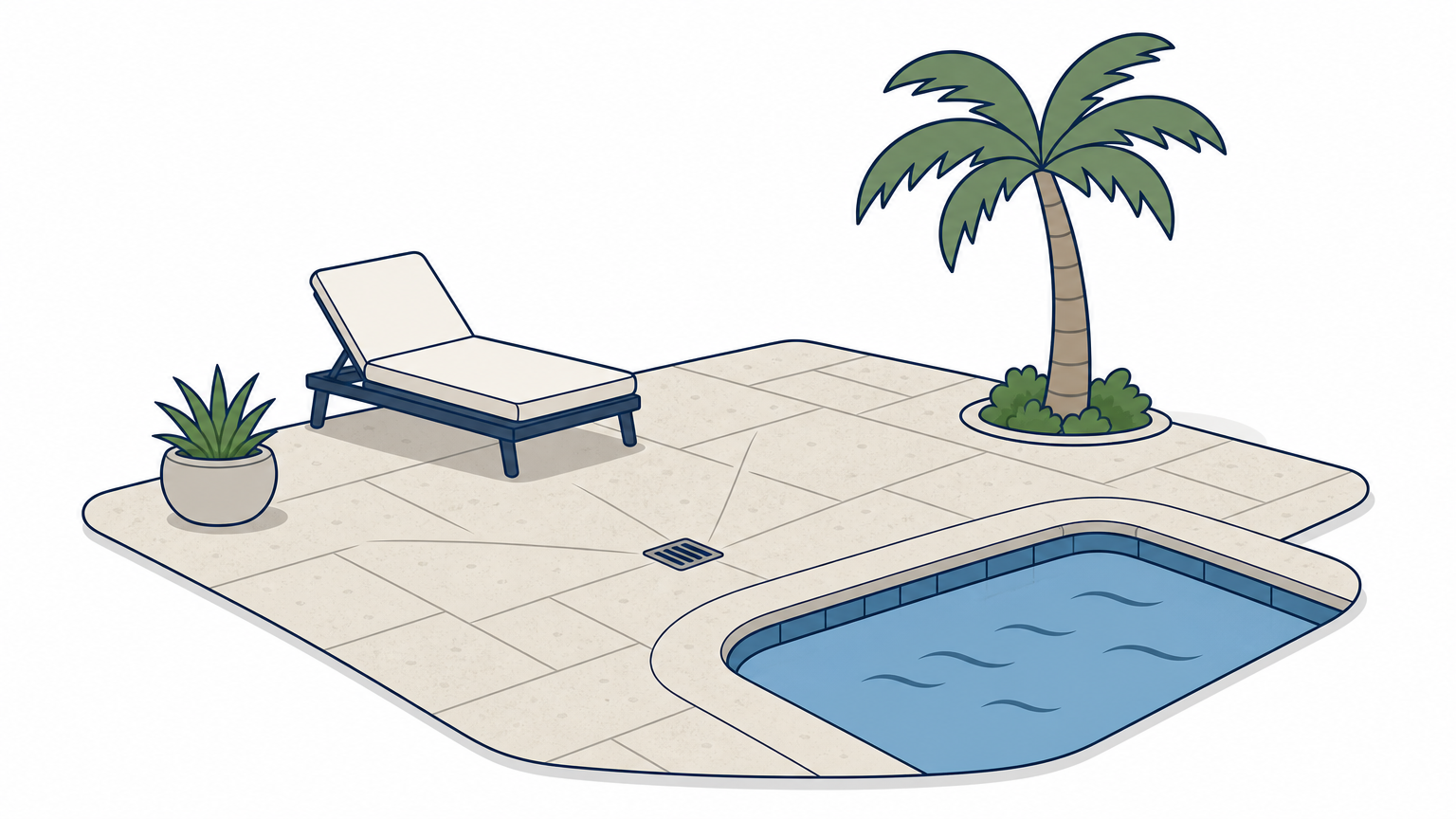
Around a pool, surface temperature and grip matter. Sealed stamped concrete can be slick when wet , so ask for a slip-resistant additive. Light-colored pavers and travertine tend to stay cooler underfoot than dark stamped finishes.
A short decision checklist
- Your all-in budget for a 400 square foot patio is under $10,000: stamped concrete is the realistic option.
- You expect to own the home for 10 years or more: pavers repay the higher price through easier repairs.
- You want a seamless look with few joints: stamped concrete delivers it.
- You may need to access buried lines or irrigation later: pavers can be lifted and relaid.
- The patio doubles as a pool deck: favor lighter pavers or travertine, or slip-resistant stamped concrete.
If you plan to stay a decade or more, pay for pavers. If the budget is fixed and tight, stamped concrete is a sound choice when it is installed well.
How to compare patio quotes fairly
Compare quotes line by line, because two bids for the same patio can differ by thousands of dollars in base preparation alone. A low number often means a thinner base or fewer control joints.
What every quote should list
Ask each contractor to put these items in writing:
- Total square footage and the shape of the patio
- Removal and disposal of any existing surface
- Base depth and compaction for pavers, or slab thickness, reinforcement, and control joint layout for concrete
- Grading and drainage plan
- Edge restraints for pavers, or sealer type for stamped concrete
- Joint sand and any sealing for pavers
- Permit and HOA requirements, and who handles them
- Warranty terms in writing
Getting a local price
Integrity Landscape's Patios & Pathways service builds residential patios in interlocking pavers, travertine, and natural stone in Jupiter and surrounding areas. Its commercial patio work covers paver or concrete surfaces. The company is licensed and insured, gives same-day quotes, and assigns a dedicated project manager to every site, so you can see how a line-by-line bid looks before you compare it with others.
The cheapest quote is rarely the lowest cost: check the base, the drainage, and the warranty before you compare totals.
Choosing the patio that fits your budget
Stamped concrete wins on upfront price, usually by 25% to 40%, which on a 20x20 patio means about $6,000 to $12,000 against $10,000 to $20,000 for pavers. Pavers win on repairability, color retention, and long-term value if you will own the home for years. Your drainage, your pool, and the quality of the base matter as much as the surface you pick.
If you want real numbers for your yard, get a free estimate for your patio from Integrity Landscape. Bring your square footage and your budget, and compare the quote against the checklist above.