
6 Front Yard Landscape Design Ideas for Jupiter, FL Homes
The best landscape design front yard ideas for Jupiter, FL share one trait: they are built for salt air, sandy soil, strong sun, and summer downpours instead of fighting them. If you want low upkeep, start with a native planting bed or a smaller lawn. If you want a front entry that works at night, add a paver walkway and low-voltage lighting. If your yard is small, containers and compact plants do more than a full redesign.
Most front yards here still follow one formula: a wide lawn, a row of clipped shrubs against the house, and an irrigation bill to keep both alive. It looks fine, but it takes weekly work and rarely adds real curb appeal. You want a front of house that looks designed, holds up through August, and does not turn into a second job.
This article gives you six ideas. Each one covers how it works, what to plant or build, and who it suits. A short planning section then shows how to combine them and in what order. Integrity Landscape has designed and built outdoor spaces in Jupiter and Palm Beach County for over 10 years, so the plant and material choices below reflect what holds up on local properties.
1. Native and Florida-friendly planting beds
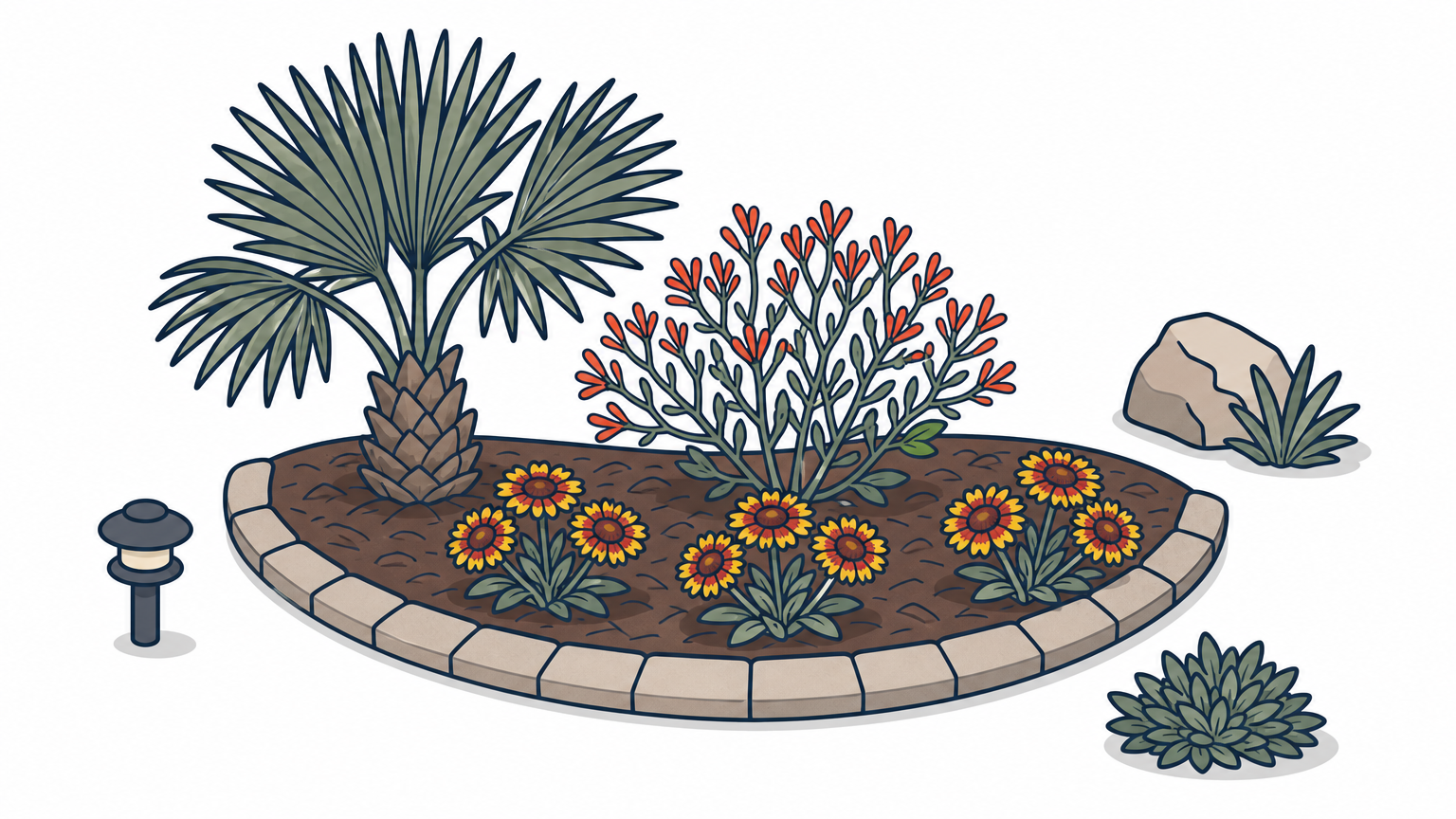
Layered native beds are the most dependable front yard landscape design idea in Jupiter. The plants already tolerate heat, sandy soil, and salt spray , and they need far less water than a lawn once they are established.
How it works
Build three layers. Put a palm or small tree at one corner, shrubs in the middle , and low grasses and flowers along the front edge. Plant in groups of three or five of the same variety instead of one of everything, so the bed reads as a design from the street.
Curve the bed out from the corners of the house so it ties into the lawn instead of hugging the foundation. Finish with mulch or decorative rock to hold moisture and suppress weeds. Integrity Landscape's rock and mulch service covers delivery, prep, and clean installation .
Plant native layers in groups of three, and the bed looks full while using a fraction of a lawn's water.
Plants and materials
Start from this palette, then adjust for how close you are to the ocean and how much sun the bed gets.
- Tree or palm: sabal palm
- Mid layer: firebush, Simpson's stopper, cocoplum
- Low layer: blanket flower, pink muhly grass, dwarf fakahatchee grass, coontie
- Oceanfront exposure: sea grape, silver buttonwood, saw palmetto
Who it suits
This idea suits owners who want a full, colorful yard without weekly work. Expect to water regularly for the first few months , then cut back sharply once roots are established. Trimming is usually a once or twice a year job.
It is also the best starting point on a budget. Plants and mulch cost less than hardscape, and you can install beds in stages . Check your HOA's plant guidelines and local irrigation rules before you order.
2. A right-sized lawn with sod or synthetic turf
Keep a lawn, but shrink it to the shape you actually use and make that area look flawless. A smaller, cleaner lawn frames your beds and costs less to water and mow than one that runs all the way to the street.
How it works
Define the lawn as one simple shape, a rectangle or a gentle curve, and edge it against beds or pavers . If your turf is patchy, replace it instead of patching it. A sod installation crew removes the old grass, preps the soil, and lays Florida-adapted sod so the lawn is even from day one.
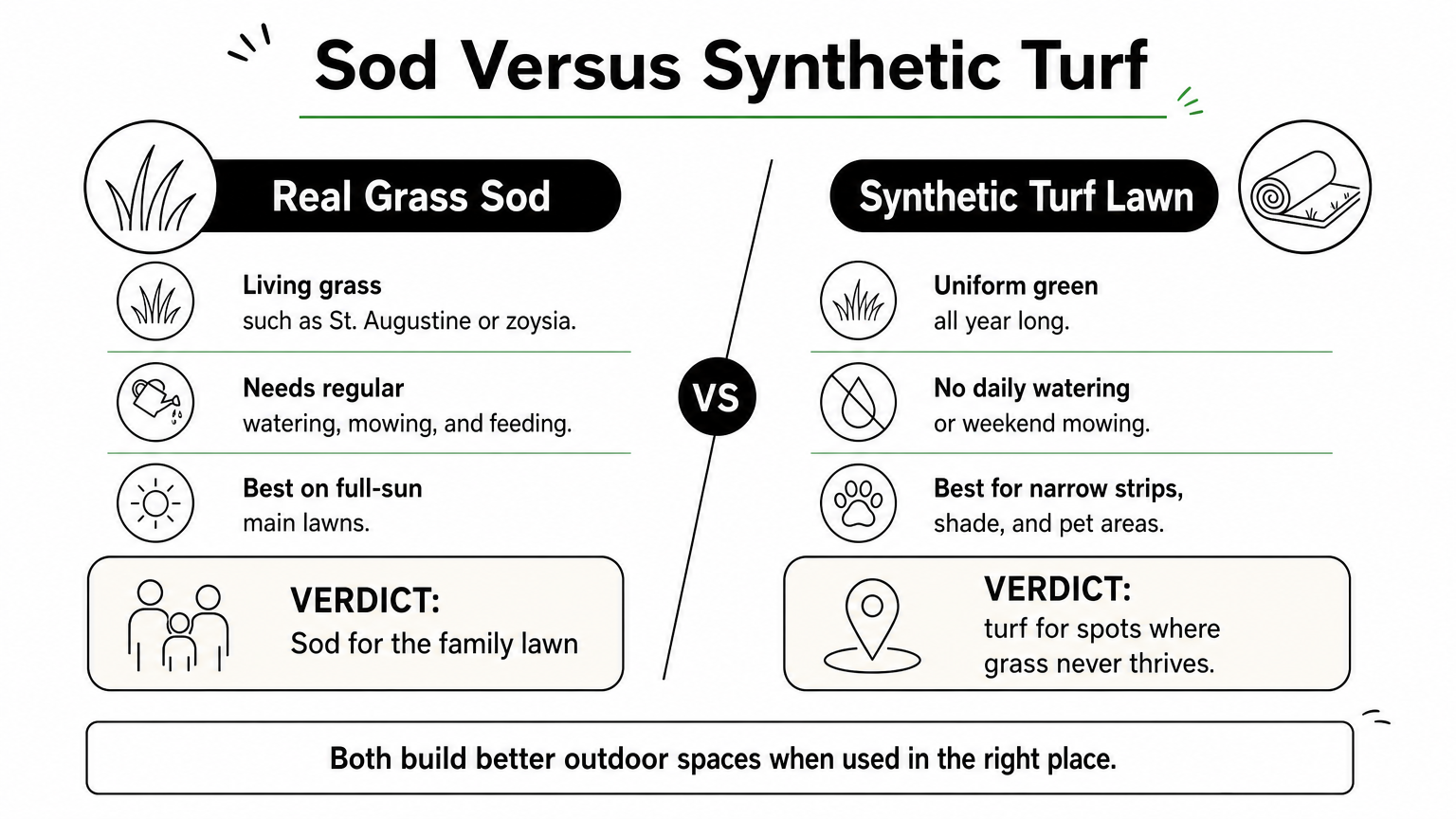
For narrow side strips, shady spots where grass thins, and pet areas, a synthetic turf lawn is the alternative. It stays green all year and needs no daily watering or weekend mowing . Check HOA rules before using it where the street can see it.
A smaller lawn with crisp edges looks more expensive than a large one that is struggling.
Sod or synthetic turf
Most front yards do best with both: sod where the family walks and plays, turf where grass never thrives. Use this comparison to decide.
| Sod | Synthetic turf | |
|---|---|---|
| Look | Living grass, such as St. Augustine or zoysia | Uniform green all year |
| Watering and mowing | Regular watering, mowing, and feeding | No daily watering or mowing |
| Best spot | Full-sun main lawn | Narrow strips, shade, pet areas |
| Watch for | Irrigation and fertilizer rules | Warm surface in afternoon sun, HOA approval |
Who it suits
Sod suits families who use the front lawn and have full sun most of the day , which describes many Jupiter lots. Turf suits owners who want a clean green look and are done with mowing.
Either way, the lawn should be the calm part of the design. Let beds, pavers, and lighting carry the detail, and keep the lawn shape simple so edging stays easy.
3. A paver walkway and entry courtyard
A paver walkway installation is the hardscape upgrade with the biggest visual return, because it turns the path to your door into a designed entrance. It is also the piece that every other idea in this list can be built around.
How it works
Make the walk wide enough for two people , about 4 feet. A path from the street to the door is usually straight. A path from the driveway can curve gently, which looks better and follows how people walk. At the door, widen the path into a small landing with room for a pair of pots.
Repeat the paver pattern in a border or the driveway apron, and the front of the house looks planned as one piece. Integrity Landscape's team is licensed and insured , and a dedicated project manager oversees every job site, which matters on a build with several trades.
Spend on the path to your door first, then plant around it.
Plants and materials
Limit yourself to one or two surfaces and match them to your trim or roof color.
- Interlocking pavers: flexible, and a section can be lifted and reset if the base settles
- Travertine: a lighter stone that tends to stay cooler underfoot
- Natural stone: irregular, casual, and good for a courtyard look
- Brick: a traditional option that suits older home styles
Who it suits
Pavers suit owners who want a premium entry and plan to stay in the home. They are the largest line item in most front yard projects, so build them first and plant around them later. A walkway also pays off on a sloped approach, where steps and a wider landing improve safety.
4. Layered low-voltage lighting
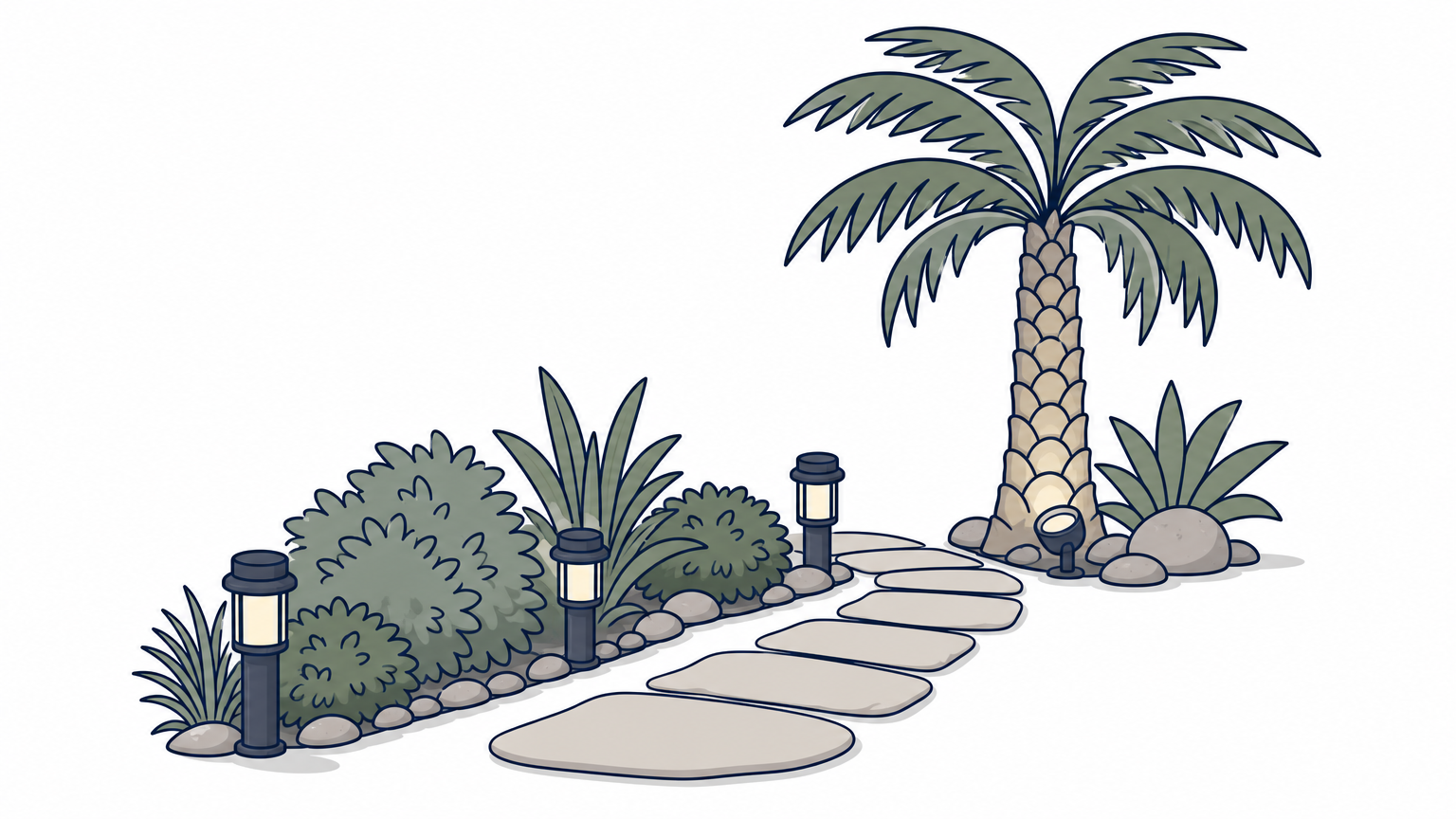
Lighting lets your front yard work after dark, and it is the most affordable way to make existing plants look designed. A low-voltage lighting system keeps the wiring safe and the running cost small.
How it works
Use three layers. Path lights mark the walkway and steps. Uplights at the base of a palm or specimen tree throw texture onto the trunk and fronds. A visible house number , lit or placed near a light, helps guests and emergency responders find you.
Keep fixtures low and shielded so you see the glow, not the bulb. Place path lights on the planting side of the walk, not the edge, so they do not catch ankles or mowers.
Light the plants you already have, and the whole yard reads as designed.
Plants and materials
Choose what to light, then choose the fixture.
- Path lights: walkways, steps, and the driveway edge
- Uplights: sabal palms, specimen trees, and fine-textured grasses
- Fixture material: solid brass or copper generally holds up better in salt air than painted light-gauge metal
Who it suits
Lighting suits every yard, but it matters most on a long walk or a home with steps . It also gives your front of house security without floodlight glare.
Plan the wiring before final planting and mulch, so cable runs stay hidden. Afterward, trim plants back from fixtures a couple of times a year so the light stays clear.
5. Small front yards: containers and compact plants
A small front yard landscape design works best with fewer, bolder pieces: one focal point, one repeating plant, and a clear path. This approach also fits a tight budget, because pots and compact plants are inexpensive to start with and easy to change.
How it works
Pick one focal point , such as a large glazed pot beside the door or a single palm. Repeat three plant varieties around it. Add height with a trellis or wall planter, and keep plantings below the window line so they do not block light or views.
Leave the walk to the door open. A tiny yard feels bigger when the eye travels straight from the street to the entry.
In a small yard, repeat three plants and add one strong focal point instead of filling every inch.
Plants and materials
Containers dry out faster in Florida heat, so choose tough plants and pots with drainage holes.
- Compact plants: coontie, society garlic, blue daze
- Bright accents: bromeliads under a covered entry, agave or aloe in full sun
- Ground cover: mulch or decorative rock between pots to keep the look tidy
- Storm prep: move or secure containers before a hurricane warning
Who it suits
This idea suits townhomes, patio homes, and owners who want a fast, low-cost refresh . A mulch top-up, three matching pots, and a lit house number can change a small entry in a weekend.
Upkeep is moderate. Plan on checking pots for water during dry stretches, and consider a drip irrigation emitter if you travel. If you later want to expand, the same plants move into a real bed.
6. A hedge or fence frame for privacy
A low fence or clipped hedge defines the edge of your property and adds privacy without walling off the house. It is the idea to pick for a corner lot, a busy street, or a yard with pets.
How it works
Keep the frame waist-high along the sidewalk so light and views still pass through, and go taller only where traffic noise or privacy demands it. Add a gate, then plant a strip of low flowers or grasses in front of the fence so it does not look like a barrier.
For a hedge, plant a single line and space shrubs by their mature width, not their nursery size. Choose slow growers where branches could reach power lines.
Keep the front boundary low and soft, and it adds structure without hiding your home.
Plants and materials
Pick the material for how much upkeep you want.
- Aluminum fencing: does not rust, a strong choice near the coast
- PVC fencing: no painting and no rot
- Wood fencing: a warm look, but more upkeep in humid air
- Hedge plants: cocoplum, silver buttonwood, Walter's viburnum
Who it suits
A frame suits owners who want privacy and a finished look . Hedges need regular trimming, while aluminum and PVC need very little.
Before you build or plant, check your town's fence height and style rules and your HOA's requirements. Front yard limits are often stricter than backyard limits, and a rejected fence is an expensive lesson.
How to choose and combine these front yard ideas
Pick one idea as the anchor, support it with one or two others, and build in the right order. The current direction in front yard design is less lawn, more native planting, and layered lighting, and all six ideas above fit that.
Compare the six ideas
Relative cost is a rough guide only, because every property differs.
| Idea | Upkeep | Relative cost | Best for |
|---|---|---|---|
| Native beds | Low after establishment | Lower | Low maintenance, budgets |
| Right-sized lawn | Sod regular, turf minimal | Medium to higher | Full-sun yards, pets |
| Paver walkway | Low | Higher | Premium entry, safe access |
| Lighting | Low | Medium | Night curb appeal, safety |
| Small yard containers | Moderate | Lower | Small lots, quick refresh |
| Hedge or fence | Hedge moderate, fence low | Medium to higher | Privacy, corner lots |
Use the rule of 3 and plan the sequence
The rule of 3 says to group plants in threes or other odd numbers, use three layers of height, and limit the design to about three main materials. It keeps a front yard cohesive. On a budget, begin with mulch, grouped plants, containers, and lighting, and save hardscape for a later phase.
Work in this order:
- Study sun, soil, drainage, and salt exposure, then sketch the layout.
- Check HOA and town rules.
- Build hardscape and fencing.
- Run lighting cable and shape the beds.
- Plant, then mulch.
- Lay sod or turf once grading and hardscape are done.
Start with one idea and build from there
The strongest front yard designs for Jupiter do a few things well. They use native layers, a lawn sized to your needs, a clear path to the door, and light after dark. Choose the idea that fixes your biggest frustration first, then add the next one when budget allows.
If you want a plan drawn for your property, talk to Integrity Landscape about your front yard landscape design. We give free estimates, same-day quotes, and next-day service across Jupiter and Palm Beach County.